In an exclusive interaction with Paper Mart, Mr. Venkataramanan Ramaswamy, Nominee Board Member and Mr. N. Rama Mohan Murali, Senior Vice President – Operations, Sripathi Paper and Boards, shared insights into the company’s latest sustainability-driven innovations. The company has developed a 25-acre Miyawaki forest, with over 150,000 trees planted, and has partnered with the Tamil Nadu government to set up a sewage treatment plant in Sivakasi. To further reduce its environmental footprint, Sripathi Paper and Boards is installing maglev vacuum pump technology, which is expected to lower energy consumption by nearly 40%.
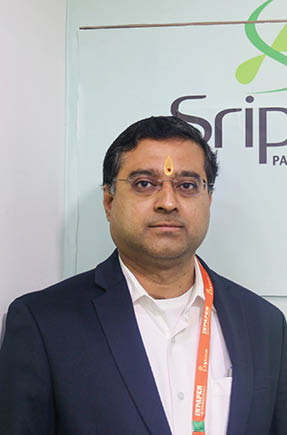
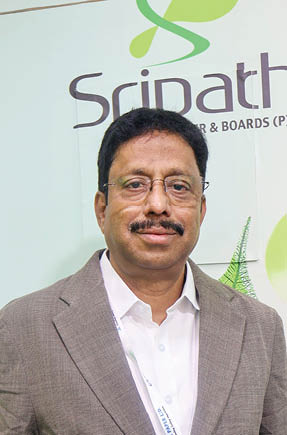
Paper Mart: Please tell us about your participation here at Paperex 2025.
Venkataramanan Ramaswamy: Paperex 2025 has been an interesting event for us. It’s been extremely busy for the last two days. Even today, I can see the stall is very full. A lot of inquiries on sustainable packaging are coming from our customers. We are building very interesting connections with respect to new and sustainable raw material sources procurement. So I would say overall it’s been ‘Paisa Vasool’. I think it’s been an excellent time for us here.
PM: Can you tell us about the latest plans in technology, product development and capacity expansion that are in the pipeline?
N. Rama Mohan Murali: As of now, we are doing some marginal enhancements. The quantum enhancements will probably come in 2027-28. We have recently developed several new products under the ‘Nano Green’ series. These are 100% recycled boards that deliver performance equivalent to virgin boards. We will also come up with a new range of barrier coating paper, and are working with some bio coating as well.
We also have capacity enhancements plans. We are currently producing 800 TPD as of now and plan to almost double this production capacity in the future. We are already in discussion with the major companies like Valmet to increase our capacity.
We also have mill upgradation planned in Sivakasi, near Coimbatore. We are also installing a maglev vacuum pump in our mill which is a new technology in India, although it is available in Indonesia, China and the US. A maglev vacuum pump uses magnetic levitation for its rotor, eliminating friction and oil, resulting in clean, high-efficiency, low-vibration, and low-maintenance operation for creating vacuums in industrial processes like papermaking. This will reduce our energy consumption by 40%.

Watch: Top Paper Companies 2023
PM: What are the recent developments and sustainable innovations happening in your company?
VR: As an organization, we are moving towards sustainability with differentiating factors in the recycle space. Recently, we have completed our first milestone, which is a 25-acres Miyamaki forest where we have planted more than 150,000 trees. This is the first phase of our ongoing milestone. So while we are planting these trees for harvesting as pulp, we are primarily doing this as an environment sustainability initiative.
We are also involved as an organization in cleaning man-made lakes, which have now become sewage lakes and we are restoring them back to being rain-fed lakes. About 130 acres of this exercise is completed with our implementation partner, Sivakasi Green Forum. And it’s been an excellent journey so far. We are also working on differentiating our water consumption. We are in a dry belt with twin monsoon benefits, but we don’t have a flowing river. So, therefore, this lake cleaning becomes very important.
Rainwater harvesting is also very important for us. We have partnered with IIT School of Sustainability and are implementing the first phase of 70-acres of rainwater harvesting as we speak.
We are working with various innovative technologies including one from Abu Dhabi, wherein we are adopting a desalination technology approach for cleaning our process water. If we do this, we will be able to enhance our water utilization and reduce our dependency on fresh water phenomenally. So today, we recirculate our water and a lot of chemicals are being added. With the desalination approach, we will utilize waste steam by treating and recycling the processed water for reuse within operations. So, we will be reducing the dependency on fresh water phenomenally.
Another initiative where we have partnered with the Tamil Nadu government is to put up a sewage treatment plant for the nearby population of quarter million people. That sewage treated water is planned to be used in our processes. That is another differentiation.

We are the first mill in South India to implement a Non-Recyclable Solid Waste boiler, where non-recyclable solid waste will be used as fuel instead of coal. In addition, we are setting up a 10-megawatt captive power plant to support our operations.
PM: Could you outline the sustainability certifications and recognitions the company has received for its sustainable initiatives? Are there any certifications underway?
RMM: We are focusing on quality and certifications for the existing capacity. We are working with BRC to certify some of our lines to be food grade compliant and therefore emerging as a pioneer in recycled food grade boards. We are also GRS certified, reflecting our commitment to sustainable practices in recyclable board manufacturing. Achieving GRS certification required strict adherence to comprehensive sustainability protocols. In addition, we are currently in the process of obtaining CII Green Co certification. The certification process is already underway, and we are confident of achieving CII Green Co Platinum status within the next three to four months.
PM: There are current challenges in the paper industry with regards to paper imports and raw material price surge. How do you plan to overcome it?
VR: We are working on some partnerships at the backward integration level wherein we will enter into long term contracts for raw materials and therefore smoothen some of the volatility on the pricing side. That’s the first step that we are working on.
We are planning some local substitution of imports which will take another 5-10 years. We are currently sowing the seeds for this purpose. We are also working on some long-term partnerships at the backward integration level for raw materials and therefore smoothen some of the volatility on the pricing side. It would not be appropriate to talk about it now but once this initiative comes to fruition, then we can talk more about it. For now, we are entering into long term arrangements for the next 5-7 years.
Beyond that, we are reducing dependency on imports to less than 30 percent and developing alternative sources of raw material locally for which we have started working.
Also Read: Starkraft Eyes Growth Through Partnerships in India
PM: Are there any initiatives to reduce reliance on non-renewable resources or energy conservation?
RMM: We are the first mill in South India to implement a Non-Recyclable Solid Waste boiler, where non-recyclable solid waste will be used as fuel instead of coal. In addition, we are setting up a 10-megawatt captive power plant to support our operations.
These initiatives will wean off of the consumption of fossil fuels and transition our dependence on renewable and regenerable sources. A lot of work is going into that domain that will be implemented by FY 2027-28 that is our goal.
PM: How do you foresee the future of the paper industry ?
VR: I think we are at the lowest point in the last 30-40 years. Being an optimist, I believe that the industry will improve moving forward. But having said that, it’s very important for players to innovate and differentiate themselves. So we have identified a few things that we can do differently and transition into the larger movement of sustainable packaging. So, this is one way to differentiate and add to the value chain.
We are working with various innovative technologies including one from Abu Dhabi, wherein we are adopting a desalination technology approach for cleaning our process water. If we do this, we will be able to enhance our water utilization and reduce our dependency on fresh water phenomenally.