
Ruchira Papers has recently embarked on an approx. INR 100 crore Modernization Programme to boost operational efficiency. Additionally, the company is introducing a new GSM range of paper in their product folio to meet the growing demand from its existing customers.
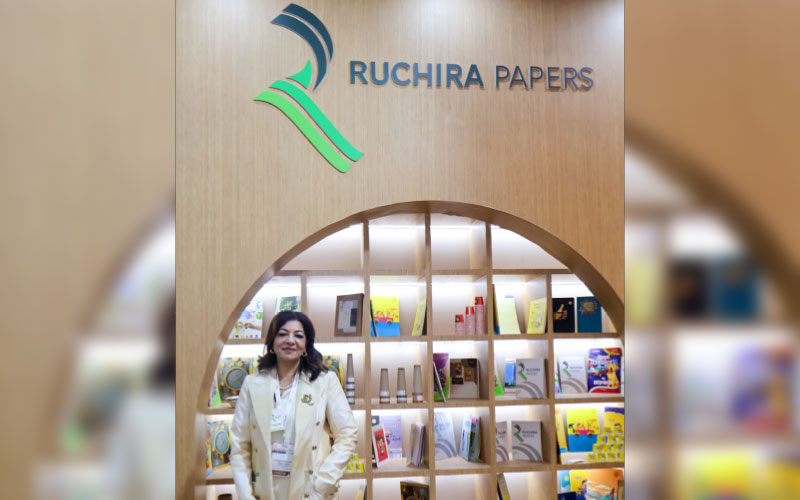
Paper Mart: Please tell us about your participation here at Paperex 2025.
Ruchica: We have been participating in Paperex for the last 15 years, and have seen it grow year after year. Alongside that, our own business has also grown steadily. Today, we view Paperex primarily as a meeting point for our longstanding dealers and industry peers rather than a platform to attract new customers or seek fresh orders.
We have reached a stage where our markets are well established. So, our focus here is not on generating business but on reconnecting with the industry peers—our dealers, fellow paper mills, and even competitors. It’s always a pleasure to meet and interact with the entire fraternity under one roof.
PM: With the approx. INR 100 crore modernization programme now in place, what is your growth strategy for the company?
RU: The approx. INR 100 crore Modernization Programme that we have just completed is now moving into the production phase, as we speak. The shoe-press machine is going into operation and the various modifications have been implemented that will lead to a substantial improvement in product quality. We might also introduce a few new products. However, we would prefer to discuss the details once everything is fully stabilized.
The additional volume will largely be absorbed by our existing dealer network, as there is already strong demand for these products.

Watch: Top Paper Companies 2023
PM: What is the latest development or innovations happening in your company?
RU: Bleached kraft paper is one of our key products and is widely used for carry bags. Earlier, we had limited GSM ranges for this segment. However, with the recent upgrades, we will now be able to produce higher GSM grades, which we plan to actively supply to our customers.
PM: Are there any new markets that you are targeting with this new GSM bleached kraft paper?
RU: The new GSM range in bleached kraft paper will primarily cater to our existing customer base. There has been long-standing demand for these GSM grades, and the additional production will be absorbed by the same customers rather than being directed toward new markets. This Modernization Programme allows us to serve our customers better by meeting their requirements more effectively and strengthening our position in the market.
PM: What are the latest sustainability innovations or technology upgrades happening in your company?
RU: Ruchira Papers initiated a major PM-3 (Writing and Printing Unit) modification in their Modernization Programme, replacing the headbox and top former, extending wire length, and installing a Bellmer shoe press to enhance press dryness and machine speed, utilising existing boilers and turbines.
PM: What role does your R&D team play to bring new innovations to table?
RU: Research and development is the core strength of our mill. We have a highly capable R&D team that is constantly exploring new possibilities and innovations. Whenever a customer or dealer brings us an idea or a new development from anywhere in the world, we take it straight to our R&D team, and their response is always, “Let’s try it and develop a lab sample.” They never say no, even though our machines may have certain limitations. To sum up, I would like to say that there may be limits to our machineries, but there is certainly no limits to our thinking and innovations.
PM: What are the current challenges in the paper industry with regards to paper imports and raw material price surge? How do you plan to overcome it?
RU: There has been a significant amount of “dumping” in the market. However, when I speak to traders, they often describe it as the “availability” of products in India rather than dumping.
This trend has made paper pricing extremely challenging for Indian paper manufacturers, who have been unable to realize their fair share due to the large volumes of imported paper in the country. This situation has persisted despite certain government measures, such as BIS implementation, since these regulations apply only to specific boards and product categories. In writing & printing grades too, prices have not been able to move upward. This is not due to a lack of market demand as the requirement clearly exists, but because dealers and converters are constantly looking for opportunistic deals from stock lots. As a result, purchasing decisions are often delayed, and prices have remained stagnant throughout the year.
We have been able to address this challenge by focusing on delivering high-quality products. This helps us to perform well and maintain a strong position in the market. The converters face a degree of uncertainty when buying imported or stock lot materials, as availability can vary from month to month. In contrast, we ensure a regular supply of products with consistent quality, which builds confidence among our customers. This reliability is the reason that they continue to buy from us, even at a slightly premium price.
Also Read: Sripathi Paper and Boards Drives Green Transformation with Maglev Pumps and NRSW Boiler
PM: How do you foresee the future of the paper industry?
RU: The future for the paper industry remains very promising. When we compare global paper consumption with that of India, it is clear that we are still at a very nascent stage. As a result, there is significant growth potential ahead. While the writing and printing segment continues to grow steadily, the most substantial growth is expected in the food packaging paper segment, especially as the industry moves away from plastic and increasingly toward paper-based solutions. Consumption of food packaging and disposable paper products is increasing rapidly in India, creating strong opportunities in the packaging segment.
Additionally, there is considerable innovation taking place in paper packaging—for example, insulated paper-based tea cartons that keep beverages warm while remaining fully recyclable. These kinds of developments highlight the evolving role of paper and its strong demands in various industries.
Innovation is happening across the value chain—at the mill level as well as among consumers. Today’s younger consumers, in particular, want to identify with sustainable packaging and are strongly opposed to the use of plastic in any form. This change in consumer behavior is redefining packaging choices and pushing the industry toward sustainable paper-based solutions.