
Bindals Papers is steadily enhancing its operational efficiency and strengthening sustainability. In an exclusive interview with Paper Mart, Mr. Ankur Bindal, CEO of Bindals Papers Pvt. Ltd., revealed that the company has recently commissioned a 72-tonne anaerobic digester, and is also setting up a 100-tonne waste-to-energy boiler, scheduled to be operational by July 2026. Additionally, the company plans to install a new turbine aimed at reducing steam consumption, thereby focusing on cost efficiency and resource optimization.
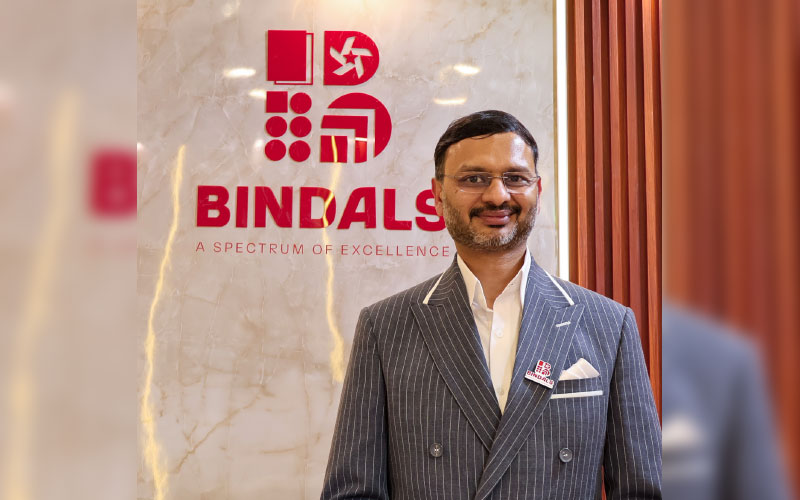
Paper Mart: Please tell us about your participation here at Paperex 2025?
Ankur Bindal: This is the 17th edition of the Paperex and we are participating in it for the ninth time. I am especially delighted this year because the event truly offers a world-class place and experience. Earlier, we often travelled to Europe, Sweden, China, for exhibitions, believing that such infrastructure would be difficult to find in India. But today, I feel that we are on par with any developed nation. The footfall has always been strong, given that Paperex is the largest exhibition for the paper industry, and even on the very first day, the response has been prominent. We look forward to even greater participation over the next two days.
PM: Your company operates one of India’s largest biomethanation plants. How are you integrating sustainability into your operations, and what future initiatives are planned for energy and water conservation?
AB: We have recently commissioned an anaerobic digester with a capacity of 72 tonnes. This is currently the largest digester in the paper industry. We are channeling all our backwater into this system, which generates nearly 20,000 cubic meters of biogas. This gas is then used in our lime kiln, making us completely self-sustainable.
Earlier, we attempted lime kiln recycling, but the process was not viable due to the dependence on coal. Now, with biogas generated from waste, we have eliminated the use of furnace oil and coal in this operation. This shift has significantly reduced our production costs and made the entire process far more sustainable.
In addition, we are setting up a waste-to-energy boiler, which is currently under commissioning and scheduled to commence operation by July 2026. This will be India’s largest RDF-based energy boiler, with a capacity of around 100 tonnes. Once operational, it will further strengthen our energy independence and sustainability efforts.
A key focus has been on lowering our steam and power consumption. We are installing a new turbine that is expected to reduce our steam usage by nearly 12–13 percent. Through these initiatives, we are continuously enhancing the efficiency and environmental responsibility of our operations.

Watch: Top Paper Companies 2023
PM: The Indian paper industry is often described as inherently sustainable. How do you see sustainability reflected in raw material sourcing and the recyclability of products?
AB: The Indian paper industry has always been inherently sustainable because all our raw materials are renewable. Nearly 95 percent of the wood is forest-free and is sourced from farmland. In addition, we rely heavily on agricultural residues such as bagasse and wheat straw, as well as recycled waste paper. We are not using any raw materials that are non-sustainable.
All the products we manufacture, whether packaging board, graphic paper, or writing and printing grades, are fully recyclable. Unlike plastics, which often end up as an environmental hazard or menace, paper naturally returns to the value chain. From raw material sourcing to product end-of-life, our operations remain sustainable at every stage. The Indian paper industry stands as one of the most sustainable manufacturing sectors in the country.
PM: What are the current challenges in the paper industry with regards to paper imports and raw material price surge? How do you plan to overcome it?
AB: One of the major challenges we are currently facing is the surge in paper imports from China, Indonesia, and several other countries. These imports are essentially being dumped into the Indian market, which creates competitive pressures. To counter this challenge, we see two possible approaches. The first is policy intervention to curb unfair imports. The second is internal optimisation of our operations, adopting advanced technologies, and reducing our cost of production so we can remain competitive against imported products.
We believe that the government should implement measures such as anti-dumping duties or a Minimum Import Price (MIP) to support domestic players. Industry associations and leaders are already in discussions with the government to push for these corrective actions.
Another pressing issue is GST. The rate was increased from 12% to 18%. While the rate itself may not pose a problem, downstream industries such as the corrugated box sector are unable to fully avail input tax credit (ITC). As a result, their costs have risen, and their working capital requirements have increased, ultimately pressurizing the mills.
We also face complications due to the 0% GST on notebook paper. Since we pay 0% GST on this product, mills are required to reverse the ITC, which adds INR 6 to INR 10 per kg to the cost of production. However, imported paper does not face this reversal requirement, putting domestic manufacturers at a disadvantage. These taxation and import-related issues collectively pose significant challenges for the Indian paper industry.
We are already in discussions with the government to bring the GST rate down from the current 18% to 5% as paper is not a luxury item but a basic necessity, and therefore should fall under a 5% tax bracket. While we continue to advocate for this, if the rate is not revised, the only way forward for us is to reduce our production costs and operate more efficiently. Ultimately, we will have to cut-down our cost and work with tighter margins to remain competitive.
Also Read: Kuantum Papers Unveils ‘KOPIO’ Copier Paper Brand; Charts Major Growth Strategy
PM: How do you see the future of the paper industry?
AB: The future of the paper industry is very bright, especially in the packaging segment. The growth is extremely strong, whether it is graphic paper, duplex board, or emerging categories like barrier-coated papers, which are poised to become major substitutes for plastics in the coming years. Even writing & printing, and copier paper continue to grow in India. While the growth rate may not be as rapid as packaging paper, it is still positive, and from a consumption standpoint, we see no cause for concern.
However, the industry is highly capital-intensive, and the interest burden on investments is substantial. This is one of the key reasons growth and expansion often appear constrained, despite strong market demand.

We are setting up a waste-to-energy boiler, which is currently under commissioning and scheduled to commence operation by July 2026. This will be India’s largest RDF-based energy boiler, with a capacity of around 100 tonnes. Once operational, it will further strengthen our energy independence and sustainability efforts.