Krofta Engineering Limited showcased its continued focus on innovation, sustainability, and cost-efficient water management for the pulp and paper industry at Paperex 2025. In an exclusive collaborative interaction with Paper Mart, Mr. Raghvendra Khaitan, Managing Director of Krofta Engineering Limited, and Mr. John Barsotti, President & Founder of Heron Innovators, Inc., discussed how their strategic partnership is bringing advanced flotation and decentralized wastewater-treatment solutions to Indian paper mills. From introducing Suspended Air Flotation (SAF) as an upgrade to conventional DAF systems, to addressing challenges around water reuse, operating costs, space constraints, and future AI integration, the discussion highlighted a shared vision.
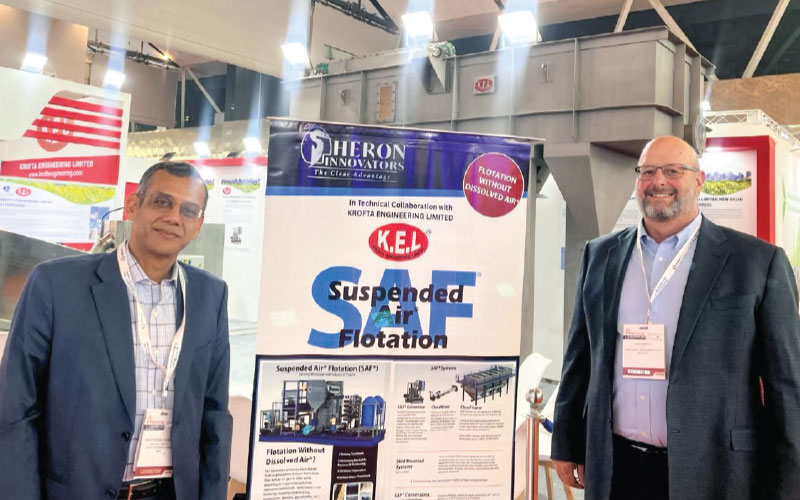
Paper Mart: What are you displaying here at Paperex 2025? How has your experience been so far?
Raghvendra Khaitan: We are displaying two new products. One is MegaCell, which works on dissolved air flotation (DAF) technology, and the second is the screw press that we launched a couple of years back for handling sludge.
On the DAF side, we have tied up with Heron Innovators, Inc., for a new technology called suspended air flotation (SAF). This is what we want to provide this year to many of our customers, where we can convert a lot of old DAFs into SAFs, which have their own inherent advantages, which John can talk about later. Mr. John Barsotti is the owner of Heron Innovators, Inc., based out of the US.
As far as our experience at Paperex goes, being the first half of the first day, two to three customers have already visited us. We have spoken to them about SAF. I think the response should be good because the industry wants to see new things coming their way and wants to know what is new in the industry. We are looking forward to the next couple of days.

Watch: Top Paper Companies 2023
PM: How can decentralized wastewater treatment systems give paper mills greater flexibility in managing water use? How are you working in that direction?
John Barsotti: In general, having treatment capability at the mill, instead of downstream at a central wastewater treatment plant, provides the ability to treat specific water in a specific way. There are generally cost savings for reuse and the ability to capture the resource before it leaves the site. We are one technology in that area.
We compete against something called DAF and we convert them and replace them. We lower the operating costs, increase solids efficiency, reduce the amount of space needed, and along with operating costs, we have much lower horsepower and oftentimes significant chemical reduction as well. Between all of these, it becomes a really cost-efficient solution at the plant that can be tailored to the plant and support a lot of reclamation efforts.
RK: To add here, having a decentralized plant brings a lot of flexibility for the customer because today water is required for many different applications—dilution, pulp mill, stock washing, and showers. If a mill has its own decentralized plant, it can operate it in such a way that it not only complies with operational requirements but also with environmental discharge standards. That gives the customer flexibility.
We compete against something called DAF and we convert them and replace them. We lower the operating costs, increase solids efficiency, reduce the amount of space needed, and along with operating costs, we have much lower horsepower and oftentimes significant chemical reduction as well.Ś
PM: The paper industry is often blamed for high water usage. What is your view on this?
RK: Correct, no doubt—it is a very water-centric industry. But at the same time, today technologies are available where water can be treated to the extent possible. I think the environment should look at removing the paper industry from the red category because that classification is no longer required.
PM: Given Krofta Engineering’s full turnkey wastewater and effluent treatment solutions, how do you tailor your systems for pulp and paper mills to maximize fiber recovery and minimize water use while keeping the plant footprint minimal?
RK: Today, cost per ton per day is very important for the industry. We provide a full solution from A to Z, which includes primary, biological, secondary, and tertiary treatment, including filtration, membranes, reuse, and sludge discharge. If sludge is not discharged, it becomes a concern because it cannot be allowed to build up.
As mentioned earlier, we have recently tied up with Heron Innovators, Inc., to add new technologies that reduce OpEx (operating expenses) for paper mills, because operating cost is a major concern today. Secondly, we have tied up with GPS Renewables Private Limited for gas conversion. In many anaerobic treatment plants, methane gas is generated, which can be further treated into CBG and CNG, providing good ROI for customers going forward.
Not many plants may implement this immediately, but with power becoming such a major concern across the country, using gas as a derivative to save fuel cost becomes a strong value proposition. We are joining hands wherever we can fill gaps so that we become a full turnkey solution provider, not only from a solution standpoint but also from a cost-reduction perspective.
We have recently tied up with Heron Innovators, Inc., to add new technologies that reduce OpEx (operating expenses) for paper mills, because operating cost is a major concern today. Secondly, we have tied up with GPS Renewables Private Limited for gas conversion.
PM: What are some of the major trends and challenges you are seeing in the industry today?
RK: A major challenge going forward is cost reduction. The paper industry is under pressure due to imports, which are hitting bottom lines badly. China and Indonesia are dumping paper into the market, and the industry is struggling.
Nobody can shut down their plant, so the idea is how much value we can add for customers—how we can help them save a few pennies in day-to-day operations. That is where technologies like SAF from Heron Innovators, Inc., come into the picture.
JB: Globally, the buzzwords today are sustainability and water reclamation, and the third major trend is increasing capacity without expanding footprint. Most plants are space-limited but want to increase capacity, reduce costs, and lower price per unit volume.
Part of that challenge lies in wastewater treatment, because normally you don’t have the ability to double your wastewater treatment capacity. The advantage is that one unit can be expanded to handle much higher capacity, reclaim more water, and operate with lower horsepower. If a customer has an existing system running at X capacity and the same machine can be used for 3X capacity, that becomes a major saving without additional investment in space or resources.
Also Read: Lineomatic Unveils Next-Gen Folio-Size Ream Wrapping Machine
PM: What unique AI-integrated processes or practices do you see in the industry or plan to implement?
RK: We are working on developing a model from an operating perspective where polymers and chemicals are used. Today, dosage control is done manually by operators monitoring flows. We want to integrate a system where parameter changes automatically adjust dosage through an online monitoring platform. This will improve efficiency and reduce operating expenses for customers. We are working on this, and it is part of our agenda for the current year.
JB: From a global perspective, there is a lot of AI activity, but much of it is still marketing, development, and literature. AI-aided design is coming, but that will likely be the next step within engineering houses.
PM: Is there anything else you would like to add?
RK: Technology is available today, and industrialists and mill owners must look at upgrading their systems. There is no technology in the world that cannot be implemented in India, either directly or through partnerships.
India is unique, with around 500–600 paper mills still operating, while many plants in Europe and the US are shutting down. There is growth here, and I would request everyone to implement newer technologies that help mills operate longer with lower operating costs.
Technology is available today, and industrialists and mill owners must look at upgrading their systems. There is no technology in the world that cannot be implemented in India, either directly or through partnerships.