
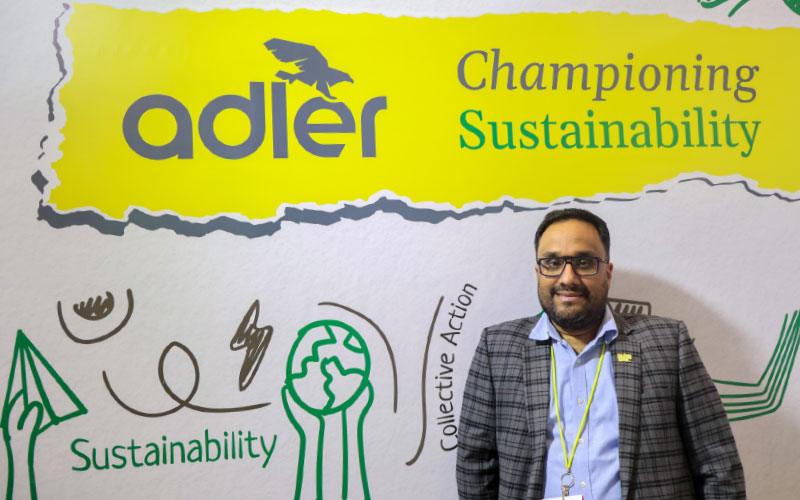
Adler Paper LLP, one stop shop for recovered paper and stocklots requirements is helping paper mills sustain their sales and profits by providing 80 grades of waste paper. Constantly recycling, reusing and shrinking carbon footprints worldwide, the company has shown resilience by overcoming market challenges, geopolitical uncertainties, and evolving customer needs with innovations. In a recent interaction with Paper Mart, Mr. Hrishikesh Vora, CEO, Adler Paper LLP, shared insights on Adler Paper’s diversification, including plans to enter pulp trading, representing an overseas supplier in India, and plans to incorporate AI in their ‘Trace & Track’ software.
Paper Mart: What are your main objectives for participating in Paperex?
Hrishikesh Vora: We have been participating in Paperex since 2009, but we don’t exhibit for business anymore. For us, it is about building relationships. In an industry where you often go years without meeting people face-to-face, our participation here is to express that we are performing well in the industry, and we are here for the long term.
PM: As the fourth-generation CEO, what is your long-term vision to carry Adler Paper LLP’s legacy forward?
HV: The paper industry has been going through a tough time, with the past two years proving particularly challenging. Despite these challenges, we are actively diversifying our business. We have plans to get into pulp trading. We are in discussions to represent an overseas supplier in India. We are also planning to get into specialised finished paper, for example, food-grade papers and tissue papers.

Watch: Top Paper Companies 2023
PM: How has the Adler ‘Trace and Track’ platform contributed to operational efficiency and customer satisfaction?
HV: Adler ‘Trace and Track’ has contributed significantly. Through the software, our customers get weekly reports and can track their shipments. We’re now looking to overhaul that entire platform. We would like to incorporate AI to automate and enhance the software, making it more user-friendly. The new update will let the customer get status updates on a real-time basis. We are looking forward to launching the updated software soon. It will take time because we want to get it right and avoid half-hearted measures.
PM: What are your views on the use of AI in the paper industry?
HV: Artificial intelligence is reshaping industry practices at an unprecedented pace. In my opinion, if you are not incorporating AI into your business, you are limiting your ability to unlock the growth potential of your business. We need to integrate AI in some format while using it reasonably. At Adler, we are not looking to replace anyone in the office with AI. We are looking at AI to help them with their job that they are doing. We want to integrate in such a way that it just functions seamlessly without people even noticing that there is AI involved.

What keeps Adler Paper ahead is that we’re doing our trade with a lot of countries, including the UK, Spain, Portugal, Greece, Italy, Holland, Belgium, Ireland, the USA, South Africa and all of the Middle East. Our philosophy is simple: to trade with as many countries as possible so that our supply chain never dries up.
PM: What domestic and international collaborative strategies does Adler Paper adopt to ensure consistent quality and a reliable supply for its clients, especially in fluctuating market conditions?
HV: The trend is changing. Indentors like us buy from a lot of trading houses. The profit margins are eroding now. What we’re noticing is that more and more packaging companies or waste paper depots want to export directly to India to have better control over their quality. We’re working with a lot of such companies now that want to come directly to India and sell their material, which they collect, they bail and then ship into containers for India.
PM: What, according to you, are the major issues affecting the supply chain?
HV: Geopolitically, things are not very good. Geopolitical issues have affected almost all the supply chains. What keeps Adler Paper ahead is that we’re doing our trade with a lot of countries, including the UK, Spain, Portugal, Greece, Italy, Holland, Belgium, Ireland, the USA, South Africa and all of the Middle East. If something doesn’t work, we always have a fallback plan, or we always have another country that is there for us. Our philosophy is simple: to trade with as many countries as possible so that our supply chain never dries up.
PM: How do you foresee the future of the Indian paper industry? What are the challenges for the industry regarding waste paper procurement?
HV: It’s been one of the toughest years, I believe. The year 2008 was nothing compared to this year. People expected 2025 this year to be better than 2024, but it’s not. It has been worse. There is a possibility that this slump might continue in 2026, but we cannot predict anything. I would like to comment that India is the future. With a high population, the growth story is ours. Even with all the difficulties, the industry will stabilise.
Also Read: Shitla Papers Targets 100% Growth, Aims to Double Sales Volumes in Two Years
PM: What is your vision for Adler Paper for the next 2-3 years?
HV: We are focusing on giving the paper mills the widest possible varieties of waste paper- helping them to sustain their sales and profits. We trade about 80 different grades of waste paper that are unheard of. We’re here for the small orders as well as the bulk orders. Our internal mantra is, “one container a day is a good day.” That’s our new tagline.
My vision is to grow old in this industry. I got into this industry when I was 18; now I have been a part of this industry for about 22 years. I hope that the industry sustains, and I believe it will. The vision is that this is the right industry to be in. We just have to wait it out. Once that happens, we have a long road ahead.
My one suggestion to everybody who is reading this article would be to keep talking. Talk to people, share your views. People out there are sharing the same experiences as you and having the same problems as you. Talking will always help you find a solution to the problems.
I would like to comment that India is the future. With a high population, the growth story is ours. Even with all the difficulties, the industry will stabilise.