
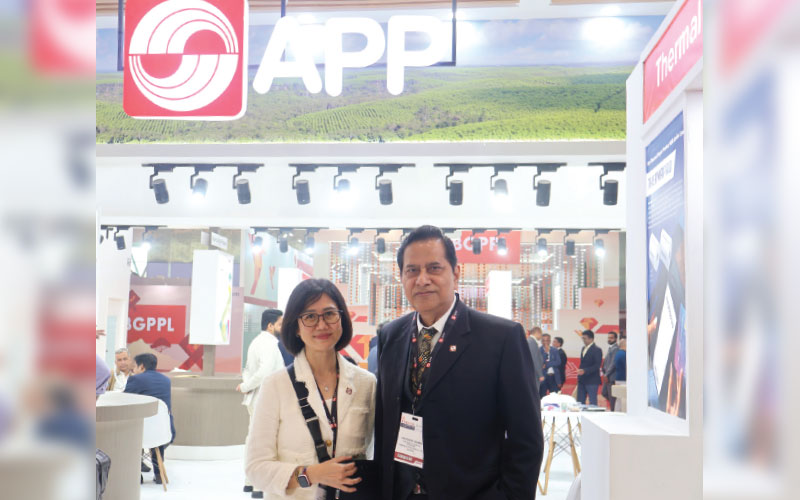
In an exclusive interaction with Paper Mart, Mr. Anil Kumar Sharma, Head Product Research and Development, and Ms. Lina Lim, Head of Product Marketing and Management of Coated Products, APP Group, highlighted the company’s significant expansion in value-added products such as tissue paper, packaging paper and packaging boards, and plans to enter thermal paper grade. Further strengthening its growth roadmap, the company is investing in a new paper machine and a barrier-coating plant, both scheduled for commissioning in 2026. These strategic investments reinforce APP’s position in the paper industry and underscore its long-term growth vision.
Paper Mart: What are the recent developments happening at APP Group?
Anil Kumar Sharma: I will mainly focus on APP Indonesia. We are currently in an expansion phase, with growth across selected product varieties, particularly in value-added segments. We are strengthening our presence across packaging grades, especially into brown paper portfolios in response to the strong growth in packaging boards, while simultaneously strengthening our white packaging segment. For this, the packaging machine for brown paper has already been installed and is running successfully.
We are also coming up with a major investment in a new white industrial board machine with a capacity exceeding 1 million tonnes, which is scheduled to commence operations in the first quarter of 2026.
In parallel, we are actively investing in plastic substitution initiatives. As part of this strategy, we are developing our own barrier coating solutions and undertaking focused R&D efforts in packaging. We have recently invested in a specialized coating plant dedicated to producing barrier-coated board, with a capacity of around 1 million TPA. This facility is expected to be commissioned by the end of 2026, most likely in the fourth quarter of 2026.
Thermal paper is another new segment we are entering. We met with some key customers at the event, communicating to them the details of our expansion roadmap and the new product offerings that they can expect from us, going forward.

Watch: Top Paper Companies 2023
PM: What new opportunities are you exploring, particularly in the tissue paper converting segment?
AKS: We are planning expansion into tissue paper converting, and discussions are currently underway. We are evaluating the possibility of extending tissue converting facilities here in India, while closely seeing the growth opportunities in the Indian market.
PM: The market has its ups and downs. How do you assess the current state of the industry—both domestically and globally and how do you overcome its challenges?
Lina Lim: The challenge between domestic players and international suppliers is always there. The key lies in balancing demand between imported and domestic supply in a way that it allows the industry to grow sustainably. Our focus is on finding that right balance, so that all players can grow and remain competitive.

We are developing our own in-house technology for the chemicals required to produce products such as bio-boards. Our objective is to integrate paper, chemicals, and coating technology within our own ecosystem.
PM: Recently supply chains have been affected due to various geopolitical issues. How are you going to overcome these challenges?
LL: This is not a challenge unique to us, it is something the entire industry is experiencing. The key lies in balancing the portfolio by identifying which segments offer stronger profitability, even as geo-political complexities increase. This requires disciplined planning and a deeper understanding of market dynamics. With the right insights, we are executing our supply chain management more effectively and plan to make even better and more informed decisions in the future.
PM: What is the role of innovation and technology in meeting the evolving demands of the customers and making the products cost-effective?
AKS: Innovation and technology are critical to meeting evolving customer demands and ensuring long-term competitiveness.
As traditional paper applications decline, innovation enables us to move beyond conventional products into new, higher-value applications. Our focus is on using technology to optimize materials, processes, and product design so we can deliver solutions that are fit-for-purpose and aligned with changing market needs.
At the same time, we are investing in in-house capabilities across chemicals, coatings, and engineered board solutions. By integrating these elements within our own ecosystem, we gain greater control over quality, performance, and speed to market.
This integrated, innovation-led approach allows us to respond more effectively to customer requirements while delivering consistent, high-quality products for the market.
At APP, sustainability is a core strategic priority. And as a result, all product developments are aligned towards sustainability, and this will continue to be a defining focus of our innovation efforts.
PM: AI is a very critical aspect for automation in the industry. What are your thoughts on it?
AKS: APP has made an effort moving towards Industry 4.0 a few years back, and now we are integrating AI-driven systems to enhance automation, minimise human error, and significantly improve operational efficiency. We are working closely with multiple technical consultants on this initiative and have already implemented several steps across our operations for smooth, consistent, and more reliable processes.
PM: What role does sustainability play in product development and operations?
AKS: Sustainability is certainly a priority for us. When we talk about biodegradable solutions, we are not limited to boards but are addressing the paper side as well, across both higher and lower GSM grades, while ensuring the products remain truly sustainable.
For bio-board in particular, we evaluate four key parameters: cost, quality, runnability, and certification. Certification must come from reputed, globally recognized institutions. Without this validation, claims of biodegradability or compostability can be misleading. For instance, a product may be recyclable, but that does not mean that it is necessarily compostable, hence there is a need for credible certification.
Additionally, awareness around sustainability is increasing worldwide, including in markets like India. Customers and brand owners are increasingly focused on reducing plastic usage. Globally, one of the most important innovations today is finding effective and scalable substitutes for plastic through sustainable solutions. Fiber-based materials present a strong opportunity in this domain, as cellulose can be modified to deliver similar characteristics that of plastics. That being said, it is not easy to substitute plastic and requires continuous innovation.
We have already commissioned a coating plant dedicated to producing bio-board, and these products are being supplied globally for applications such as cup stock and lunch boxes. This phase served as a valuable learning experience, and now, we are moving towards a much larger-scale investment.
At APP, sustainability is a core strategic priority, and as a result, all product developments are aligned towards sustainability and environmental responsibility, and this will continue to be a defining focus of our innovation efforts.
We want to continue being a socially and environmentally responsible company. We want to produce paper which is good for the environment while consistently meeting customer expectations.
PM: Different regions have varying compliance standards. How does APP ensure compliance across different geographies?
AKS: At APP Group, we manage compliance across different geographies by applying a single global standards framework while adapting to local regulatory requirements.
All operations and suppliers must meet APP’s global policies on legality, sustainability, labour, and environmental management. At the same time, local compliance and legal teams ensure that country-specific laws and regulations are fully met, and where local standards are higher, those take precedence.
This is supported by regular internal and third-party audits, certification systems, and ongoing monitoring to ensure consistency. Compliance is reinforced through training, clear accountability, and escalation mechanisms, allowing APP to operate responsibly across diverse markets while meeting customer and regulatory expectations.
Also Read: Pakka Scales Up Food Packaging Segment; Focusing on Flexible Packaging and Value-added Products
PM: What is your vision for the future?
AKS: As one of the larger market players in the industry, we want to continue being a socially and environmentally responsible company. We want to produce paper which is good for the environment while consistently meeting customer expectations. This is evident with the launch of Regenesis – APP’s sustainability platform to deliver our renewed overarching ambition for a sustainable future – in September 2025.
We also want to build long-term relationships with our customers, and have a global presence, ensuring that we remain close to the customers. Our focus is on bringing together quality, cost efficiency, and customer value, and for this, innovation is the key enabler that must remain as the core of our strategy, going forward.
APP launched Regenesis – APP’s sustainability platform to deliver our renewed overarching ambition for a sustainable future – in September 2025.