
KRecycling Private Limited, a Gurugram-based paper products company, has entered a new phase of growth with the commissioning of a state-of-the-art coating facility in Ludhiana, Punjab. The investment marks the company’s expansion into thermal paper, sublimation paper, C1S chromo paper and greaseproof grades, supported by high-speed coating technology, in-house chemical formulation capabilities and stringent quality control systems. In this exclusive interview with Paper Mart, Mr. Amanbir Singh Sethi, Director & Mr. Sanjeev Khullar, CEO, KRecycling Private Limited, shares insights on the new plant’s capacity, technology differentiation, quality focus, regulatory outlook and the company’s strategy to build a strong B2B presence in domestic and export markets.
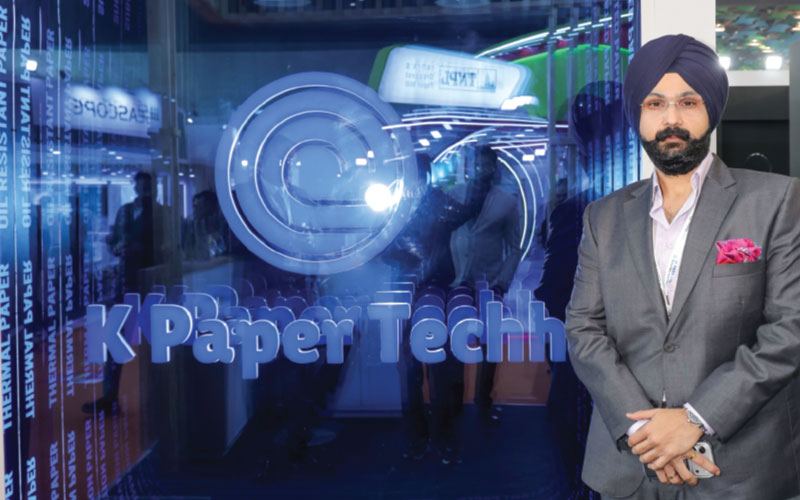
Paper Mart: Please tell us about your new venture and the product segments you are addressing through this investment.
Amanbir Singh Sethi: We have started a new coating plant, a full-fledged coating unit in Ludhiana, Punjab.Through this facility, we are manufacturing and supplying coated products such as thermal paper, sublimation paper and C1S chromo paper to the market.
PM: What is the installed capacity of the new coating plant? When did you start commercial production?
ABS: The plant has a per-day capacity of 40 tonnes, which translates to around 1,200 tonnes per month. Commercial production at the facility commenced in April 2025.

Watch: Top Paper Companies 2023
PM: Which markets are you currently supplying to, and how do you see exports shaping up in the near to medium term?
Sanjeev Khullar: At present, our primary focus is on the Indian market, with supplies spanning regions from Bangalore and Mumbai to Kolkata and North India. We have also started exporting to Sri Lanka and are actively targeting markets such as the UAE, Saudi Arabia, Sri Lanka and select African countries.

PM: What proportion of production do you expect to export?
SK: Initially, we expect exports to account for around 20–25 percent of our production. For now, the domestic market remains our main focus.
PM: Could you highlight the key technology features of the coating line you have installed and how it differentiates you from existing players?
SK: We have invested in a state-of-the-art coating machine sourced from China, operating at a speed of 400 metres per minute. Most coating plants in India operate at around 200 metres per minute, so this gives us a significant productivity advantage.
In addition, our in-house chemical kitchen allows us to develop formulations comparable to international standards. The line has two coating units—a pre-coat followed by a thermal coat—ensuring superior thermal paper quality. Online calendaring further enhances smoothness, bulk and matte finish. We benchmark our products against high-quality grades from Korea and China.
PM: In products like thermal paper, chemistry and quality control are critical. How have you strengthened your capabilities in this area?
SK: We have onboarded a professional team with extensive experience in thermal paper manufacturing. A dedicated laboratory equipped with advanced testing instruments has been set up to monitor parameters such as particle size and image density. Testing is carried out at three stages—during coating, during rewinding and before packing.
Printouts are retained to ensure print quality stability, which is the most critical performance parameter in thermal paper. Material is released to the market only after meeting strict quality benchmarks.
PM: Thermal paper can be a volatile segment, influenced by imports and base paper availability. How do you view the current market dynamics, particularly with regard to regulation?
SK: A lot depends on imported thermal paper coming into India. There are not many large coating players in this segment domestically. We believe that BIS standards should be implemented for thermal paper, and that low-priced stock-lot imports should be restricted. Moreover, rupee depreciation will also make imports non-viable in coming times.
We have already taken this up with the Government of India. Once BIS is imposed on thermal paper, the market will see more fair play, and low-cost stock-lot imports will reduce.

We are supplying across India, from Bangalore to Mumbai, Kolkata and North India. We have also started exporting to markets like Sri Lanka. We are targeting markets such as the UAE, Saudi Arabia, Sri Lanka and possibly some African markets.
PM: What is your outlook for the thermal paper market over the next few years?
SK: The market is generally very good. Thermal paper is used everywhere today, from e-commerce, ticketing, petrol pumps to cinemas and labels. We see a growth rate of about 5–7 percent over the next 7–10 years, which is why we invested in this plant.
PM: Beyond thermal paper, you mentioned that the machine allows you to manufacture multiple coated products. Could you elaborate on this product basket?
SK: This is a multi-product coating machine. Apart from thermal paper, we are also producing C1S chromo paper for pouch manufacturing, as well as greaseproof OGR paper. We are not dependent on a single product.
We can carry out different types of coating and offer a broad product basket. That is why we are looking to build strong customer relationships.
PM: What are the key applications for C1S chromo paper, and how are you approaching collaborations with brands and converters?
SK: The primary application is pouch making. It is also used for gumming sheets and label manufacturing. While there is competition from stock-lot material, we are already tied up with some large companies and trials are going on. We will be manufacturing for them, though we are not disclosing names at this stage.
PM: You also spoke about greaseproof OGR paper. What differentiates your offering in this segment, particularly for food-grade applications?
SK: Our greaseproof OGR paper is used for sandwich and burger wrapping. It has a kit value of 7+ and is PFAS-free. Many manufacturers use cheaper PFAS-based chemicals that do not meet food-grade standards. Our product is food-grade approved, and we are deliberately targeting niche, higher-quality segments rather than competing in low-quality markets.
Also Read: MLM Expands Pan-India Presence, Eyes Pharma Sector and Value-added Paper Innovations
PM: Which players do you benchmark against in terms of quality, and what kind of base paper do you use?
SK: We benchmark ourselves against A-grade export-quality products. Virgin-grade base paper is used for coating, and all chemicals employed are PFAS-free to ensure safety and compliance.
PM: Would you like to share any final thoughts?
SK: We are now looking to build a strong customer base. The plant is running well, and quality is being closely monitored. We believe we can emerge as a significant player in the thermal and C1S chromo segments.
At present, we supply finished thermal paper mainly to POS manufacturers and converters in India, supplying jumbo rolls on a B2B basis. We are not entering small-roll manufacturing for the Indian market, as that would place us in competition with our customers. For now, we are focused on supplying jumbo rolls to converters only.
The market is generally very good. Thermal paper is used everywhere today, from e-commerce, ticketing, petrol pumps to cinemas and labels. We see a growth rate of about 5–7 percent over the next 7–10 years, which is why we invested in this plant.