
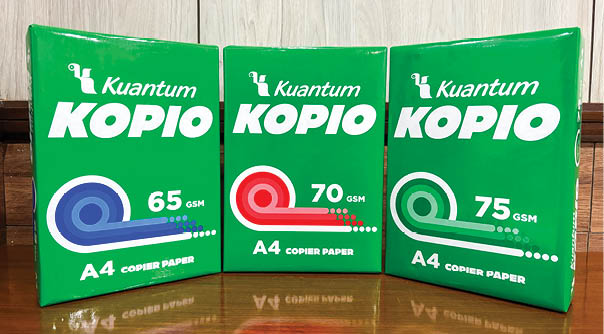
Kuantum Papers recently launched its new copier paper brand ‘KOPIO’ at Paperex, available in 65, 70, and 75 GSM. In an exclusive interaction with Paper Mart, Mr. Jagdeep Hira, CEO of Operations, Kuantum Papers Limited, shared insights into the new product as well as the company’s broader expansion strategy, which includes increasing the production capacity by 50% i.e to 675 TPD and expanding its portfolio of specialty paper products. The company aims to strengthen its market presence by diversifying into new product categories such as coated papers and barrier papers and is also evaluating the tissue paper segment, given its fast-paced growth in India. Together, these strategic initiatives reinforce Kuantum Papers’ commitment to operational excellence and value-led growth, creating a strong foundation for sustained profitability.
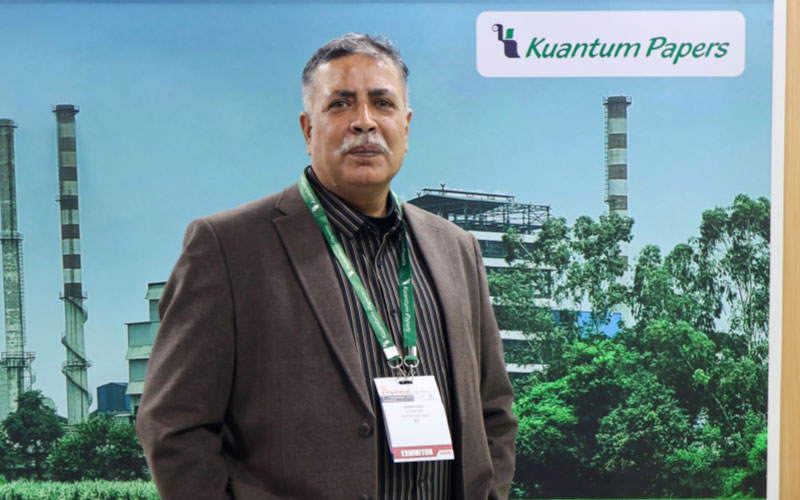
Paper Mart: Please tell us about your participation here at Paperex 2025.
Jagdeep Hira: Participation at Paperex has always been significant for Kuantum Papers. It has been an excellent platform to collaborate with our stakeholders, connect with new partners and suppliers and gain valuable insights from industry stalwarts and peers. Our association with Paperex goes back to its very inception in 1993 and this 17th edition was particularly special as we launched our new copier paper, Kuantum Kopio, along with the unveiling of the vibrant new packaging of our K-One and Konquer copier paper range. Paperex 2025 has reinforced our belief that we are a strong & dominant player in the Indian Paper Industry.
PM: Can you tell us about this new product that you have launched in Paperex?
JH: Our newly launched copier paper, KOPIO, is available in 65, 70 and 75 GSM and represents one of the finest paper qualities. It comes with excellent brightness, great print clarity and smooth double-sided printing, with reliable performance across both laser and inkjet printers. Most importantly, Kopio brings together performance and responsible manufacturing, aligning with the evolving expectations of the customers.

Watch: Top Paper Companies 2023
PM: With this new product launch, are there any capacity expansion plans in the pipeline?
JH: Mr. Pavan Khaitan, our Vice Chairman & MD, balances his exceptional vision with a pragmatic approach towards execution. We are executing a major expansion project at the plant level for production infrastructure along with the enhancement of utilities and strengthening the circular economy in paper manufacturing, backed by AI and data-driven technologies. We have already upgraded PM 4, our largest machine during mid FY 25-26 leading to higher production and efficiency and I am proud to share that another machine has just been upgraded and commissioned today to produce high-quality specialty papers. By June 2026, all four of our paper machines will stand modified with the latest technology to produce approximately 675 TPD.
This expansion also includes the installation of a Displacement Digester System (DDS) to improve pulping efficiency, fiber yield and process stability and the addition of a new coating plant to expand our presence in premium specialty and packaging grades.
PM: How do you think that the ongoing expansion plans will improve the efficiency of the operations?
JH: At present, the paper industry is experiencing an all-time low, and unless we enhance efficiencies and strengthen our bottom line, long-term success will remain elusive. Efficiency is a continual improvement process that every manufacturer must commit to in order to excel. With higher productivity, efficiencies naturally improve, and this pursuit goes beyond mere productivity expansion—it is equally about elevating quality.
For Kuantum, our approach has always been customer-centric. When the customer is satisfied, business follows naturally. We consistently work backward from the customer’s perspective, understanding their requirements, their expectations, and their product needs and this approach guides how we serve them.

Our approach has always been customer-centric. We consistently work backward from the customer’s perspective, understanding their requirements, their expectations, and their product needs and this approach guides how we serve them.
PM: The company has also invested in advanced process control systems. How is the company ensuring overall process optimization in the mill with this new technological advancement?
JH: When your inputs are controlled, your outputs remain consistent. Our strategy has been to tighten input control, minimize variability, and ensure that the team is not engaged in managing the operation, but rather they are skilled in ensuring that the automation is managing the operations.
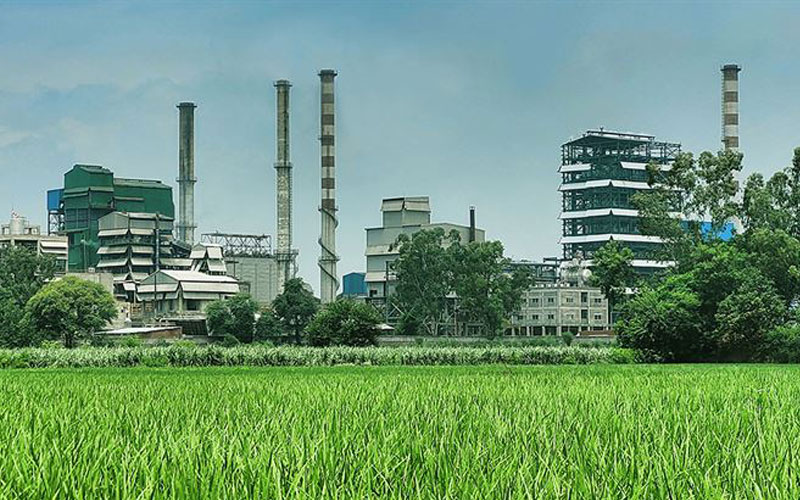
Through Project Nirmaan, our digital transformation initiative, we have established a strong technology foundation by integrating closed-loop automation, Advanced Process Control (APC) systems and predictive analytics. They provide a comprehensive, real-time view of plant operations and are deployed across critical units, including the boiler, pulp and paper sections.
The aim and philosophy is to get on to 100% manual-free intervention in process control through improved automation at each stage, resulting in AI-enabled decision making and higher efficiency. The APC framework has reduced variability, optimised chemical usage and strengthened operational reliability, paving the way for a smarter, data-driven and future-ready manufacturing ecosystem at Kuantum.
PM: What is your vision and goals for Kuantum Papers in the coming year and how do you plan to achieve those goals?
JH: This is actually my second tenure with Kuantum Papers and in many ways, it feels like a homecoming. Working with Kuantum and for Kuantum has always been close to my heart.
Our vision for the coming year is to consistently deliver superior quality, strengthen the company’s competitive edge and achieve industry-leading performance. We are targeting an increase in EBITDA beyond 20%, and this will be driven by strong collaboration across teams and disciplined execution. This is the reason we have made strategic investments in advanced machinery, instrumentation, automation and AI-led systems along with upskilling and training our workforce. These initiatives are designed to improve efficiency, reduce variability and enhance product quality across operations.
The aim and philosophy is to get on to 100% manual-free intervention in process control through improved automation at each stage, resulting in AI-enabled decision making and higher efficiency.
PM: Raw material shortage is a prime challenge in the paper industry. What is the company’s strategy to overcome this obstacle?
JH: The foremost thing for any industry is to have secured raw material. We need a steady supply of raw material so as to operate smoothly, and for business to remain on the track. For us at Kuantum, this begins with our Social Farm Forestry Programme. Within just one year, our clonal plantation initiative has expanded multifold with active participation from farmers across and beyond our region. By promoting direct farmer procurement, we are building stronger relationships, ensuring fair value for farmers and creating a transparent, reliable supply chain.
Our second key raw material is wheat straw. Being located in Punjab, one of India’s highest producers of wheat straw, availability is not a challenge. The focus, therefore, is on efficient sourcing, responsible utilization and long-term security. To address seasonality, we are strengthening our storage infrastructure, enabling us to stock wheat straw well in advance and ensure uninterrupted operations throughout the year. This is being done in collaboration with stakeholders to create an environmentally conscious organisation, helping prevent stubble burning and creating value from agricultural residue.
PM: Paper imports nowadays are greatly impacting the domestic players. What are your views on it and how can we overcome it?
JH: If we look deeper, it’s clear that no one can fully control this trend. Paper imports are rising year-on-year, and they will likely continue to do so. Instead of focusing solely on the impact of these increasing imports, the real priority should be strengthening our own business operations: improving efficiencies, reducing production costs, and enhancing quality.
Competition is always good for growth. It provides the push we all need to improve continuously, and Kuantum embraces that. But rising imports are certainly a concern that the entire industry must collectively overcome.
Looking ahead, in the next 5-10 years, we see ourselves emerging as a stronger, more diversified and future-ready organization.
PM: As you said, there needs to be a balance between quality and cost of production. How difficult or complicated is it to maintain it? What is your outlook on it?
JH: When we talk about the cost of production versus quality, the real conversation should be about quality versus profit. If your costs increase because you are enhancing customer satisfaction, you will be rewarded—if not immediately, then certainly in the long run. A happy and satisfied customer ultimately brings sustained value to the company.
That being said, we strongly believe that when processes are optimised and decisions are data-led, variability is reduced and quality improves organically without any disproportionate cost increase, resulting in improved profitability.
Also Read: Ruchira Papers Invests in Enhancing Quality, Unlocks New GSM Range of Papers
PM: How do you foresee the future of the paper industry and what are your future plans in the next 5-10 years?
JH: If you look at the overall paper industry, some segments may decline while others grow, but the overall demand outlook is extremely promising. When you compare India’s production volumes from five years ago to today, the growth is evident, and it will continue upward. Across the industry, many players are announcing new projects and expansion plans, which directly indicates strong consumption patterns in the market.
Segments like packaging are showing strong CAGR growth of around 5.6% through 2030 and with the increasing push against single-use plastics, specialty products are gaining momentum. Tissue Paper is another fast-growing category due to focus on personal hygiene and growing consumer consciousness. The modus operandi may shift depending on global and local circumstances, but one thing is certain: demand for paper, especially in India, is steadily growing.
For our company, production is expected to grow by 20–25% in the near future, and by 50% by mid of FY 2026-27.We are also expanding into new product categories such as coated papers, barrier papers and a new range of tissue products. Looking ahead, in the next 5-10 years, we see ourselves emerging as a stronger, more diversified and future-ready organization. Through strategic capacity expansion, entry into high-value product categories and a sharp focus on sustainability, we are positioning ourselves to lead the next phase of growth in India’s paper industry.
We are targeting an increase in EBITDA beyond 20%, and this will be driven by strong collaboration across teams and disciplined execution.