
JMC Paper Tech Pvt Ltd has unveiled MillMind, an AI-driven mill intelligence platform designed to transform how paper mills monitor, analyse, and optimise operations. In an exclusive interaction with Paper Mart, Mr. Sneh Patel, Chief Operating Officer, and Mr. Ritesh Vajariya, AI Advisor, JMC Paper Tech Pvt Ltd, explained that MillMind integrates production data, costs, energy consumption, and analytics into a single, user-friendly system that works alongside existing ERP and DCS setups. The platform has already secured its first international order from Modern Laminates Ltd, Uganda, underscoring strong market acceptance. JMC has also strengthened its global footprint through a technical partnership with Kawanoe Zoki Co. Ltd. of Japan, further reinforcing its technology-led growth strategy.
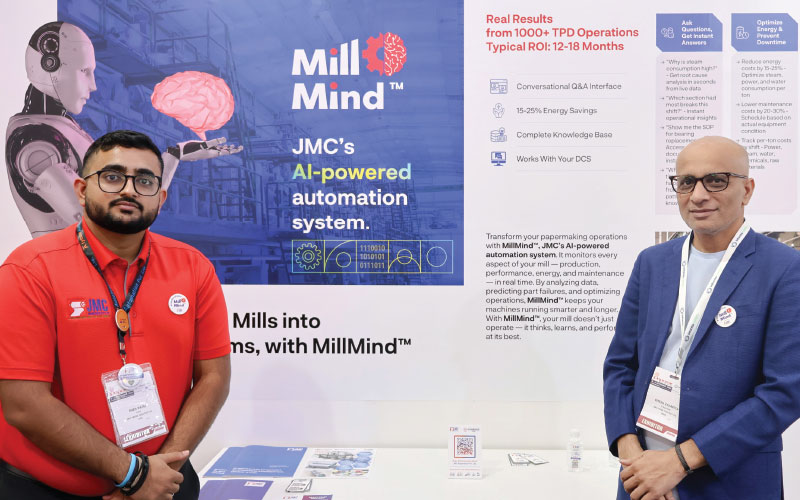
Paper Mart: To start with, please introduce MillMind.
Sneh Patel: MillMind is JMC’s innovation in mill intelligence, developed to give mill owners, operators, and maintenance teams complete visibility into their operations. The platform brings together day-to-day production data, costs, expenses, and analytics into a single, easy-to-use system. It is designed as a continuously evolving solution that grows as more customer insights are incorporated, making mill performance easier to monitor and understand over time.

Watch: Top Paper Companies 2023
PM: What was the inspiration behind developing MillMind?
Ritesh Vajariya: At JMC, we visit a large number of mills across India and globally. During these visits, we consistently observed common challenges, daily reporting issues, lack of visibility, and difficulty in accessing actionable information. By listening closely to these pain points, we realised there was an opportunity to create a solution that not only addresses operational challenges but also helps owners visualise and understand their mill performance in a far more effective way.
PM: What kind of investment went into developing this platform?
SP: The investment was not primarily financial but intellectual. We focused first on understanding mill business processes in depth and then identifying where technology could add value. Instead of imposing technology on operations, we worked backward from real operational needs. While the product development itself took less time, the research phase required significant effort.
JMC has recently entered into a technical partnership with Kawanoe Zoki Co. Ltd., a Japan-based tissue paper machine manufacturer.
PM: How long was the development journey?
RV: The journey has been ongoing for about six months, starting around June–July 2025. Importantly, research and development will never stop. As we continue interacting with customers, new insights keep emerging, leading to additional features and improvements.
PM: Is MillMind a standard product or can it be customised?
SP: MillMind is 100% customized to customer requirements. It is not a modular, one-size-fits-all solution. No two mills are identical– automation levels, DCS availability, and operational setups vary significantly, especially in markets like India. The system is therefore built around what each mill already has and what the customer wants to achieve.
PM: What types of mills can use MillMind?
SP: MillMind is suitable for all types of mills, highly automated mills in Europe or the US, as well as mills with minimal automation in developing markets. It works alongside existing ERP and DCS systems and provides a level of operational visibility that those systems typically do not offer.
The platform brings together day-to-day production data, costs, expenses, and analytics into a single, easy-to-use system.
PM: What differentiates MillMind from existing automation solutions?
RV: MillMind does not automate or control machines. Instead, it sits on top of existing automation systems, using the data they already generate and presenting it in a more meaningful, visual, and decision-friendly way. It acts as a unifying layer that enhances understanding for owners, operators, and maintenance teams.

PM: Can you explain the main components of the software in simple terms?
RV: MillMind consists of several key components:
Chat Interface: Similar in concept to ChatGPT, this allows users to ask questions in natural language. It currently supports multiple languages, including English, Hindi, Spanish, and Japanese. Users can ask mill-specific questions such as monthly production figures, and the system generates accurate reports within seconds.
Document Q&A System: Mills can upload SOPs, manuals, and supplier documents. The system reviews these documents and allows operators and maintenance personnel to quickly retrieve specifications– such as bearings, materials of construction, or equipment details– without manually searching through files.
Cost Analytics Dashboard: Designed primarily for owners, this module provides insights into production, losses, energy consumption, raw material usage, downtime, and cost breakdowns by mill section. It enables short-term and long-term analysis to identify inefficiencies and cost overruns.
Live Mill Dashboards: For mills connected through DCS, MillMind provides real-time data and analysis for pulp mills, recycle mills, and paper machines. Owners can access live operational data from anywhere in the world, including on mobile devices.
The strongest marketing driver is visibility and cost savings. Based on early analysis, mills can achieve 18–20% cost savings after implementing MillMind.
PM: Can you tell us about the Japanese collaboration you mentioned?
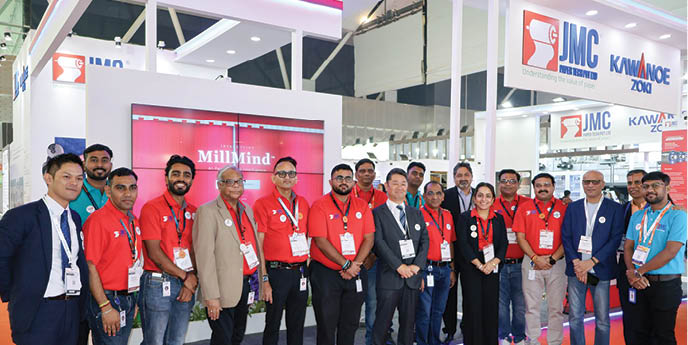
SP: JMC has recently entered into a technical partnership with Kawanoe Zoki Co. Ltd., a Japan-based tissue paper machine manufacturer. Under this collaboration, Kawanoe Zoki will supply critical components, while JMC will provide non-critical components to deliver cost-effective tissue paper machine solutions for the Indian market. Kawanoe Zoki has nearly 240 installations worldwide, and approximately 80% of tissue paper used in Japan is produced on their machines.
PM: What is the current market response to MillMind?
RV: The response has been extremely positive. Many industry professionals have stated that they have not seen a system like this before. Customers are eager to provide inputs and collaborate on further improvements. We have already received our first order from Modern Laminates Ltd., Uganda, which is a strong validation of the platform.
PM: How do you address concerns about AI errors and user training?
SP: AI operates in the background of MillMind. Users interact with the system through simple questions and dashboards. If an error is identified, users can provide feedback directly within the system, allowing continuous improvement. Initial training requirements are minimal and focus mainly on data entry and system usage during implementation.
PM: How will MillMind be marketed, and what value does it offer owners?
RV: The strongest marketing driver is visibility and cost savings. Based on early analysis, mills can achieve 18–20% cost savings after implementing MillMind. By establishing performance baselines for specific grades and operating conditions, owners can quickly identify deviations, optimise processes, and maintain consistent efficiency. The system continues to learn over time and proactively highlights areas requiring attention.

MillMind does not automate or control machines. Instead, it sits on top of existing automation systems, using the data they already generate and presenting it in a more meaningful, visual, and decision-friendly way.