
TKM Group provides the Indian paper and board industry with more than just cutting technologies; it delivers local expertise. The company’s partnership with Foresight Tech in India ensures that customers benefit from first-class cutting products and premium services. What matters more than the price, is the path to the correct knife and optimal cut in the world of paper and board converting.

For over a century, the TKM Group has been setting benchmarks in the manufacturing of industrial cutting tools, doctor blades, and saws. As a global market leader headquartered in Remscheid, Germany, the company services a diverse range of industries. Today, the TKM Group, with 13 companies and 950 employees, stands as one of the global leaders for first-class cutting tools and solutions. The TKM sales and service program covers not only first-class machine knives but also various service components along the cutting application.
A key driver of this success in India is the cooperation with its partner Foresight Tech. Through this partnership, TKM provides the Indian paper and board industry with more than just cutting technologies; it delivers local expertise. In one of the world’s most dynamic growth markets, this partnership ensures that customers benefit from first-class cutting products and premium services. Through this network, TKM and Foresight nowadays service almost all key players in the Indian paper and board industry.

Watch: Top Paper Companies 2023
The sheeter machine, and therefore the sheeter knife, is one of the most technical and challenging cutting tools in the world of cutting. If the wrong material is used, the knife set-up is incorrect, or the knife does not suit the material to be cut, this can result in higher maintenance costs, longer shutdown times, and inferior cutting results such as dust issues or customer complaints. With the right approach and focus on this tool, operational costs can be reduced and the overall success of the company can be improved. In this complex converting environment, the price of the product becomes a second or third priority. This article serves as a service guide for selecting the right cross-cutting knives and offers practical approaches for achieving an almost perfect cut.
Paths to the Optimal Cut – Decision-Making Guidelines for Cross-Cutting Knives
At the end of the paper production process, the cut determines the quality of the finished product. The cross-cutter, which trims the paper to its final format, plays a central role in this process. Achieving an optimal cut, however, requires not only high-quality knives but also the perfect coordination of all involved components and processes. With the correct use and set-up, lifetimes of several months or even up to a year without knife changes are frequently achieved. In such a high-performance environment, the product more than pays for itself.
Requirements for an Optimal Cut
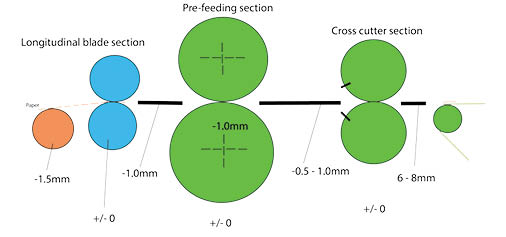
To achieve reproducible results, circular knives must be mounted in stable guides and holders. All mechanical and pneumatic components should operate without play. In particular, the cross-knife drums must be free of gear or bearing play, and all machine components, both before and after the blade section, must be correctly adjusted.
Guide plates that control the paper web should be positioned slightly below the web path, and the reference speeds before and after the pre-feed section must be optimally set. The catch station also plays an important role – it is recommended to use belts from the same manufacturer to ensure consistent results.
Blade Warm-Up and Blade In-Run Time
The so-called warm-up phase of cross-cutting knives is often underestimated. Follow the OEM recommendations or rely on your own experience. The first eight hours are the most critical period for ensuring a long lifetime and high-quality cutting results of the sheeter knife. Common TKM recommendations for the run-in time after a knife change are: a minimum of 30 minutes at 100 m/min with no material, 50% of the maximum speed for a maximum of 300 gsm for 24 hours, and full speed only after 24 hours.
After three weeks, re-adjust the knives and re-tighten the bolts. By following this simple process, a lifetime of several months is achievable.

As a general rule, the longer the warm-up time, the longer the knife‘s service life will be. Of course, no customer likes to run their machine without material; however, the more time the knives have to be properly adjusted to each other and to the material, the longer the lifetime will be in the end. Fewer knife failures, fewer knife changes, and better cutting quality are the results of this handling. It truly pays to give the knives the time they need.
Knife Material and Surface Quality
The choice of blade material and surface finish is crucial. High-quality materials and mirror-polished surfaces improve both the cutting performance and blade lifetime. While carbide knives offer excellent cutting performance and the longest life times, they are more sensitive to vibrations and shaft deflection, especially on wide machines of 2.5 to 3.5 meters. Dust accumulation can also impair surface quality over time.
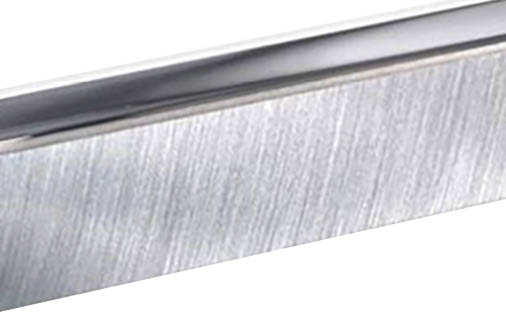
TKM recommends tungsten carbide (TC) products for board and powder steel grades (PM-steel) knives for fine paper. The better grindability and the mirror-polished surface roughness will ensure better cutting results with an almost dust-free cutting over the entire knife lifetime.
Fine Adjustment of the Knives
The setting of the cross-cutting knives is often the number one source of errors. Adjustments should only be carried out by trained personnel. Mistakes made during the setup cannot be simply corrected later on – further adjustments shorten the blade life and increase the risk of knife breakage, especially for tungsten carbide (TC) knives.
The longitudinal (slitter) knives must be optimally adjusted as well: angles, pressure, overlap, cutting position, and lead must all be precisely set to achieve the best cutting results.
Operator Skills
Regular training and refresher courses for machine operators and maintenance staff are essential. Only well-trained personnel can fully realize the high precision of the cross-cutter. TKM supports the operation with practical on-site training courses to improve cutting skills and get the best out of every TKM knife.
Paper and Board
Changes in paper formulation – such as variations in pulp content – must be communicated to operators in advance. Multi-layer cutting reaches physical limits; therefore, cutting pressure and the volume of material must always be considered. Increasing machine capacity must not compromise cut quality: blades cannot work miracles if the machine and material set the limits.
For board – whether folding cartons, binder spines, 100% recycled or virgin fiber, coated or uncoated – each type requires individual adjustment of knife selection and cutting angle. Higher cutting volumes increase compression in the cut; in such cases, a sharper blade angle is recommended.
Also Read: Paper Mart Emagazine Feb-Mar, 2026
Conclusion
The optimal cut on a cross-cutter results from precise coordination, high-quality knives, correct machine settings, and skilled personnel. Consistent quality, long blade life, and efficient production can only be achieved by carefully managing all parameters – from material selection and warm-up time to precise fine-tuning.
Choosing your partner for cutting tools is not only a matter of price and function; an in-depth understanding of the knife application is as important as the knife itself. This is what TKM and Foresight Tech stands for being a partner for the entire cutting process, today and tomorrow, to ensure the best possible cutting.