
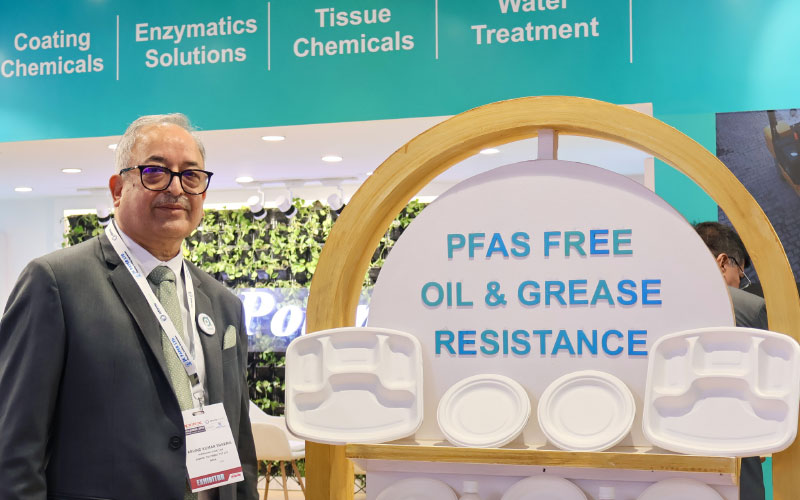
Anmol Polymers is focusing on advanced barrier coating solutions. In an exclusive interaction with Paper Mart, Mr. Arvind Kumar Sharma, Director, Anmol Polymers Pvt. Ltd., emphasized the company’s push toward PFOA/PFOS-free and PFAS-free barrier coating solutions for food-contact packaging and the pulp moulding segment. The company is developing biocides and odour-control solutions that effectively reduce VFA levels, producing smell-free paper. Going forward, Anmol Polymers aims to expand its portfolio with fluorine-free barrier coatings, dry and wet strength resins, and advanced surface sizing agents, reinforcing its commitment to high-performance paper solutions.
Paper Mart: Please tell us about your participation here at Paperex 2025.
Arvind Kumar Sharma: Our participation at Paperex, the world’s largest exhibition for the pulp and paper industry, proved to be highly impactful and encouraging. The exhibition provided an excellent platform to engage with a wide spectrum of industry stakeholders, including paper manufacturers, converters, exporters, and technology partners, both from India and overseas. We had meaningful interactions with a large number of export-oriented customers, indicating strong potential for expanding our international footprint. The interactions reinforced our product relevance and highlighted clear opportunities for business growth, product positioning, and deeper customer collaboration in both domestic and export markets.

Watch: Top Paper Companies 2023
PM: What are your latest innovations in speciality chemicals and additives catering the pulp and paper industry? Who are your key clients in the paper industry?
AKS: There has been a focused emphasis on barrier coatings – PFOA/PFOS free products & PFAS free barrier coatings which resonated well with customers seeking functional performance improvements and sustainable alternatives to Single Use Plastics (SUL) for the food contact packaging & pulp molding industry.
Additionally, we observed strong interest in biocides and odour control solutions, highlighting the growing importance of hygiene, process stability, and product quality in paper manufacturing. Our odour control solutions are specifically designed for the recycled test liner and fluting segment. Odour has emerged as a critical challenge for recycled paper mills in India, particularly due to the increasing adoption of ZLD systems. Our solutions are backed by proven case studies demonstrating effective VFA reduction and significant smell control across multiple paper mills in India.
Anmol Polymers offers a wide range of digester cooking additives designed to improve pulp yield while simultaneously reducing bleaching chemical consumption in pulp mills.
PM: How do your specialty chemicals help address the specific challenges (such as fiber degradation and odor) faced by the paper industry?
AKS: Considering the current challenges faced by the industry, particularly fiber degradation and foul odour issues, we are offering highly effective dry and wet strength aids that enable mills to produce superior-quality paper despite the inferior raw materials available in the market. In many cases, mills have even been able to replace imported fiber with locally sourced waste paper by using our dry strength technologies.
Today, Anmol Polymers is recognized as one of the leading brands in addressing odour-related challenges faced by recycled paper mills operating under Zero Liquid Discharge (ZLD) systems. Our IN-SITU ClO₂ Generation System Program, along with our range of oxidizing and non-oxidizing biocides, has helped numerous mills across India significantly reduce VFA levels and successfully produce smell-free paper, thereby enhancing both product quality and working environments.

Our retention aid and drainage programs have also played a key role in optimizing wet-end chemistry. By enhancing fines and filler retention and improving drainage, we help mills maintain a cleaner wet-end system while contributing to a reduction in TDS levels, ultimately supporting better runnability and product quality.
PM: How do your products help in pulp efficiency and improve stock preparation processes in the paper and tissue segments?
AKS: Anmol Polymers offers a wide range of digester cooking additives designed to improve pulp yield while simultaneously reducing bleaching chemical consumption in pulp mills. In cases where mills face challenges in repulping raw materials containing wet-strength resins—particularly in the tissue segment—we have successfully supported them in significantly reducing slushing time and improving operational efficiency.
Our retention aid and drainage programs have also played a key role in optimizing wet-end chemistry. By enhancing fines and filler retention and improving drainage, we help mills maintain a cleaner wet-end system while contributing to a reduction in TDS levels, ultimately supporting better runnability and product quality.
PM: The company is working on the Total Chemical Management (TCM) program for specialty chemicals. Please elaborate on how this program will help in catering the pulp and paper industry with its end-to-end solutions?
AKS: We offer a comprehensive Total Chemical Management (TCM) Program for specialty chemicals, aimed at optimizing chemical consumption while enhancing the overall production efficiency of paper machines. As part of this program, our technical team conducts a detailed system audit, studying factors such as charge demand, deposition challenges, and biological conditions. Based on these insights, we help mills optimize chemical dosages, improve retention and drainage, reduce sizing chemical consumption, and maintain required strength parameters.
Additionally, our solutions support a cleaner wet-end system and significantly help in minimizing stickies-related issues, ensuring smoother operations and better paper quality. Our Total Chemical Management solutions are designed to optimize chemical usage across pulp, sizing, and machine operations making it a complete, worry-free end to end package for all kinds of mill operations.
We offer a comprehensive Total Chemical Management (TCM) Program for specialty chemicals. With this program, we help mills optimize chemical dosages, improve retention and drainage, reduce sizing chemical consumption, and maintain required strength parameters.
PM: What is the current status of the specialty chemical market, especially in the paper industry ? How do you foresee its future?
AKS: Considering the highly competitive market environment and the challenges currently faced by the paper industry, specialty chemicals play a crucial role in enhancing efficiency and enabling mills to produce higher-value specialty grades, helping them move beyond commodity paper. By developing differentiated properties and unique performance characteristics, paper mills can target niche segments, command better pricing, and improve overall productivity—even with the deteriorating quality of available waste paper.
Specialty chemicals such as strength additives and stickies control programs hold significant potential in this context. While many mills in India are still cautious about increasing the usage of Dry Strength Resins (DSRs), global practices typically involve using 1–3% DSR to produce high-quality paper from lower-grade fiber sources.
The future of specialty chemicals in the Indian paper industry is undoubtedly promising. Manufacturers will need to continuously innovate and upgrade their technologies to successfully address the challenges posed by declining fiber quality and evolving market needs.
Also Read: Adler Paper’s Success Strategy: ‘One Container a Day’
PM: What are your future plans in the next 5-10 years? Are there any new product developments in the pipeline?
AKS: Looking ahead, our future strategy will focus on advancing fluorine-free barrier coatings, developing higher-performance dry and wet strength resins, and introducing improved surface sizing agents. A key part of our approach is to gradually shift the application of specialty chemicals from the wet end to surface sizing. This not only helps maintain a cleaner wet-end system but also supports better fiber recycling efficiency, improved paper quality, and enhanced odour control.
In alignment with the growing needs of the e-commerce and packaging industries, our innovations aim to support mills in producing stronger, sustainable, and smell-free paper, while meeting evolving market expectations for performance and environmental responsibility.
Anmol Polymers is addressing odour-related challenges faced by recycled paper mills operating under Zero Liquid Discharge (ZLD) systems. Our IN-SITU ClO₂2₂ Generation System Program, along with our range of oxidizing and non-oxidizing biocides, has helped numerous mills across India significantly reduce VFA levels and successfully produce smell-free paper, thereby enhancing both product quality and working environments.