
Elof Hansson is a global trading house with over a century of experience, connecting buyers and sellers across pulp, paper, stocklots, building materials, machinery and related industrial segments. Paper Mart interviews Mr. Mikael Forslund, CEO, Elof Hansson Group, & Mr. Per Lundström, Vice President- Machinery Division, Elof Hansson India Pvt. Ltd., on the company’s evolving role in recycling-led materials, machinery solutions and sustainable business models.
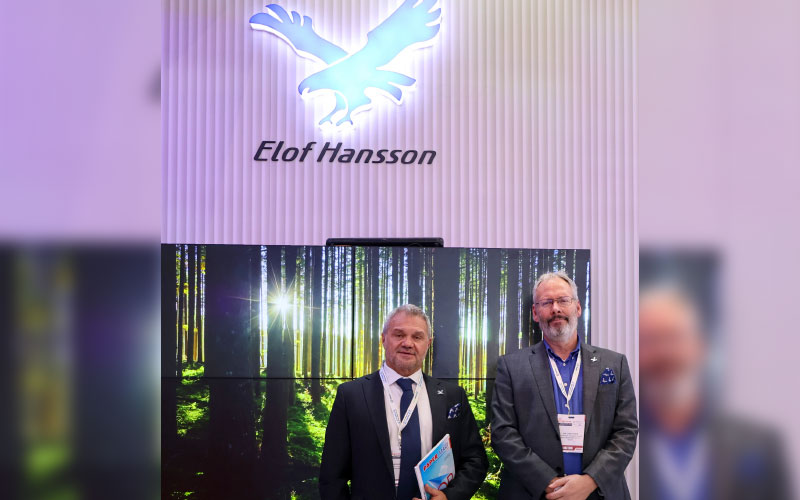
Paper Mart: Tell us what’s new at Elof Hansson.
Mikael Forslund: What is new for us is that, besides paper, board and pulp, we are also developing our machinery side. We are pioneering new areas within the industry. One area developed first was the water side, where we use machinery and technology to clean water. Later, this was extended to air as well. That is something new.
Even if the pulp and paper industry is growing, we still need to do something with recycled material. We have started building two big plants in the United States, one in California and one in Iowa, where we use recycled cartons such as milk boxes and used packaging.
These cartons include plastic, which is needed to glue them together. We do not need to add anything extra into the process, and we do not need to clean them separately, because the process works under very high pressure and high temperature. Everything is cleaned by itself, and the cartons are converted into a rigid panel material. This product can replace gypsum. We have already made a deal with one of the biggest suppliers in the United States for roofing materials, where this becomes one part of the roofing material. It can also be used for ceilings indoors, roofs, door blades and similar applications. This is something that is selling now.
We have contracts in Europe and are investigating the possibility of doing this in India. That will come in due course.
Another area we are looking at is what we call paper shell. These are sheets made from cellulose fibre, including hemicellulose. This is done under extremely high pressure, a couple of hundred bars. You can form it into many shapes, including roofing blades, electronics components, and composites for cars.
Car manufacturers are interested because you can integrate small instruments into the material, and when you remove it from the car, you can recycle it again and make something new. The same applies to roofing material. When you remove it, you can recycle it again. That is circular business.
There is a huge market in India for both the machinery and the resulting end products. We can help build the plant and also take an off-take agreement to sell the end products.

Watch: Top Paper Companies 2023
PM: You spoke at length about using recycled cartons to develop a panel material that can substitute gypsum in certain applications. Could you explain how this material is produced and where it is being used today?
MF: The advantage of this is that we do not need a big process around it. For gypsum, you need large ovens and burning. This is more friendly to nature because nothing needs to be burned. When it comes to material parameters, it is more or less the same, but it has slightly better strength regarding water. It does not absorb water as easily.
In Europe and the United States, there are regulations where raw material suppliers, such as liquid packaging producers, need to prove that they are taking care of recycled material. We are one part of that system. We can report how much recycled raw material has been used, helping them meet compliance requirements.
This is already established in Europe and the US, and we have just started the process in India. With this product, you can also do different shapes and finishes. You can add paper layers, change aesthetics, and adapt it for different applications.
PM: Sustainability and circularity seem central to these developments. From your long experience, how do you see the pulp and paper industry evolving in terms of using side streams and creating new value?
MF: I have been in the industry since 1983. Today, it is clearly a sustainable industry. We now extract side streams from pulp mill processes and make other products. For example, lignin, which binds fibres together, is taken out and used in other applications.
The car industry is interested in lignin for pressed components and substitutes. Soap is another reusable stream. As a trading house, we help connect different mills and raw material suppliers. Sometimes we do not have the final solution, but we have the right contacts to connect suppliers and customers.
PM: You briefly mentioned AI and digital tools during your speech in the inaugural session. How is Elof Hansson beginning to use AI in its operations and decision-making?
MF: We are working on AI to find systems and platforms to identify where materials can be purchased and sold and how to connect them. We are at an early stage, but we strongly believe in it. We also use AI internally while analysing and reviewing different contracts. We explore process improvements to find the best solutions.
PM: As several speakers in the inaugural session noted, the industry is going through a challenging phase where coming out of tough times calls for greater innovation and efficiency. From your perspective, how does Elof Hansson support the industry at this point?
MF: We help suppliers enter new markets. In India, we work with both customers and suppliers. Because we are present globally, we can connect Indian suppliers with markets they did not have access to earlier.
Per Lundström: We also work closely with the machinery group, helping machinery manufacturers find new solutions. The focus is on running the machines smoother, improving how the machines operate, and supporting solutions that reduce environmental impact. Through this, we help make the machinery more sustainable, not only for today, but also for the future.
Also Read: Parason Follows Philosophy of Simplicity, Transparency, and Practical Value for Customers
PM: As a global trading house with a strong presence in India, how would you describe Elof Hansson’s core role today?
MF: We buy products in our own name and sell them in our own name. We are transparent about the source of the product. Trust is central to our system. We handle compliance reporting, which is important for banks and insurance companies. We manage freight and shipping door to door through our global logistics group. We also offer financial solutions, including long-term credit to customers.
PM: At last, what message would you like to share with the Indian pulp and paper industry?
MF: Cooperation is the key. No one has all the answers. Innovation comes from cooperation between innovators, suppliers and customers.
There are many young people entering the industry with new ideas. They will do business differently. We need to listen to them and give them the means to develop ideas. India has strong universities with smart ideas. These need support to reach the market. Cooperation between different groups is the key to innovation.