
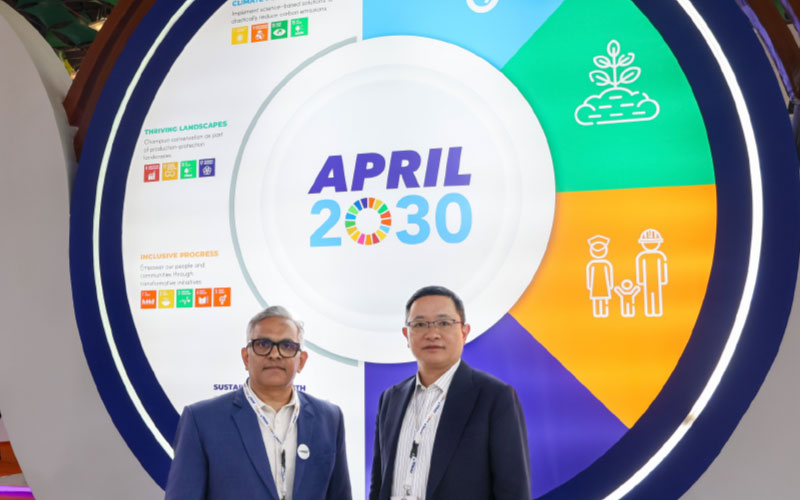
In an exclusive interaction with Paper Mart, Mr. Suneel Kulkarni, Managing Director, Pulp, Paper and Board, India and Subcontinent, APRIL Group and Mr. Wanyan Shaohua, Paper Business Head, Vice President, Commercial, APRIL Group discuss how the company is catering to niche segments in the Indian market, with a strong focus on tissue paper, sustainable packaging and speciality paper segment, including thermal paper and kraft paper, to meet evolving market demand. Looking ahead, APRIL Group aims to further grow in the tissue paper segment, guided by its QPC philosophy—ensuring cost-effectiveness, quality, and operational efficiency across all its product segments, ultimately delivering ‘value’ to its customers.
Paper Mart: APRIL Group acquired a controlling stake in Origami. What drove this strategic decision to formally enter India’s tissue paper market?
Suneel Kulkarni: The tissue paper segment in India is growing, but it is still at a relatively nascent stage of development. At the time, Origami was the only company that made strategic sense for us. While we have a very strong upstream presence through our own plantations, we were looking to strengthen our downstream capabilities with a brand that had pan-India reach. Origami not only stood out as a well-established player with nationwide presence in the tissue segment, but there was a strong alignment between Origami’s DNA and our own values and way of working, which ultimately led to the acquisition.
PM: What are the latest developments happening at APRIL Group?
SK: This year, we have significantly expanded our portfolio with a strong focus on sustainable packaging solutions. We have introduced a new grade that is specifically designed for the cups, plates, and disposable applications, offering a greener alternative to plastic. In addition, we have developed specialty paper grades, including thermal paper and kraft paper. With a growing shift from plastic to paper-based packaging, these products are well aligned with evolving market preferences and sustainability goals.

Watch: Top Paper Companies 2023
PM: How do you see the packaging segment evolving over the years? How do you plan to meet these demands?
SK: Packaging is currently an oversupplied market segment, and we anticipate its consolidation in the coming years. Over the next five years, we expect significant churn, with inefficient players gradually exiting the industry. In anticipation of this, we have focused on investing in state-of-the-art, high-capacity machines that deliver consistently high-quality packaging products. Our objective is to build capacity with efficiency, enabling us to offer comprehensive value to our customers, providing ‘the right product, of right quality, at the right price’.
PM: What are your current capacities for the paper and paperboard segment?
Wanyan Shaohua: We have a total production capacity of approximately 3 million TPA, for each paper and paperboard, across the group. We manufacture both fine paper and packaging grades, with operations spread across multiple countries. Our primary production bases are in China and Indonesia, which is the backbone of our global manufacturing footprint.

We operate on a core philosophy we call QPC-Quality, Productivity, and Cost, serving customers in over 100 countries.
PM: The paper industry is highly competitive. What are your key differentiators that help you stay ahead of competition and sustain growth?
SK: We operate on a core philosophy ‘QPC’— that is—Quality, Productivity, and Cost. Cost competitiveness comes from our operational efficiency and scale, but that alone is not enough. We need to ensure quality and efficiency (productivity) that translates into value for our customers or buyers. Our products deliver superior quality and enable better productivity during manufacturing and converting processes, resulting in long-standing relationships with our customers that span many years. They keep coming back to us and today, we serve customers in over 100 countries, which reflects the level of trust, consistency, and commitment we bring to the market.
PM: What are the challenges and the opportunities that you see in the paper industry?
WS: From a global perspective, one of the key challenges is on the demand side. In many markets, particularly in Europe and the US, demand for writing and printing paper is declining. While India continues to see growth, the industry is globally required to rationalise capacity year-on- year to align with weakening demand in these mature markets.
The second major challenge is increasing competition for land. Paper, paperboard, tissue paper , and several other paper grades require plantation which has intensified pressure on land availability. In countries such as Brazil where land is used for multiple purposes such as soybean cultivation, cattle farming or rearing, and other agricultural activities, land costs have risen sharply over the past few years, posing a challenge for the entire industry.
On the opportunity side, the demand for the hygiene related products like tissue paper, are witnessing a rising demand, not just in India but globally, driven by growing health and hygiene awareness. Similarly, high-end and specialty packaging grades are witnessing robust growth. However, the success of these segments depends on offering the right product having the right quality to meet evolving customer demands.
Sustainability is another long-term opportunity that is emerging in the paper industry in general. This is not something that needs to be forced on consumers. The next generation naturally prefers greener, recyclable solutions. Products derived from papers are biodegradable and return to the natural environment far more easily and efficiently than plastics, which makes paper-based alternatives increasingly attractive.
Finally, integration will be a key differentiator going forward. Companies with a strong upstream presence, including access to plantations and pulp, will be better positioned to manage costs and ensure supply security. In contrast, non-integrated players that depend on external sourcing of wood or pulp may face increasing challenges over the long term.
We aim to complement the domestic industry, and are not here to distort pricing or impact the profitability of local mills.
PM: What is your long-term strategy for the Indian market and how do you plan to meet the growing demands in the paper and paperboard segments?
SK: From an Indian perspective, our approach is rational and balanced. We are not here to dump products in the Indian market or disrupt the local ecosystem. India already has a vast number of producers delivering good-quality paper products, and we respect that. Our intention is to play a niche, gap-filling role, serving customers as a quality-focused partner. We aim to complement the domestic industry, and are not here to distort pricing or impact the profitability of local mills.
WS: More broadly, as the economy grows and the per capita incomes rise, the demand for paper, tissue paper, and paperboard products, that are closely linked to everyday life, will continue to increase. Based on our experience in other markets for the past two decades, we have concluded that economic development naturally leads to an upgrade in consumption, with customers seeking higher-quality products.
Our objective is to lead this shift by delivering quality products and services to our customers. While some players may attempt to gain short-term benefits by cutting costs and downgrading quality, we do not see that as a sustainable strategy. To build a strong, long-term business and brand, the focus must remain on delivering better products and service, and that is the path we intend to follow.
PM: Sustainability is nowadays a very critical aspect for every industry. How do you ensure sustainability in papermaking?
WS: As mentioned earlier, our entire plant model is sustainable. We develop plantations in Indonesia and Brazil, which are then converted into pulp and subsequently into paper and paperboard. This integrated approach ensures that sustainability is embedded across the entire value chain.
In addition, all plantation development strictly adheres to international standards. Our group follows a ‘one-to-one’ policy, under which, for every hectare of plantation developed, we protect one hectare of natural forest, in a manner best suited to the ecosystem. As a result, in Indonesia alone, out of approximately one million hectares under our management, nearly half is dedicated to plantations, while the remaining half is preserved as protected conservation land.
We have a total production capacity of approximately 3 million TPA, each of paper and paperboard, across the group. We manufacture both fine paper and packaging grades, with operations spread across multiple countries.
PM: How do you leverage your captive energy to meet the energy requirement of your mill? Are you investing in renewable energy as well?
SK: Our manufacturing complex is highly integrated, encompassing pulp, paper, and paperboard production. A significant portion of our energy requirement is met internally through our pulp operations. During the pulp production process, organic by-products derived from wood are combusted in a recovery boiler to produce energy. Today, the pulp line is capable of generating up to 150% of the energy required for its own operations, creating surplus power. In several of our global operations, including our pulp mill in Brazil, this excess electricity is supplied/ sold to the grid.
The paper and paperboard mills consume the electricity and steam generated by the pulp line. Although this significantly reduces dependence on external energy sources, it does not fully cover total demand. Approximately 30% of our energy requirement is still met through conventional boilers.
In addition, we have invested in renewable energy, with 26 MW of installed solar power capacity at the mill. We plan to nearly double this capacity to around 50 MW by the end of next year, further strengthening our transition toward cleaner and more sustainable energy sources.
PM: What is your Vision for 2030?
WS: Our 2030 roadmap is fundamentally centred on sustainability. It is closely aligned with the United Nations’ framework for social and progressive development, which spans multiple focus areas. From this framework, we have identified and adopted the elements that are most relevant to our industry.
We formally launched our 2030 Sustainability Goals in 2020, during the COVID period. We were probably one of the few and the earliest Asian companies in our sector to do so. These goals are structured around four key pillars- environment, social development and inclusive progress, climate change, and recyclability.
Each pillar is supported by clearly defined KPIs that are embedded into our annual operational and management targets. Progress of these KPIs is independently audited every year by KPMG, ensuring transparency and accountability. Our latest audited progress report for 2025 is publicly available on our website.
This framework serves as a long-term guide, allowing us to not just define and track our sustainability goals that are relevant for business, and are reviewed year after year, but also reflects our social commitment; for instance, the number of female employees representation in the leadership and factory roles in markets promoting gender parity. However, such goals are quite comprehensive and not easy to apprehend, especially in countries like India and Indonesia.
Sustainability also goes beyond climate change, it also encompasses social responsibility and recyclability. For instance, 99.8% of the chemicals used in our manufacturing facilities are recyclable, and sustainable, reinforcing our commitment to responsible production. Overall, our sustainability agenda is deeply integrated into how we operate our business.
PM: What are your future plans?
SK: We will continue to expand into the tissue paper segment which is one of the key areas. This is where we see strong growth potential and will continue to invest, in contrast to writing and printing paper and paperboard that are currently facing overcapacity across the industry.
The focus is not just on adding capacity, but also on the manner of production. We will focus on our ‘QPC’ philosophy, delivering the right quality products at a more competitive cost. This will aid us to serve our customers better and remain competitive even in an oversupplied/overburdened market.
Integration will be a key differentiator going forward. Companies with a strong upstream presence, including access to plantations and pulp, will be better positioned to manage costs and ensure supply security.