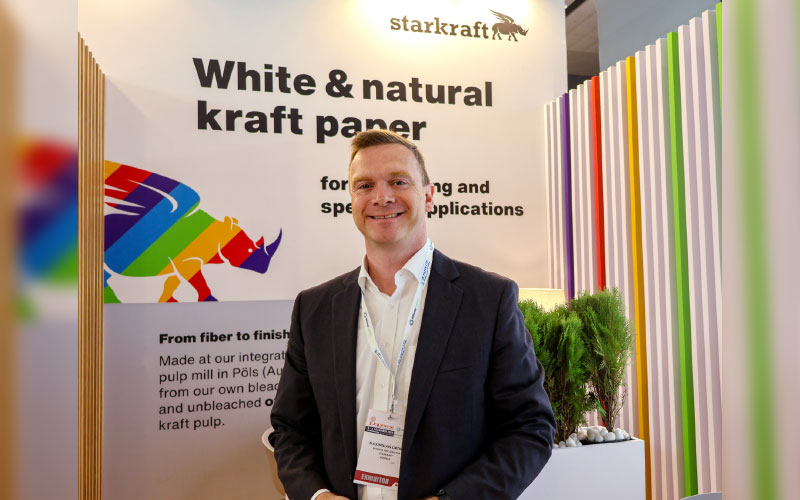
Starkraft is a European paper manufacturer and part of the Heinzel Group, supplying specialty papers with a strong focus on sustainability. Paper Mart interviews Mr. Maximilian Ortner, Business Unit Director, Starkraft, on the commissioning of a new paper machine, its evolving MG–MF paper portfolio, and opportunities in flexible packaging as markets transition towards forest-based materials. The discussion also covers sustainability, regulatory and consumer drivers, India’s strategic importance, and Starkraft’s approach to long-term partnerships.
Paper Mart: To start with, what’s new at Starkraft?
Maximilian Ortner: We are operating in a very dynamic environment compared to last year. What is new for Starkraft is that we have successfully introduced our new paper machine, PM6, to the market. Historically, we operated with two machines, and in May 2024 we launched PM6.
Since then, we have acquired new customers and are pleased with how the machine is performing. We have established good partnerships and are serving these customers. We have a loyal customer base, and this is what we are looking for. It has been a challenging year, but overall we have done okay and have done a good job bringing new products into the market.
PM: How has PM6 expanded your product mix, particularly in terms of MG and MF paper grades and grammage range?
MO: Traditionally, we have been manufacturing MG paper. With PM6, we are also addressing MF paper. However, our paper sits somewhere between MG and MF and is closer to MG, which we see as a key advantage.
PM6 paper is not a standard MF grade. It has properties closer to MG, positioning it slightly higher than standard MF. We produce papers in natural, meaning unbleached, as well as in white-bleached grades. In terms of grammage, we cover a range from 20 to 100 GSM, and in some cases even higher.

Watch: Top Paper Companies 2023
PM: Flexible packaging and the shift from fossil-based to forest-based materials featured strongly in your remarks. How do you see this transition playing out, especially in the Indian market?
MO: Flexible packaging is one of the growing segments. As an industry, we are transitioning from fossil-based materials to forest-based materials. This is a global trend, and we see it clearly in India as well.
There is a lot of innovation happening in India, with new partners bringing ideas on how to add value. Our focus is on supplying base paper to partners who add value and then deliver to the final customer. This is Starkraft’s strategy.
We see more opportunities and partnerships emerging in India. Compared to the last show, there has been a visible increase in activity related to value addition, bio-based materials and bio-based coatings. This reflects the speed and innovation of the Indian market.
What is also interesting is that products developed in India do not remain limited to the domestic market. These coatings and materials are also supplied to large global brand owners, who are learning from India. The speed of the market is strong.
PM: From a cost and performance standpoint, how close are paper-based alternatives today to competing with conventional materials?
MO: We are reaching a point where performance and price are at a level where paper-based solutions make sense. This has improved significantly over the past few years, and our partners are getting there. Finished products can now be competitive.
At the same time, there will always be applications where plastic-based packaging remains relevant. It is unrealistic to assume that all plastic packaging will be replaced. There is space for both materials, and this needs to be respected.
However, many applications are transitioning, and the end consumer is driving this change. Consumers prefer paper-based packaging when given a choice. This aligns with the broader trend, and more global brands are moving in this direction where it is economically feasible.
PM: How do regulation, sustainability requirements and consumer preferences together influence the pace of this transition?
MO: There are increasing regulatory requirements that the industry must navigate, and pressure is rising. Regulations will play a supportive role, but ultimately, the consumer will drive the industry.
Consumers are demanding more sustainable products that are not fossil-based. This trend is already visible and is unstoppable. Regulations will support this movement, but the consumer is clearly in the driver’s seat.
PM: Could you outline Starkraft’s market share, installed capacity and how trends such as downgauging are influencing your grade mix?
MO: We do not disclose market share. Our total installed capacity is 330,000 tonnes. When we look at average basis weights today, there is a clear trend towards downgauging, with lower grammages becoming more common.
Our installed capacity covers grades from 20 to 100 GSM, in both unbleached and white-bleached papers.
PM: India seems central to your long-term outlook. How important is the Indian market in Starkraft’s strategy, and what kind of partnerships are you looking to build here?
MO: India is a very dynamic market and is performing strongly in terms of GDP growth. It is clearly a market where one has to be present.
We are focused on building long-term partnerships. Starkraft is part of the Heinzel Group, a family-owned business, and we operate with that philosophy. We value relationships and are here for the long term.
Our focus is on service, quality and delivery, with sustainability as an additional core pillar. We are not interested in short-term, transactional business. We have found partners who fit well with us, and we expect to build on this foundation. We believe 2026 will be more successful than 2025.
PM: How is sustainability embedded within your organisation?
MO: Sebastian Heinzel, CEO of the Heinzel Group, has placed sustainability at the core of the business. Every business decision is evaluated through a sustainability lens. Our philosophy is that green is the new default.
Every CapEx project undergoes a sustainability vetting process. Starkraft operates as an integrated paper mill, with a strong footprint in terms of energy use. Around 98 percent of our energy is non-fossil-based, which is a very high standard.
We are investing further in new technologies to eliminate fossil fuels entirely over the coming years. Our pulp mill is directly integrated with the paper machine, allowing pulp to be transferred in liquid form, which improves efficiency.
Also Read: Gayatrishakti Tissue Introduces 9 GSM Tissue Paper; Plans to Set Up New Tissue Paper Machine in Vapi
PM: How does energy set-up support your sustainability goals?
MO: Most of the energy we use is generated within the pulp mill itself. Power and steam are produced from the pulp manufacturing process, which is inherent to our integrated set-up.
PM: Finally, how does Starkraft plan to support the evolving needs of Indian customers, particularly where specialised solutions or additional R&D may be required?
MO: We are ready to support India’s growth. During the show (Paperex 2025), we had several discussions, and most customer requirements can be met with our existing portfolio.
In some cases, customers require specialised solutions, and this may involve additional R&D. We are prepared to do that. We do not claim to cover every application, but where a customer needs a specific solution, we are willing to develop it together.