Pakka is investing INR 750 crore in Project Jagriti in India and INR 3,000 crore in Project Kawok in Central America. In an exclusive interaction with Paper Mart, Mr. Ved Krishna, Managing Director, Pakka Limited, shared that the company is scaling up its food packaging segment, focusing on flexible packaging and expanding its bagasse-based, value-added products. In the coming months, the company will also introduce delivery and takeaway containers, further accelerating the shift toward compostable solutions. Looking ahead, the company plans to invest in R&D to develop innovative, commercially viable solutions, reimagining the future of the packaging segment.
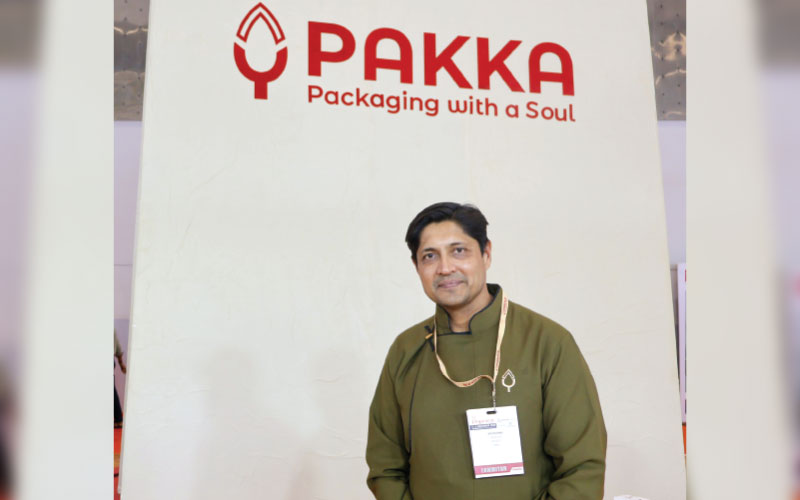
Paper Mart: What are the latest developments and innovations happening in your company?
Ved Krishna: Our focus is on transforming the food packaging space by shifting toward compostable and more earth-friendly materials. One of the key focus areas has been flexible packaging, for instance, multi-layered products used for packaging potato chips, chocolates, and crackers. We are working to evolve these solutions that are commercially available, developing and re-imagining it for the future.
In addition to it, we are coming with major launches over the next couple of months. We are launching delivery and takeaway containers, which will significantly accelerate the shift toward compostable solutions. In parallel, we are also expanding our portfolio of food packaging materials. Our responsibility is to ensure that our products perform consistently and deliver clear value to the customer. If we fail to do that, challenges inevitably arise, and if we succeed, the opportunities in the segment will continue to expand.

Watch: Top Paper Companies 2023
PM: You have announced two projects-Project Jagriti and Project Kawok. Can you tell us about these projects in detail?
VK: We are currently developing two major projects focused on flexible packaging solutions. In India, we are setting up a 40,000-tonne facility under Project Jagriti with an investment of approximately INR 750 crore, scheduled for commissioning around June this year. Alongside this, we are coming up with Project Kawok in Central America. The 150,000-tonne Guatemala facility comprises an investment of about INR 3,000 crore. The first phase of the Guatemala facility is expected to be commissioned toward the end of this year, around October–November, with the subsequent phase coming on board approximately a year later.
PM: Which machine manufacturers have you partnered with for your ongoing projects?
VK: Our main machinery supplier is Allimand, a French company known for its specialization in the products and processes. They are a highly focused technology provider for specialized applications. While there were several competing suppliers, we chose Allimand as our primary machinery partner as our equipment supports their core machine, and we work closely with Allimand to co-develop products and processes with them.
We are coming with major launches over the next couple of months. We are launching delivery and takeaway containers, which will significantly accelerate the shift toward compostable solutions. In parallel, we are also expanding our portfolio of food packaging materials.
PM: How do you see the current market scenario in the paper industry?
VK: It is undoubtedly a challenging time right now, but the essence of entrepreneurship is that you cannot blame anyone else. Ultimately, we decide what products we make, the costs at which we manufacture them, and how effectively we serve our customers. As packers, we consciously avoid blaming market conditions. We believe that the onus lies with us: what we create, sell and the quality of products we bring to market, all of this is within our control. We believe in taking responsibility rather than blaming the market.
PM: How do you view the distinction between biodegradable and compostable materials, and how important is sustainability in driving customer adoption?
VK: Compostable and biodegradable materials are closely related. All compostable materials are biodegradable, but not all biodegradable materials are compostable. Biodegradation simply means that microbes break the material down, whereas compostability implies that it breaks down in a way that is beneficial and converts into compost. However, our role is not to preach this distinction to the customer. Our primary responsibility is to create value. If we deliver a better-performing product with clear value, customers will naturally adopt it. Expecting adoption of products purely because it is more sustainably produced does not work in practice. It is always about creating meaningful value for the customers.
The first phase of the Guatemala facility is expected to be commissioned toward the end of this year, around October–November, with the subsequent phase coming on board approximately a year later.
PM: How do you ensure quality products amid price competitiveness in the market?
VK: Quality is a non-negotiable asset for us. Regardless of pricing pressure or even short-term losses, we would never compromise on quality because we believe it delivers long-term value. It is our responsibility as a company and team to deliver high-quality products. While volatility is a reality in the current market, our position in a specialised segment differentiates us from commodity players, resulting in relatively lower volatility. We also work with long-term customer arrangements with many of our customers contracts lasting a year without break—which further protects us from market fluctuations. As reflected in our financials, our performance has remained fairly stable over the years, and our future plans are pretty clear.
Also Read: Premiumisation over Volume: Star Paper’s Strategy for a Changing Kraft Market
PM: What are your future plans for the next 5-10 years?
VK: Our objective is to transform the food packaging and food service space, and we believe scale is the only way to achieve that. We are scaling through multiple approaches. One is by expanding what we know, that is, using sugarcane residue, or bagasse to manufacture value-added products. At the same time, we are pursuing an asset-light strategy. We source our facilities for both paper-based and molded fiber products, selectively to other producers and thereby broadening our product grades.
We also invest in R&D and innovation. Our focus is on different product disciplines and processes to evolve new solutions and bring further growth. Our ambition is bold: to grow nearly 20x over the next four to five years. It is a big, audacious goal, and our journey will define how far we go in this direction.
Our focus is on transforming the food packaging space by shifting toward compostable and more earth-friendly materials.