

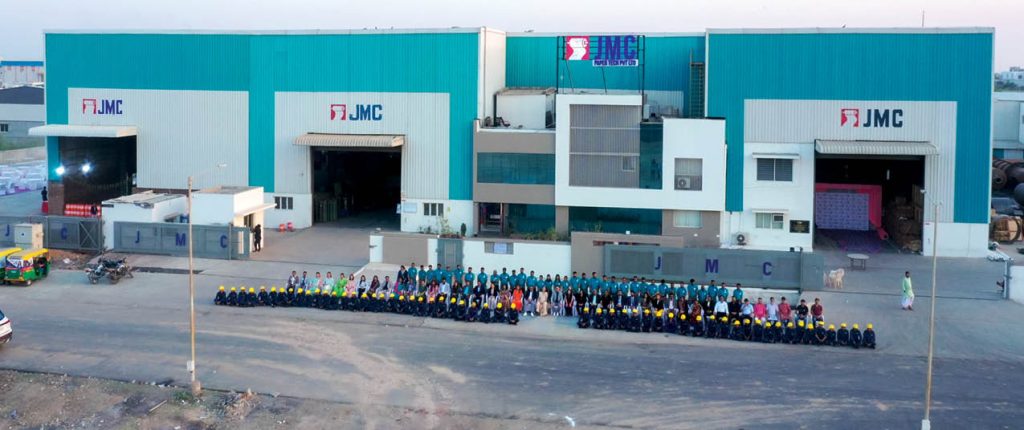
In an exclusive interview with Paper Mart, Mr. Sneh Patel, Chief Operating Officer, JMC Paper Tech Private Limited, explains the shift in modern paper mills from reactive control towards predictive and coordinated process control. He highlights the growing integration of DCS, QCS, PLCs, APC, MPC, drives, AI, machine learning, and smart instrumentation to understand the relationship between multiple variables and reduce process variability. Mr. Patel also discusses JMC’s vision of creating a digital intelligence layer through MillMind™, where AI supports operators, engineers, and management in moving from automation and integration towards prediction and optimisation, with greater process stability and reduced variability at the core of performance improvement.

Paper Mart: Where does process variability remain most persistent in paper manufacturing today, and how does it affect quality and operating performance?
Sneh Patel: Process variability remains one of the biggest challenges in papermaking because the process involves continuously changing raw materials, water systems, mechanical conditions, chemistry, steam, vacuum, speed, and operator interventions.
In our experience, the most persistent variability starts in the stock preparation and the approach-flow system. Changes in furnish composition, recycled-fibre quality, consistency, freeness, ash content, temperature, pH, chemical dosage, and refining directly influence machine performance.
On the paper machine, variability occurs across several critical areas include headbox consistency and pressure, basis-weight profile, forming and drainage, vacuum, press loading, moisture entering the dryer section, steam pressure, condensate removal, dryer temperature, size-press operation, moisture profile, caliper, reel tension, and machine speed.
For recycled-fibre mills, furnish variability is particularly important because every incoming batch can behave differently.
Tighter stability and control of stock consistency, basis weight, moisture, steam and condensate, refining, vacuum and machine speed can deliver measurable improvements in production, fibre and energy consumption, paper quality, machine runnability, and reduction in sheet breaks.
The objective should therefore not simply be to operate the machine faster. The objective should be to operate it steadily at the optimum operating point.
[bsa_pro_ad_space id=16]
Watch: Top Paper Companies 2023
PM: How has the approach to controlling process variability changed in recent years?
SP: Traditionally, paper mills depended heavily on operator experience and conventional feedback control. When a parameter deviated, the operator would observe the change, identify the probable cause, and then make a correction. Modern mills are moving from this reactive approach toward predictive and coordinated process control.
DCS and QCS remain fundamental, but mills are increasingly integrating information from PLCs, drives, QCS, laboratory systems, energy meters, vibration monitoring, and production databases. The important change is that we can now examine the relationship between multiple variables rather than controlling each parameter independently.
For example, a moisture deviation may not simply be a dryer-steam problem. It can originate from furnish consistency, drainage, press dryness, vacuum, machine speed, or steam/condensate performance.
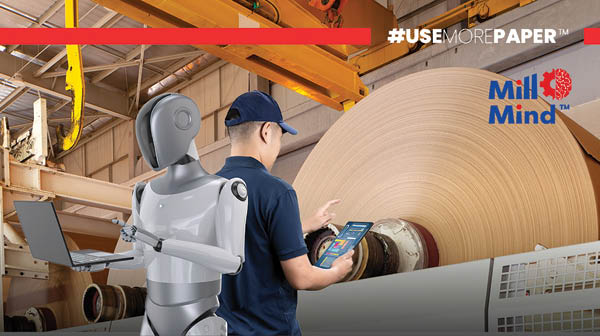
At JMC, we see the next stage as creating a digital intelligence layer over the existing automation infrastructure. This is also the philosophy behind MillMind™—bringing operating, production, consumption, quality, and equipment information together so that management and operating teams can obtain useful insights from data rather than looking at isolated numbers.
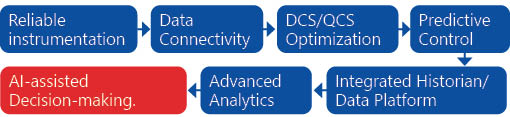
The future is therefore moving from automation → integration → prediction → optimisation.
PM: How are Advanced Process Control and Model Predictive Control being applied to reduce process variability?
SP: Advanced Process Control (APC) and Model Predictive Control (MPC) are particularly valuable in papermaking because many variables interact with one another and because there are significant process delays. Traditional PID control generally reacts to an individual deviation. MPC can consider several process variables simultaneously, understand their interactions, and calculate corrective actions while respecting operating constraints.
Potential applications include basis-weight control, moisture control, stock consistency, refining, steam and condensate optimisation, dryer control, approach-flow stability, broken management, and energy optimisation.
For example, instead of waiting for final-sheet moisture to move outside its target, an advanced control system can consider machine speed, press-section moisture, steam pressure, dryer differential pressure and other variables, and adjust the process proactively.
The greatest benefit is often not simply a higher average production rate. It is the reduction in standard deviation around the target. When variability decreases, mills can operate closer to their quality and process limits without increasing the risk of off-spec production. This can result in higher production, reduced fibre usage, lower steam consumption, and fewer breaks.
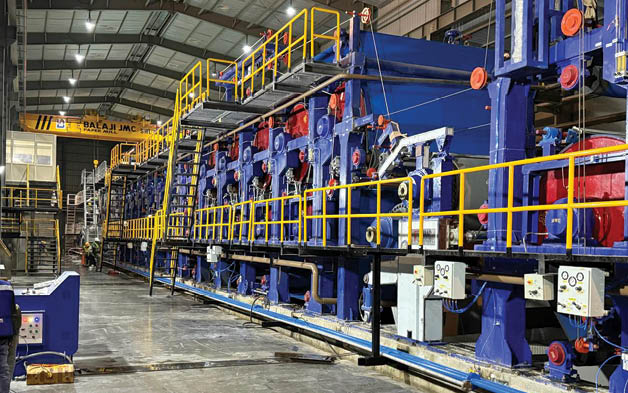
Automation has significantly improved consistency in important paper-quality parameters such as GSM/basis weight, moisture, caliper, formation, strength, Cobb, RCT, burst, tensile and reel quality. However, the greatest improvement occurs when quality information is connected with process information.
PM: What practical role are AI and machine learning playing in predicting and correcting process deviations?
SP: AI and machine learning are becoming practical tools for identifying patterns that conventional control systems may not recognise easily.
A paper machine generates enormous amounts of data every day. Historically, much of this data has been stored but not fully utilised. AI can analyse relationships between hundreds of parameters and identify patterns that occurred before a sheet break, quality deviation, excessive steam consumption, abnormal vibration, loss of drainage, poor formation, or other operating problem.
The real value of AI, is therefore not merely generating reports after an event, but providing early warning before the deviation becomes a production problem.
At JMC, through our work with MillMind™, our philosophy is that AI should support operators, engineers and management rather than replace their experience. For example, instead of an engineer manually searching historical trends, an intelligent system should eventually be able to answer questions such as: What changed before the last five sheet breaks? Why has steam consumption increased? Which parameters correlate with lower RCT? What operating conditions produced our best-quality reel?
This is where AI becomes genuinely useful for the mill.
PM: How are online measurement, smart instrumentation, machine vision, and QCS improving real-time detection and control?
SP: You cannot effectively control what you cannot reliably measure.
Modern QCS and smart instrumentation provide continuous information on basis weight, moisture, caliper, ash, temperature, pressure, flow, consistency, vibration, steam, condensate, vacuum, and energy consumption. Machine vision is also becoming increasingly valuable. High-speed cameras can help identify sheet breaks, edge problems, wrinkles, defects, contamination, and abnormal web behavior that are difficult for operators to continuously observe.
However, one of the biggest problems we still see is not necessarily the absence of automation, but measurement quality. A sophisticated control algorithm cannot compensate for an incorrectly calibrated consistency transmitter, unreliable flowmeter, damaged pressure transmitter, or poor-quality laboratory data.
Therefore, before investing heavily in AI or advanced controls, mills should ensure that critical instrumentation is properly selected, installed, calibrated, and maintained.
Our approach is simple: first create trustworthy data, then integrate it, and finally apply intelligence to it.

Ultimately, the future paper mill will not simply be more automated. It will be more connected, more predictive and more self-optimising, while keeping experienced operators and process engineers at the centre of decision-making.
PM: How are newer drive and motion-control technologies helping mills reduce variability?
SP: Modern sectional drive systems have significantly improved paper-machine stability.
A paper machine contains multiple mechanically connected but independently controlled sections. Small speed differences between the forming, press, dryer, size press, calendar and reel sections can create tension variations, wrinkles, sheet instability, and breaks.
Modern AC drives, vector control, high-resolution feedback, synchronised control architecture and faster PLC communication allow much tighter coordination between machine sections. Advanced systems can maintain accurate speed ratios, draw, and web tension while responding rapidly to acceleration, deceleration and process disturbances.
This becomes increasingly important as machine speed increases because the tolerance for synchronisation error becomes smaller.
Drive-system health should also become part of predictive maintenance. Motor current, torque, speed error, bearing temperature, and vibration can provide early indications of mechanical or process abnormalities.
Therefore, the drive system should no longer be viewed only as a means of rotating equipment; it is an important source of process information and machine-health data.
PM: How are automation, advanced control, and integrated process data helping mills achieve more consistent paper quality?
SP: Automation has significantly improved consistency in important paper-quality parameters such as GSM/basis weight, moisture, caliper, formation, strength, Cobb, RCT, burst, tensile and reel quality. However, the greatest improvement occurs when quality information is connected with process information. For example, if RCT decreases, looking only at the laboratory result tells us what happened, but not why.
When quality data is integrated with furnish composition, refining, consistency, basis weight, moisture, press loading, steam conditions and chemical dosage, the mill can start identifying the process conditions responsible for that result. This allows mills to move from quality inspection to quality prediction.
The long-term objective should be to establish a digital operating window for every grade: the combination of process parameters that repeatedly produces the desired quality at the lowest practical fiber, chemical, steam, and electrical consumption. That can become a powerful competitive advantage.
PM: As control systems become more intelligent, how is the operator’s role changing?
SP: The operator’s role is becoming more important, but different.
In traditional mills, operators spend considerable time watching individual parameters and manually correcting deviations. As automation becomes more intelligent, routine adjustments can increasingly be handled automatically. This allows operators to concentrate on process supervision, abnormal-condition management, optimisation, and decision-making.
However, automation should not become a black box. Operators need to understand why the system is recommending or making a particular change. Therefore, future operator interfaces should provide not only alarms, but also context and possible causes.
The best result comes from combining experienced operators with intelligent digital systems. AI has tremendous analytical capability, while experienced papermakers possess practical process knowledge developed over years. Combining the two creates a much stronger operating environment than either one working independently.
PM: What typically prevents a mill from achieving the full benefits of advanced automation?
SP: The biggest limitation is often not technology itself.
Common barriers include legacy PLC/DCS systems, disconnected databases, poor instrumentation, inconsistent tag naming, unreliable sensors, insufficient historical data, manual laboratory records, weak network infrastructure, and lack of integration between production, quality, and maintenance systems.
Another major issue is organisational. Production, electrical, instrumentation, quality, maintenance, and management teams sometimes operate with separate information systems. The result is multiple versions of the same operating reality.
Workforce capability and acceptance are equally important. If operators believe that automation or AI is being introduced to replace them, adoption becomes difficult. They should instead be involved from the beginning and shown how technology can make their jobs easier and decisions better.
Cybersecurity and data security must also be considered as connectivity increases.
For many mills, therefore, the correct first investment is not necessarily the most sophisticated AI platform. It may be better instrumentation, standardised data, connectivity, and system integration.
Also Read: Paper Mart Emagazine Aug-Sep, 2026
PM: Can you share a recent implementation that measurably reduced variability or improved quality consistency? Where should mills prioritise investment next?
SP: At JMC, our practical approach is strongly influenced by operating experience from paper-machine projects and by implementing digital solutions in a real mill environment.
One important learning has been that meaningful improvement comes from connecting production, quality, consumption, and equipment information rather than treating them as independent systems. This philosophy has contributed to the development and implementation of MillMind™, which is designed as an intelligence and information layer around mill operations. Instead of replacing existing PLC, DCS or QCS infrastructure, the objective is to extract more value from the data that mills already generate.
For future investment, we believe mills should prioritise in the following sequence:
The industry should also focus increasingly on measuring success through variability, not only averages. Two machines may both average the same GSM, moisture, or production, but the machine with the smaller standard deviation will generally have better quality consistency, lower waste and greater opportunity for optimisation.
Ultimately, the future paper mill will not simply be more automated. It will be more connected, more predictive and more self-optimising, while keeping experienced operators and process engineers at the centre of decision-making.