

In an exclusive interview with Paper Mart, Mr. Ganesh Balakrishna Bhadti, Executive Director (Operations & Projects), Seshasayee Paper and Boards Limited, shares that the transition from traditional PID-based control to integrated and autonomous control is reshaping process stability across paper mills. Today, the integration of DCS, APC, QCS, online analysers and AI-based predictive analytics is enabling mills to respond more proactively to process variations. At Seshasayee Paper and Boards, APC implementation in the pulp mill has helped minimise bleaching cost, brightness variation and optimise bleach chemical demand, while AI is being implemented for online monitoring of steam trap controls.

Paper Mart: Process variability remains a central challenge in integrated paper manufacturing. Where does variability remain most persistent today, how does it impact quality and performance, and which specific process stages or parameters offer the greatest measurable gains when stabilised?
Ganesh Bhadti: In an integrated mill, variability compounds non-linearly across the value chain, significantly impacting quality, quantity, and bottom-line costs, depending on input availability and price. For example, an uncorrected 1.5 Kappa unit variation from the digester translates into a 10–15% shift in bleaching chemical demand, wet-end charge instability, and a 3–5% increase in web breaks on the paper machine hours later.
Variability can originate from raw materials, equipment, operations, operating crews and operating systems. However, the criticality and impact of these variables are evident in the pulp mill and stock preparation areas, which eventually influence machine runnability, cost and quality.
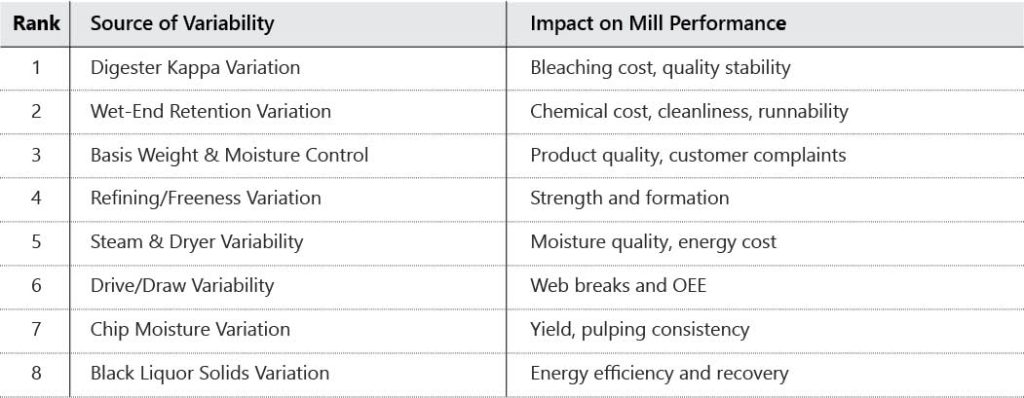
Based on operational metrics across integrated facilities, variability remains most persistent across eight primary zones:
The largest contributors to mill-wide variability are raw material variation, particularly chip moisture, digester Kappa variability, refining consistency, wet-end chemistry stability, basis weight and moisture control, and dryer/drive stability. Among these, Kappa number control, wet-end retention, basis weight/moisture control, and chip moisture stabilisation typically provide the highest measurable economic gains because their effects cascade through the entire integrated mill process.
Stabilising these parameters delivers immediate gains, including better machine runnability, fewer web breaks, and optimised chemical consumption.
[bsa_pro_ad_space id=16]
Watch: Top Paper Companies 2023
PM: How has the approach to controlling process variability changed in recent years? How are mills moving beyond conventional automation and feedback control to achieve greater stability?
GB: The transition from traditional single-loop PID control to integrated autonomous control has fundamentally changed the way we approach process stability and key performance benchmarks. Historically, mills relied on reactive Single-Input, Single-Output (SISO) feedback loops and operator intervention, often after laboratory results became available.
Today, mills combine island-level Distributed Control Systems (DCS) with Advanced Process Control (APC), online analysers, Quality Control Systems (QCS), and cloud-based AI predictive analytics to dynamically adjust process targets. For example, instead of waiting hours for manual freeness lab tests to adjust refiner disc gaps, online freeness sensors integrated with AI continuously optimise specific energy against fibre quality in real time. In our pulp mill, the implementation of APC has helped minimise brightness variation and optimise bleach chemical demand. On the energy front, we are currently implementing AI-based online monitoring of steam trap controls to identify and address heat losses.
Overall, variability originating from raw materials and equipment can be minimised through reduced manual intervention and the adoption of predictive control. The key to further improvement is accurately predicting future process conditions and taking corrective action in advance rather than reacting to deviations after they occur. Advanced technologies such as AI, APC, and DCS are helping mills achieve this objective and improve process stability.
PM: How are Advanced Process Control (APC) and Model Predictive Control (MPC) being applied to reduce process variability, and where have they delivered measurable gains?
GB: The true strength of Model Predictive Control (MPC) lies in its ability to handle processes with long lag times of 15–45 minutes or more, such as continuous digesters and bleaching towers, as well as processes with significant cross-coupling, such as interactions between cross-direction (CD) moisture, basis weight and steam pressure.
APC and MPC are increasingly being deployed to address some of the most persistent sources of process variability in integrated pulp and paper mills, particularly in processes characterised by long dead times, strong process interactions, and frequent disturbances. Their greatest value lies in managing complex operations such as continuous digesters, bleaching operations, stock preparation systems and paper machine quality control, where traditional PID-based control often struggles to maintain stability.
Variability typically originates from fluctuations in raw material properties such as chip moisture and fibre quality, digester Kappa number variation, refining consistency, wet-end chemistry instability, steam pressure fluctuations, and interactions between basis weight, moisture and machine speed. These disturbances propagate throughout the production chain, resulting in increased chemical consumption, reduced quality consistency, higher web break frequency, and lower machine efficiency. MPC reduces this variability by simultaneously controlling multiple interrelated process variables, predicting future process behaviour, and proactively compensating for disturbances before they impact product quality.
In paper machine applications, MPC has demonstrated measurable benefits by reducing machine-direction (MD) moisture variability. Also, across operating paper machine Quality Control Systems (QCS), coordinated multivariable control has reduced MD moisture variation by 40%, enabling a target shift of +0.6% moisture in finished paper while maintaining product specifications. This is resulting in reduced drying energy consumption and improved profitability.
Similar gains have been achieved through tighter Kappa control, improved bleaching chemical efficiency, stabilised refining performance, enhanced wet-end retention, and improved basis weight and moisture profiles. By minimising process oscillations and keeping operations closer to optimal targets, APC and MPC improve runnability, increase production rates, reduce operating costs, and deliver more consistent product quality across the entire integrated mill.

By minimising process oscillations and keeping operations closer to optimal targets, APC and MPC improve runnability, increase production rates, reduce operating costs, and deliver more consistent product quality across the entire integrated mill.
PM: What practical role are AI and machine learning playing in predicting and correcting process deviations before they affect production or quality?
GB: AI operates as the real-time predictive layer above MPC, identifying non-linear patterns across multi-departmental datasets that may not be detected by human operators or standard algorithms.
Practical applications and quantified impact of AI and Machine Learning (ML):
Predictive Web Break Prevention: By analysing over 200 high-frequency signal streams, including vibration, draw tension, headbox pressure variations, vacuum levels, and QCS profiles, neural network models predict sheet break risks 3–7 minutes before occurrence with an 84–89% accuracy rate. Automated target adjustments can reduce actual web breaks by 25–35%.
Soft Sensors for Unmeasured Variables: Machine learning algorithms estimate real-time continuous Kappa numbers, achieving a correlation (R^2) of 0.93 against lab tests, as well as wet-end charge demand. This can reduce the latency associated with laboratory testing from 120 minutes to virtually zero.
Equipment Health Monitoring & Predictive Maintenance: Vibration analytics combined with thermal profiling detect bearing wear and valve hysteresis 30–45 days prior to functional failure, helping reduce total unplanned mill downtime from an industry average of 4.5% down to <1.8%.
Looking ahead, AI in manufacturing will focus heavily on implementing deep learning, computer vision, digital twins, and LLM-assisted decision tools to convert these predictions into actionable shop-floor routines. The objective is to move beyond simply predicting deviations towards enabling faster and more informed corrective action before they affect production or product quality.
PM: How are online measurement, smart instrumentation, machine vision, and QCS improving real-time detection and control of variation? Where do significant measurement or data gaps still remain?
GB: Modern online measurement, smart instrumentation and Quality Control Systems (QCS) are enabling mills to detect and respond to process variation in real time, supporting tighter and more responsive process control.
Modern QCS frame scanners measure at scan speeds up to 500 mm/sec with spatial resolution below 1 mm, enabling tight process control loops and more precise monitoring of paper quality parameters.
However, significant measurement and data gaps still remain in several areas:
Freeness (SR/CSF): Online freeness analysers have improved, but sensor fouling remains an issue and requires recalibration every fortnight.
Wet-End Chemistry/Micro-Stickies: Charge analysers provide good trend monitoring, but absolute sticky quantification of stickies still relies on laboratory extraction methods, with a 3–4 hour lead time.
Finished Paper Physicals: Structural metrics like Short-span Compressive Test (SCT), Ring Crush Test (RCT), and internal bond strength (Scott Bond) still depend on physical testing in climate-controlled laboratories maintained at 23°C, 50% RH.
Fibre morphology: Further advancements are required in fibre morphology, which remains a largely untapped area. Fibre morphology could provide valuable information on final paper properties and enable furnish optimisation while maintaining targeted strength level.

PM: Drives and motion control directly influence speed, tension, synchronisation, and machine stability. How are newer drive technologies helping mills reduce variability across the machine?
GB: Modern paper machines operating at 1,000–1,500 m/min move the paper web at speeds exceeding 80 km/h. At these velocities, dynamic speed matching across machine sections must be instantaneous.
Speed Synchronisation: Modern Direct Drive Systems (DDS) using AC Variable Frequency Drives (VFDs) over high-speed optical fieldbuses, such as PROFINET IRT and EtherCAT, maintain section-to-section speed accuracy within ±0.001%.
Draw Tension Control: Real-time load-sharing algorithms control web draws to precision tolerances of ±0.05 N/m, reducing strain-induced micro-fractures in the sheet.
Reel Hardness Optimisation: Coordinated torque control of the primary and secondary reel arms helps eliminate nip-pressure variations, reducing roll-structure defects, such as starring and crepe wrinkles, at the winder by 80–90%.
PM: How are automation, advanced control, and integrated process data helping mills achieve more consistent paper quality, and which quality parameters have benefited most?
GB: Integrating DCS, QCS, drives, pulp mill analytics, and ERP systems removes operational buffers between departments, directly contributing to improved bottom-line profitability and quality consistency. Making integrated information readily available in the format required by users improves transparency and troubleshooting efficiency. It also reduces dependency on specific individuals by capturing and sharing operational knowledge. By transferring the experience of operators into digital systems, every operator can benefit from process-engineering expertise and make more informed decisions.
All these operational improvements are contributing to improvements in mill efficiency, reductions in specific energy consumption, yield improvements, and reductions in specific water consumption.
The quality parameters that have benefited most include GSM and moisture profiles, where CD/MD profile variance has been reduced by more than 60%. Caliper and smoothness have also improved contributing to more uniform reel hardness and surface printability. In addition, improved control of ash distribution and formation enables optimisation of strength-to-filler ratios with minimal chemical consumption.
Today, mills combine island-level Distributed Control Systems (DCS) with Advanced Process Control (APC), online analysers, Quality Control Systems (QCS), and cloud-based AI predictive analytics to dynamically adjust process targets.
PM: As control systems become more intelligent, how is the operator’s role in process control and decision-making changing?
GB: Automation is shifting the operator’s role from manual execution towards high-level process management, decision-making and exception handling. We are witnessing a significant change in how operators allocate their time. Traditionally, a substantial portion of an operator’s time was spent on manual adjustments, which is now shifted towards an autonomous mill, wherein the time allocation is largely being directed towards validation of AI results, process optimisation, root cause analysis and good maintenance practices.
In the system improvements part, we are witnessing a reduction in the number of alarms to operators on operational deviations that remain within safe cognitive limits. Real-time decision-support dashboards reduce the mean time to detect and correct process drifts (MTTD/MTTR) within a few minutes.
PM: What typically prevents a mill from achieving the full benefits of advanced automation and intelligent control?
GB: There are several technical and organisational friction points that can prevent mills from realising the projected benefits of automation and intelligent control.
On the technical front, instrumentation and calibration drift is the first challenge. The second is legacy systems and fragmentation, where over 60% of operating paper mills run a mixture of legacy platforms. The third is the data quality and silos, and the final is the workforce capability and trust. When operators lack training or trust in “black-box” models, override rates can exceed 35%, potentially returning the process to suboptimal manual control limits.
From an organisational perspective, advanced automation needs a mindset change at the leadership level, which must then be transferred to the different hierarchy of the mill.
Also Read: Paper Mart Emagazine Aug-Sep, 2026
PM: Can you share a recent implementation that measurably reduced variability or improved quality consistency? What results were achieved, and where should mills prioritise investment next?
GB: As mentioned earlier, the implementation of APC in our bleach plant operations has provided significant leverage in reducing bleaching chemical cost while maintaining consistent quality through real-time closed-loop brightness control. The proposed futuristic steps include a Cloud-Edge Integrated Predictive Asset and Process Analytics Platform across our pulp and paper operations, optimisation of soot blowing in the recovery boiler, optimisation of the steam and power distribution system, and AI-based safety systems.
The proposed futuristic steps include a Cloud-Edge Integrated Predictive Asset and Process Analytics Platform across our pulp and paper operations, optimisation of soot blowing in the recovery boiler, optimisation of the steam and power distribution system, and AI-based safety systems.