
Mill modernization has become the baseline. Comparable mills increasingly operate similar technologies. Sustained competitiveness now on how effectively investments are integrated, optimized, and translated into measurable operational performance.
For many years, modernization in the Indian paper industry was measured by the technologies a mill installed. Today, that measure is less meaningful. Comparable mills operate with similar process equipment, automation platforms, quality control systems, and resource management technologies, yet achieve markedly different operational outcomes. The difference lies in how effectively these systems are integrated into everyday operations, adapted to mill-specific conditions, and continuously optimized.
The Indian paper mills have reached this stage through different modernization paths. Large integrated manufacturers have built centralized operating environments where stock preparation, paper machines, utilities, quality control, and resource management function through connected digital platforms. TNPL describes this as a “one-stop” framework connecting operations “from pulping to finished paper.” JK Paper similarly integrates its core manufacturing processes through DCS and QCS platforms, while Emami Paper has extended coordinated automation across production, energy, water, and finishing operations.
Other mills have adopted a more selective approach. Sripathi Paper & Boards continues to operate mature production assets while modernizing critical sections through DCS, QCS, online quality monitoring, process debottlenecking, and energy-efficient utilities. Rather than replacing entire production lines, the emphasis is on extending the capability of existing assets through carefully planned interventions.
Investment philosophies have evolved alongside modernization. Capital expenditure is increasingly evaluated by lifecycle performance, operational flexibility, resource efficiency, and long-term reliability rather than equipment cost alone. Sripathi evaluates projects through Total Cost of Ownership (TCO), while JK Paper emphasizes lifecycle value and return on investment. Emami balances phased upgrades with integrated modernization, and TNPL combines large-scale expansion with continuous upgrades across existing operations. Different approaches, but a common objective: extracting greater value throughout an asset’s operating life.
Modernization has thus become the baseline. Competitive advantage increasingly depends on how effectively those investments perform once they become part of everyday operations.

Watch: Top Paper Companies 2023
Capability Is Only the Beginning
Advanced systems create capability. Extracting their full value requires continuous refinement as production requirements, raw material characteristics, process conditions, and customer expectations evolve. Capability, in other words, is only the starting point.
Performance is shaped as much by operating conditions as by installed equipment. Raw material variability, water quality, process chemistry, legacy interfaces, operator capability, and data interpretation all influence the value extracted from existing systems. JK Paper identifies changing production requirements, raw material quality, operator skill levels, legacy equipment interfaces, and limited use of analytics among the principal constraints. TNPL similarly points to raw material variability, sensor fouling, and the operational complexities associated with extensive process-water recycling.
These constraints vary across mills. At TNPL, extensive water reuse substantially reduces freshwater consumption but also increases the complexity of process chemistry, demanding closer control over deposits, sensors, and system stability. At Sripathi Paper & Boards, groundwater quality places additional demands on water treatment systems, influencing chemical consumption and equipment performance. The same technologies, therefore, can deliver different outcomes under different operating conditions.
The human element remains equally significant. As automation expands and process data become more abundant, the ability to interpret information and act upon it assumes greater importance. JK Paper captures this relationship succinctly by emphasizing “effective implementation, integration, operator adoption, and continuous performance monitoring.” The observation shifts attention from technology itself to the operating practices that determine its effectiveness.
A similar concern emerges from the supplier side. Valmet attributes much of the unrealized potential of advanced systems to the “Black Box Syndrome,” where “operators lack the deep system understanding required to trust and manipulate advanced controls.” The challenge is therefore not limited to installing sophisticated systems but enabling people to use them with confidence and consistency.
Individual systems may perform efficiently in isolation. Their greatest value emerges when they function as parts of a connected manufacturing system.
Integration Creates Value
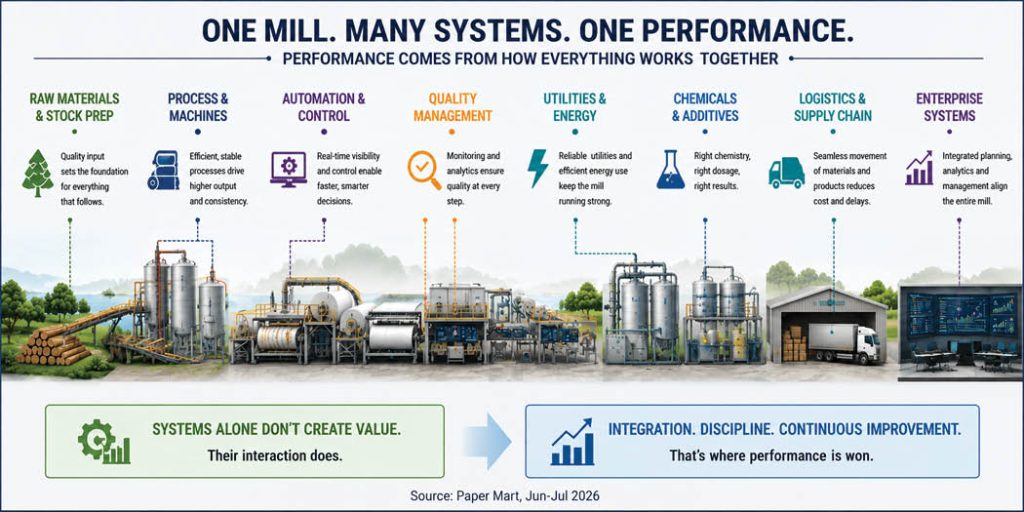
Individual systems create value only when they function together. Process equipment, automation platforms, and quality control systems form the production core. Utilities, chemical dosing, logistics, and enterprise management systems support and strengthen overall mill performance. Their greatest value emerges when information flows seamlessly across these functions, enabling faster decisions and coordinated process control.
At leading mills, integration extends well beyond centralized process control. TNPL links production, utilities, logistics, and enterprise systems through a common digital framework covering operations “from pulping to finished paper.” JK Paper similarly integrates its core manufacturing processes through DCS and QCS platforms, while Emami coordinates process equipment, automation, chemical dosing, and utilities through centralized monitoring.
Integration also determines how quickly a mill responds to operational changes. At TNPL, deviations detected through the Quality Control System automatically trigger adjustments in process control, chemical dosing, and steam management. Similar synchronization extends to ERP-linked warehousing and utility operations, allowing production, inventory, and energy demand to respond as a unified system. The result is faster corrective action and greater process stability.
Integration also brings new challenges. Legacy equipment, biological treatment systems, and interfaces developed across different phases of expansion still demand manual coordination, particularly during grade changes and process transitions. Integration remains a continuing process rather than a finished project.
This observation extends beyond individual mills. Valmet describes many paper mills as operating with “islands of automation,” where equipment supplied by different vendors communicates only within limited boundaries. The resulting fragmentation creates information silos, making it difficult for operators to visualize the complete process or fully exploit advanced optimization tools.
The distinction lies not in the number of automated systems but in the quality of their interaction. Connected systems improve production stability, utility optimization, product quality, and operational responsiveness. Where those connections remain incomplete, operators continue to rely on manual adjustments or localized optimization that benefits one section without improving overall mill performance.
Integration ultimately proves its value through operating results rather than system architecture. Those results provide the clearest measure of successful modernization.
Performance Is the Real Benchmark
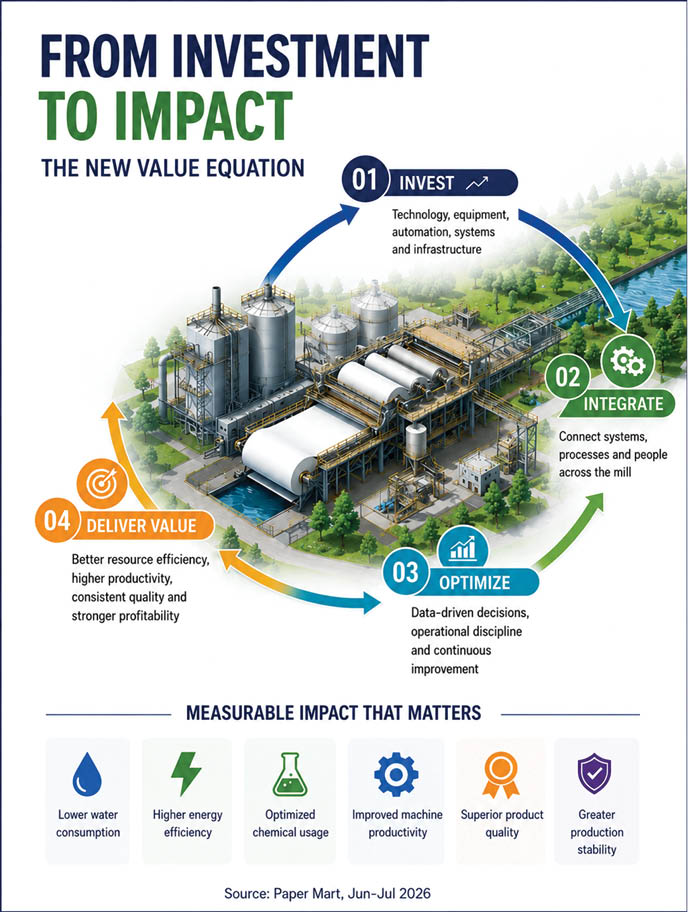
The value of modernization is measured on the shop floor. Improvements in water consumption, energy efficiency, and chemical optimization provide one measure of modernization. Gains in machine productivity, product quality, and production stability provide another, offering a far more meaningful assessment than the sophistication of installed systems.
The benefits are reflected in different ways across mills. TNPL, for example, has reduced specific water consumption from 40 m³/ MT in 2016-2017 to 26 m³/MT in 2025-26 through water conservation, recycling, and process optimization, “making TNPL one of the most water-efficient bagasse-based mills in the world.” The mill has also achieved 100 percent power self-sufficiency, maintained chemical recovery efficiency above 97 percent, and recorded its highest-ever annual production of 6.34 lakh MT. Together, these gains illustrate how coordinated improvements across multiple systems strengthen overall mill performance.
Sripathi Paper & Boards presents a different model. Rather than replacing entire production lines, the mill has focused on targeted interventions with measurable returns. Energy-efficient vacuum blowers have reduced electricity consumption by 15-17 percent, while process debottlenecking and upgraded quality monitoring have strengthened both operational efficiency and product development. Freshwater consumption has been brought down to below 2 m³ per tonne, illustrating how selective modernization can produce substantial resource savings.
JK Paper reports improvements of 5-10 percent in energy efficiency, 10-20 percent in water consumption, and 3-8 percent in chemical optimization over the past three to five years through automation and process control. Emami Paper likewise reports gains in productivity, runnability, product consistency, and water efficiency, with freshwater consumption reduced to 10.9 m³/MT and sustained power and steam optimization enabling the mill to surpass successive PAT cycle targets.
These examples demonstrate that modernization is increasingly evaluated through measurable outcomes rather than the scale of investment. TNPL captures this philosophy by describing its objective as transforming “resource efficiency into a measurable competitive advantage.” The statement reflects a broader shift across the industry, where technology is expected to deliver quantifiable improvements in production, quality, sustainability, and operating economics.
Performance gains, however, are not permanent achievements. They require continuous monitoring, disciplined execution, periodic upgrades, and informed investment decisions to sustain them over time. Those considerations are increasingly shaping the way mills evaluate future technology investments.
Technology Investments Are Becoming Operational Decisions
Investment decisions have become increasingly operational. Mills now evaluate projects by the improvements they deliver in process stability, resource efficiency, operational flexibility, and lifecycle value rather than by the equipment they add. Technology selection has become part of manufacturing strategy rather than a stand-alone capital exercise.
This shift is evident in the way mills evaluate modernization projects. Sripathi Paper & Boards assesses investments through Total Cost of Ownership (TCO), considering operating costs, maintainability, and ESG objectives alongside capital expenditure. JK Paper similarly evaluates projects through lifecycle value and return on investment, choosing between incremental improvements and integrated modernization according to the operational gains expected from each initiative. Emami follows a comparable approach, combining phased upgrades with larger modernization programmes where long-term benefits justify broader intervention. TNPL, meanwhile, balances integrated expansion with continuous incremental improvements that strengthen productivity and resource efficiency across existing operations.
Long-term value also depends on execution. Planning, compatibility with existing systems, phased implementation, operator preparedness, and post-commissioning optimization determine whether an investment achieves its intended outcomes. JK Paper summarizes the approach through “effective implementation, integration, operator adoption, and continuous performance monitoring.” Technology begins creating value only after it enters routine operation.
Supplier observations complement this changing investment philosophy. ANDRITZ notes that most Indian mills continue to favour incremental modernization because investments are expected to deliver measurable operational improvements with manageable capital commitments. Valmet, however, cautions that decisions driven primarily by initial cost often result in fragmented multi-vendor architectures that become increasingly difficult to optimize over time. The balance, therefore, lies between immediate affordability and long-term operational efficiency.
Investments continue to be evaluated long after commissioning. Their success depends on how consistently they improve production, reduce variability, optimize resources, and adapt to changing manufacturing requirements. In that sense, investment decisions have become operational decisions.
The same philosophy is shaping the next phase of modernization, where the emphasis is shifting from expanding technology footprints to extracting greater value from every investment.
Also Read: ITC Paperboards and Specialty Papers Division Strengthens Its Data Architecture and Technological Ecosystem to Support Future Innovations
The Next Gains Will Come from Smarter Operations
Modernization is entering a more selective phase. Rather than expanding their technology footprint indiscriminately, mills are strengthening existing systems, improving process intelligence, reducing resource intensity, and enabling faster operational decisions. New technologies are increasingly expected to complement an established manufacturing ecosystem rather than function as isolated additions.
The priorities naturally differ across mills. TNPL identifies AI-assisted process optimization, digital twins, autonomous quality control, and advanced fiber utilization as the next areas of development, while emphasizing that these initiatives must strengthen operational excellence. JK Paper similarly highlights predictive analytics, artificial intelligence, advanced automation, and sustainability-driven technologies, provided they deliver measurable gains in productivity, quality, and resource efficiency. Emami Paper focuses on deeper process automation, digital monitoring, energy optimization, and further reductions in water consumption. Sripathi Paper & Boards continues to prioritize automation, renewable energy integration, energy efficiency, and systematic modernization of existing assets.
Despite these different priorities, the objective remains consistent: extracting greater value from every tonne of fiber, every unit of energy, every cubic metre of water, and every technology investment. TNPL expresses this objective succinctly as resource efficiency through intelligent automation.
The same direction is reflected in supplier expectations. ANDRITZ sees future modernization being shaped by integrated solutions that simultaneously improve productivity and environmental performance. Valmet expects connected systems, advanced analytics, and decision-support tools to play an increasingly important role in helping operators convert process data into timely operational decisions. The focus, therefore, extends beyond acquiring new technologies to making better use of those already installed.
Modernization has significantly strengthened the technological capabilities of Indian paper mills. The next phase of improvement will depend on how effectively those capabilities are connected, managed, and continuously refined. Technology will continue to provide the foundation, but sustained competitiveness will increasingly be determined by the quality of execution on the shop floor.