
Paper quality and machine performance depend on how tightly a mill can control process variability. Across critical stages of papermaking, mills are using advanced control, real-time measurement and automation to detect deviations earlier and maintain more consistent operating conditions.
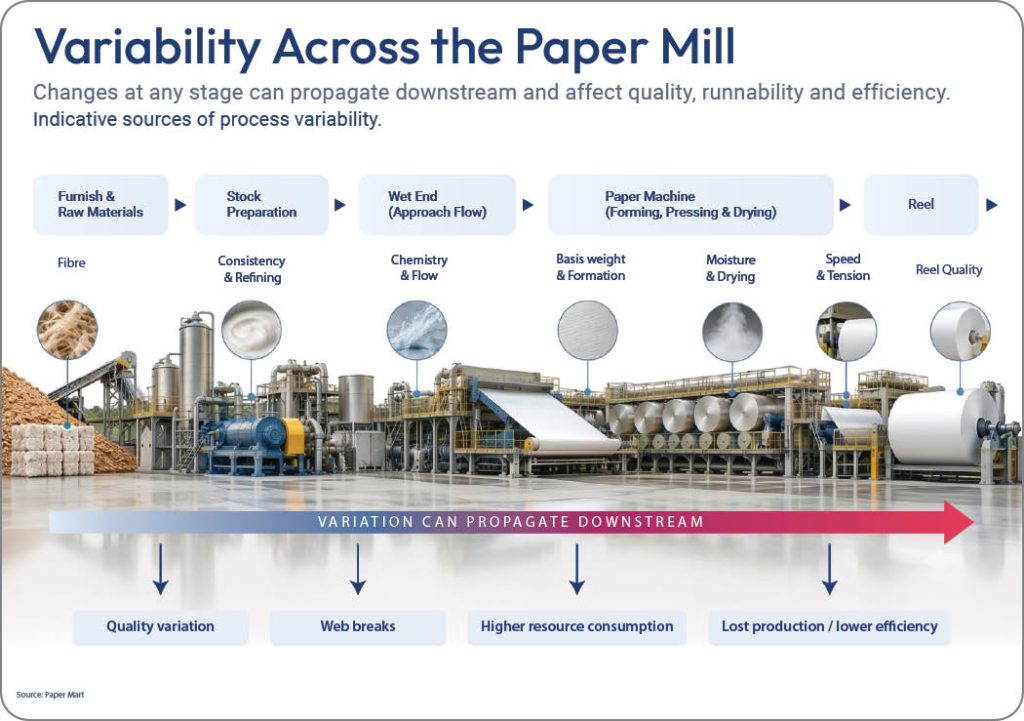
Papermaking is often described as a highly automated process. Yet automation by itself does not guarantee stability. The more fundamental challenge is variability. Changes in furnish, fibre characteristics, stock consistency and chemistry can affect conditions further along the process. Refining, steam, moisture, machine speed and mechanical conditions can add to this variability, resulting in quality variation, sheet breaks, higher consumption or lost production.
For an integrated mill, the consequences can extend well beyond the point at which the variation originates. Ganesh Balakrishna Bhadti, Executive Director (Operations & Projects), Seshasayee Paper and Boards describes the effect particularly starkly. According to Ganesh Balakrishna, “variability compounds non-linearly across the value chain.” He cites an uncorrected 1.5 Kappa-unit variation at the digester as an example. It can translate into a 10–15% shift in bleaching chemical demand, wet-end charge instability and a reported 3–5% increase in web breaks on the paper machine hours later.
The same interconnectedness is evident closer to the paper machine. Suresh Babu Thallapaneni, Vice-President, Kuantum Papers identifies stock preparation, basis-weight control, moisture profiling, refining, headbox consistency, drying and reel operations as persistent sources of variation. “Even a small fluctuation can eventually show as a quality issue or an efficiency loss,” he says.
Ashok Kumar, Executive Director, Pudumjee Paper Products, emphasizes that a small variation in one part of an integrated process can affect subsequent sections, leading to quality problems, runnability issues, sheet breaks, higher energy consumption and reduced production efficiency.
For TNPL, the challenge is particularly pronounced in the wet-end approach-flow system and CD profiles. “Because TNPL utilizes a unique, delicate agricultural-residue, bagasse-heavy furnish mix, the wet-web strength of the paper sheet is inherently lower than pure softwood kraft pulp. Consequently, small hydraulic, chemical or thermal variations propagate downstream rapidly, triggering quality defects or costly machine downtime,” notes Kumar Jayant, Additional Chief Secretary/Chairman & Managing Director.
SVR Krishnan, CEO, Sripathi Paper and Boards approaches the problem in terms of common-cause and special-cause variation. He identifies ambient conditions, equipment wear and raw-material fluctuations as potential sources of common-cause variation, while incorrect furnish mix, operator error, machine setup, sensor failure, chemical application and unplanned operating changes can create assignable causes. The consequence is not simply an unstable parameter, but reduced process capability, making it difficult to keep the process consistently within the required specification limits.
The practical question for paper mills, therefore, is not simply how much automation they have, but how effectively measurement, control and data systems work together to contain variability across the process. The focus, therefore, is on maintaining stable process conditions across interconnected stages of production.
This makes the sources of variability across the mill important to understand: how early they arise, how they propagate and where they can be controlled.

Watch: Top Paper Companies 2023
The Problem Is Variability, Not Automation
Variability can originate at many points across the mill. SVR Krishnan traces the chain from furnish and raw-material control through wet-end controls, short circulation, steam and condensate systems and tension and draw control up to the pope reel. Jagjeet Singh Khanna, Paper Machine Head, Pakka Ltd. identifies stock-preparation variables such as freeness, consistency and furnish mix, wet-end chemistry and ash, headbox consistency, and CD/MD basis-weight and moisture profiles as particularly important.
The important point is that these parameters cannot be treated independently. Ashish Gupta, Unit Head and Senior President, Emami Paper Mills, makes this explicit. “…the greatest gains come not from controlling one isolated parameter, but from stabilising the complete process chain from stock preparation to the finished sheet.”
TNPL’s experience illustrates why upstream stability matters. Kumar Jayant reports that maintaining approach-flow consistency within ±0.02%, for example, stabilises headbox delivery and reduce machine-direction basis-weight swings, allowing production targets to move closer to the lower allowable limit and thereby reducing raw-fibre usage by a reported 1–2%.
At the other end of the process, CD moisture and calliper, drying behaviour, machine speed and reel tension can determine whether the paper machine remains stable. Suresh Babu Thallapaneni, Vice-President, Kuantum Papers notes that an uneven cross-direction (CD) moisture profile can result in curl, cockle and dimensional instability, while reel operations require precise tension and winding control to minimise breaks, wrinkles and defects.
The implication is significant: the variability visible at the paper machine may not be caused there. SVR Krishnan notes that longitudinal weight and moisture variation is controlled by machine loops, but its root causes can originate in stock preparation.
This makes the limitations of individual-loop control more apparent.
Coordinated and Predictive Control
For decades, the basic operating model was straightforward: measure a variable, compare it with its target, and correct the deviation. Operators played a central role in interpreting the process and adjusting individual loops. That approach remains fundamental, while current control practices increasingly combine multiple variables and anticipate process disturbances. Advanced Process Control (APC) and Model Predictive Control (MPC) are central to this approach.
Jagjeet Singh Khanna describes the distinction succinctly. According to him, mills traditionally depended on operator intervention and PID-based feedback control; today, they are increasingly using APC, MPC, feedforward strategies and real-time process data. Instead of waiting for variability to affect quality, the aim is to predict and correct disturbances beforehand.
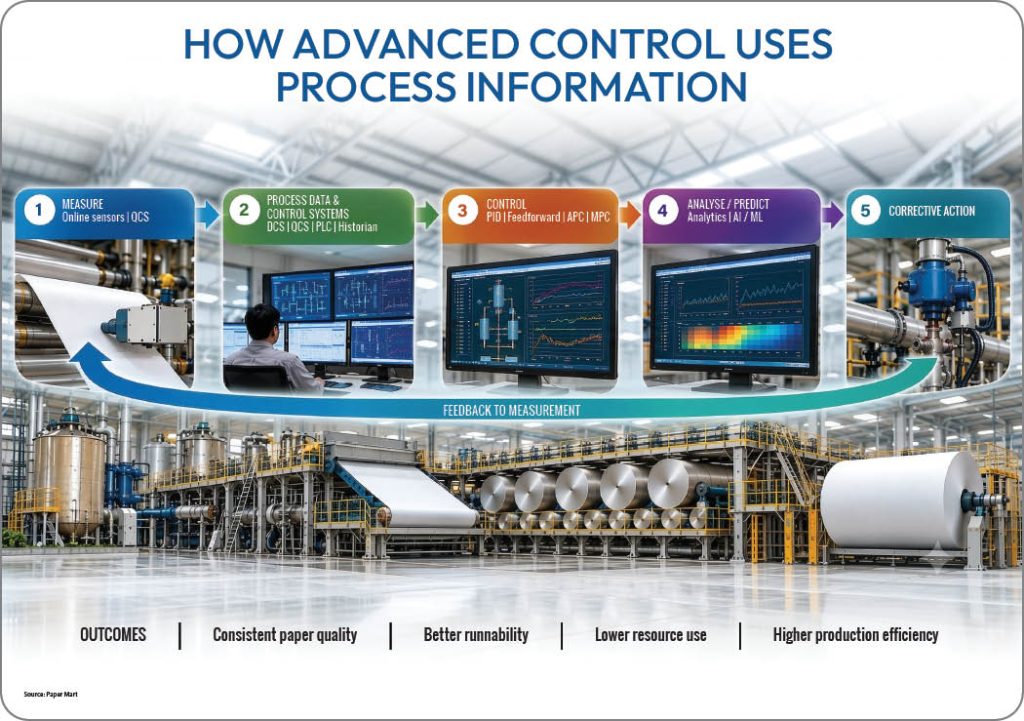
Ashish Gupta sees greater integration of DCS, QCS, advanced process control, process historians and analytics as the next stage of automation. Such integration can help identify process deviations earlier and enable corrective action before they develop into quality or production problems.
“For example, instead of waiting for GSM or moisture to move outside the target and then correcting it, an integrated control system can identify changes in consistency, stock flow, steam conditions or machine speed that are likely to cause the deviation and initiate corrective action,” says Ashish Gupta.
The reason advanced control is particularly relevant to papermaking is that many variables interact and some processes have substantial delays. Ganesh Balakrishna points to processes with 15–45-minute or longer lag times, such as continuous digesters and bleaching towers, as well as the cross-coupling between CD moisture, basis weight and steam pressure.
MPC can therefore consider several variables simultaneously and calculate corrective action while respecting process constraints, rather than allowing individual loops to respond independently.
“In paper machine applications, MPC has demonstrated measurable benefits by reducing machine-direction (MD) moisture variability. Also, across operating paper machine Quality Control Systems (QCS), coordinated multivariable control has reduced MD moisture variation by 40%, enabling a target shift of +0.6% moisture in finished paper while maintaining product specifications,” says Ganesh Balakrishna. “This is resulting in reduced drying energy consumption and improved profitability.”
The next layer is AI and machine learning. But the industry’s views suggest that AI should not be portrayed as replacing APC, MPC or DCS. Rather, it is increasingly being positioned above the control layer, identifying patterns and relationships that conventional control may not capture.
Ganesh Balakrishna describes AI as “the real-time predictive layer above MPC,” identifying non-linear patterns across multi-departmental datasets. Ashish Gupta sees AI and ML as a predictive intelligence layer above DCS, QCS and APC, capable of providing early warnings of instability, predicting quality characteristics and identifying patterns associated with web breaks or quality drift.
Ruchika Garg, Director, Ruchira Papers, identifies practical applications including predictive quality control for basis weight, moisture and calliper, predictive maintenance and anomaly detection.
Ashok Kumar points to another potential application of AI/ML: historical production data can be used to identify settings associated with good results and recommend or automatically apply them when the same grade is produced again. These settings can range from headbox dilution and vacuum to steam pressure and sectional-drive draw.
But prediction depends on something more basic: the mill must first be able to see what is happening.
Seeing the Variation: Measurement, Data and the Digital Control Loop
Effective control architecture requires reliable information. Better algorithms cannot compensate for poor measurements.
Modern QCS systems can continuously measure basis weight, moisture, calliper, ash and colour, while smart instrumentation and machine vision extend visibility into process conditions and surface defects. Ashish Gupta notes, “At Emami Paper Mills, we consider reliable measurement to be the foundation of automation. Once a parameter can be measured accurately and consistently, it becomes possible to move from manual correction towards closed-loop control.”
Sneh Patel, Chief Operating Officer, JMC Paper Tech puts the principle more bluntly: “You cannot effectively control what you cannot reliably measure.” This perspective is important because it identifies measurement quality, not simply automation, as a continuing constraint. An incorrectly calibrated consistency transmitter, unreliable flowmeter or poor laboratory data can undermine an otherwise sophisticated control algorithm.
SVR Krishnan describes a transition from process experts manually adjusting the machine after analysing laboratory reports towards online QCS measurements, virtual measurements and real-time process monitoring and quality-management systems. Feedforward control can use measurements at an earlier process stage to provide predictive information to a later stage before the variation reaches the product.
Yet the measurement gap has not disappeared. Abiali Jani, Director, Jani Sales, identifies fibre quality, refining efficiency, wet-end chemistry and sheet formation as areas where online measurement remains less developed and where mills continue to depend on laboratory testing or operator experience.
Ruchika Garg similarly points to limited online measurement of fibre characteristics, wet-end chemistry and retention efficiency, while pitch, stickies and deposits remain difficult to detect before they affect the process. She also identifies a second problem: many mills still have isolated DCS, QCS, PLC and condition-monitoring systems, limiting plant-wide analytics.
Kumar Jayant describes the use of real-time virtual sensors at TNPL. Process data such as pressure, temperature and flow are used to estimate properties that are otherwise difficult to measure continuously. An AI-driven soft sensor, for example, can estimate drainage capability from refiner power, stock flow and consistency rather than waiting for periodic laboratory testing.
The effectiveness of that architecture ultimately has to appear in the product and the mill’s operating results.
Assessing Outcomes: Quality, Runnability and Efficiency
The ultimate test of improved control is not the sophistication of the control system. It is whether the mill produces more consistent paper while running more reliably and consuming fewer resources.
The most visible quality parameters are basis weight, moisture and calliper, but the interviews also point to formation, ash, strength, colour, stiffness, ply bond and reel quality. SVR Krishnan identifies basis weight, moisture, calliper, ply bond, bulk and stiffness as key indicators of paper/paperboard variability, with weight and moisture among the most critical.
Abiali Jani also points to weight, moisture, calliper, ash, formation, thickness profile and reel quality as parameters benefiting most from automation, advanced process control and integrated process data.
The relationship between tighter control and product quality is evident in Ashok Kumar’s account. The control systems he describes continuously monitor process variables and can adjust thick- and thin-stock flows or steam pressure when deviations occur.
Ruchika Garg reports that APC/MPC applications can produce tighter CD/MD profiles, improved grade-change performance and lower break frequency, alongside reported reductions in fibre, steam and refining energy consumption.
The efficiency effect is particularly important because a narrower variation band can allow a mill to operate closer to its specification or process limits without increasing the risk of off-specification production. JMC explains that reducing standard deviation around the target can enable higher production, lower fibre and steam consumption and fewer breaks.
Drives and motion control are another part of process stability. They are not a separate automation story but an important means of controlling physical variability in speed, tension and synchronisation. SVR Krishnan reports that advanced frequency drives, sensor less vector drives and direct-drive motors can eliminate backlash and slippage, while high-speed communication helps synchronise multiple machine sections. The reported result is more precise speed and tension control and fewer web breaks and instances of product variability.
Ashish Gupta similarly regards sectional AC drives, electronic line-shafting, torque control and improved tension control as integral to overall process automation, helping maintain accurate draws, speed relationships and web tension.
At TNPL, these controls also link paper-machine performance with upstream furnish and approach-flow conditions. TNPL links furnish stabilisation, approach-flow consistency, CD profile control and moisture management to fibre and steam utilisation. It reports that improved structural uniformity allows a higher average reel moisture target, with a 0.5% increase in moisture potentially generating fibre and drying-energy savings.
That is why the focus is increasingly shifting from improving averages to reducing variation around those averages.
Implementation Challenges: Systems, Skills and Integration
Implementing advanced control requires more than installing APC or AI-based systems. In many cases, the first requirement is considerably less glamorous: reliable instrumentation, clean data and sound basic control.
Emami’s approach is explicit. It advocates strengthening instrumentation, basic control loops and data quality before progressively building advanced-control capabilities, noting that APC/MPC can perform only as well as the measurements and basic control infrastructure supporting them.
Abiali Jani identifies the principal practical obstacles as legacy control systems, poor or missing process data, outdated instrumentation and insufficient integration between DCS, QCS and other plant systems. Workforce readiness is another factor: operators and maintenance personnel need training to work effectively with advanced automation and AI.
Ruchika Garg makes a similar observation about isolated automation systems, while Sneh Patel of JMC Tech broadens the issue to data architecture and organisational integration. Legacy PLC/DCS systems, disconnected databases, inconsistent tag naming, unreliable sensors, insufficient historical data and manual laboratory records can all restrict the value that advanced analytics can extract.
Advanced automation also changes the operator’s role. Rather than disappearing from the process, the operator increasingly becomes a supervisor of a more automated process, dealing with abnormal conditions, troubleshooting, grade changes and decisions that require contextual knowledge.
Jagjeet Singh Khanna describes the transition as a move towards “process supervision and exception management.” Ashish Gupta similarly stresses that the objective is not to replace the operator, but to provide better information, faster response and more consistent control.
Sneh Patel adds an important qualification: automation should not become a black box. Operators need to understand why a system is recommending or making a particular change, and the strongest operating environment combines AI’s analytical capability with the practical knowledge of experienced papermakers.
Effective implementation therefore depends on system maturity as well as technology.
Also Read: Paper Mart Emagazine Aug-Sep, 2026
Integrating Control, Data and Process Knowledge
The preceding examples point to the importance of integrating control systems, data and process knowledge rather than treating them as separate functions.
TNPL’s description of this progression is particularly ambitious: from single-loop control to multivariable control, from reactive feedback to proactive feedforward, and from isolated automation islands to mill-wide orchestration. Its proposed architecture includes virtual sensors, AI overlays on MPC, anomaly detection and high-frequency analytics.
Other mills place greater emphasis on selective and pragmatic AI adoption. Ashish Gupta argues that AI should be introduced selectively and pragmatically, with reliable instrumentation, clean data, process knowledge and operator validation preceding sophisticated applications.
The objective is to keep the process closer to its optimum despite disturbances.
Sneh Patel, JMC Paper Tech captures the distinction well: “The greatest benefit is often not simply a higher average production rate. It is the reduction in standard deviation around the target.” The statement captures the relationship between process variability, production and resource efficiency.
The extent of the benefit depends on reliable instrumentation, quality data, integrated systems and process knowledge. For mills, the objective remains straightforward: consistent paper quality, stable machine operation and efficient use of fibre, chemicals and energy.