In an exclusive interview with Paper Mart, Mr. Sneh Patel, Chief Operating Officer of JMC Paper Tech Private Limited, discusses Balaji JMC’s progress in improving environmental performance since commencing production in April 2025. The mill has reduced electricity consumption, thermal-energy intensity, GHG emissions intensity and freshwater intake through operational stabilisation and the implementation of a closed-loop water system and effluent treatment plant. Operating entirely on recovered fibre, with old corrugated containers (OCC) as its sole raw material, Balaji JMC is also strengthening incoming-material quality control to improve fibre efficiency and reduce contamination. Mr. Patel outlines the mill’s 2030 targets and the potential role of MillMind AI optimisation, dryer-section heat recovery and renewable energy in advancing its environmental performance.

Paper Mart: What measurable progress has your mill made since 2022–23?
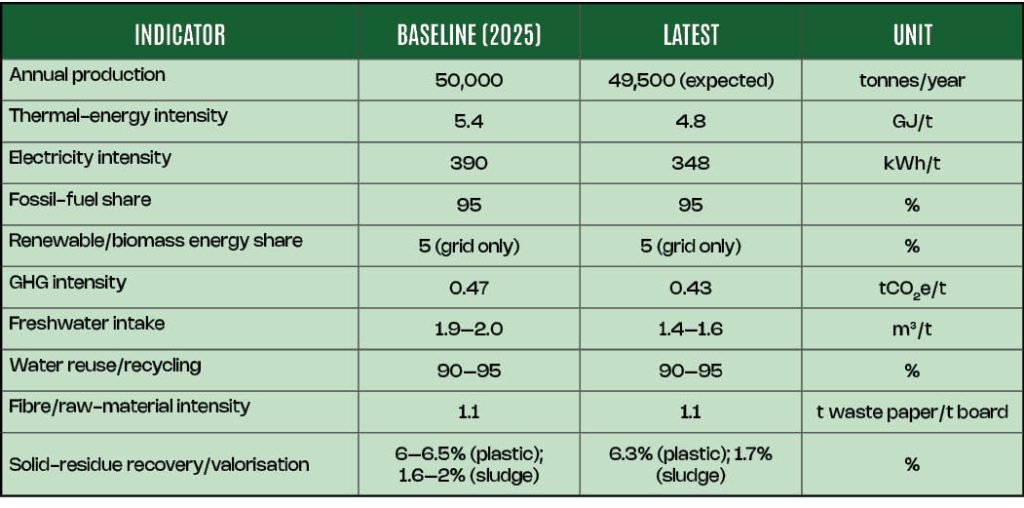
Sneh Patel: Balaji JMC began production in April 2025, so we use our first few months of operation as the baseline rather than 2022–23. Since then, we have made progress in three main areas. Electricity consumption has reduced from approximately 390 to 348 kWh per tonne of paper, representing an improvement of about 11%. Steam consumption has decreased from 2.07 to 1.83 tonnes per tonne, bringing thermal-energy intensity down from around 5.4 to 4.8 GJ per tonne. Over the same period, our GHG emissions intensity has declined from approximately 0.47 to 0.43 tCO₂e per tonne.
We have also reduced freshwater intake from around 1.9–2.0 to 1.4–1.6 m³ per tonne through our closed-loop water system and Effluent Treatment Plant (ETP). We now discharge only a small amount of water every three to four months. These improvements have been achieved as we have stabilised production, including our move to continuous, three-shift operation in September 2025.

Watch: Top Paper Companies 2023
PM: How is the mill reducing energy use and carbon emissions?
SP: Since commencing production in April 2025, we have reduced electricity consumption from approximately 390 to 348 kWh per tonne of paper. Steam consumption has also decreased from 2.07 to 1.83 tonnes per tonne during the period covered by our July to October 2026 operating figures. Thermal-energy intensity is now around 4.8 GJ per tonne, while GHG emissions intensity has declined from approximately 0.47 to 0.43 tCO₂e per tonne.
We do not currently use biomass or generate renewable energy on site. Our renewable energy contribution comes from electricity supplied by the CFE grid and is estimated at approximately 5% of total energy use. Much of the improvement has resulted from operating the paper machine more consistently and at higher production rates, which reduces stoppages and unnecessary steam and power consumption. Our natural-gas boiler, which supplies all process steam, remains the largest source of fossil emissions, followed by purchased electricity.
PM: How far has water use been reduced?
SP: During the initial months of operation, freshwater consumption was around 1.9–2.0 m³ per tonne of paper. We have reduced this to approximately 1.4–1.6 m³ per tonne through our closed-loop water system and ETP. These systems allow us to treat and reuse most of our process water, with an estimated recycling and reuse rate of 90% to 95%. The main challenge in reducing freshwater intake further is the buildup of stickies and odour in the recirculated water, which can affect machine operation and paper quality.
The main challenge in reducing freshwater intake further is the buildup of stickies and odour in the recirculated water, which can affect machine operation and paper quality.
PM: What is changing in fibre sourcing and efficiency?
SP: Our mill operates entirely on recovered fibre, using Old Corrugated Containers (OCC) as the sole raw material. We do not use virgin pulp or mixed wastepaper in our furnish. Most of our OCC is sourced regionally from Chihuahua and the neighbouring US states of New Mexico, Texas and Arizona, helping us limit transportation distances.
We currently use about 1.1 tonnes of recovered paper to produce one tonne of board. The biggest opportunity to improve fibre efficiency is to control the quality of incoming material. To support this, we have introduced a supplier quality-claim process based on ISRI scrap specifications. Loads that do not meet the required grade are documented with photographs and reported to suppliers. This helps us address contamination issues and reduce the amount of plastic, stickies and other unwanted material entering our process.
PM: What has improved in effluent, emissions and chemicals?
SP: Our main improvement in this area has been reducing effluent discharge through the closed-loop water system and effluent treatment plant (ETP). We treat and recirculate process water rather than discharging it continuously. At present, we generally operate for three to four months between discharges, releasing only a small volume of water when the system needs to be refreshed.
Comparable figures for changes in effluent load, air emissions and chemical consumption are not available in the current data. As we increase water reuse, the main challenge is controlling the build-up of stickies and odour in the system.
PM: How much of the mill’s waste is now being recovered or reused?
SP: On average, around 7%-8% of the material processed becomes residual waste. Approximately 80% of this residue is recovered as plastic, while the remaining 20% is collected as sludge. Separating and recovering the plastic portion is our main waste-recovery activity, as it accounts for the largest share of the residues generated at the mill.
PM: What has the green transition required in investment?
SP: Because Balaji JMC was built as a new mill and started production in 2025, much of our environmental investment was included in the original project rather than added later through retrofits. The original scope supplied and engineered by JMC Paper Tech included the closed-loop water system, ETP, energy-efficient drives and the MillMind AI platform. We therefore do not report a separate environmental or decarbonisation capital expenditure figure for the past three years.
The closed-loop water system and ETP have delivered the clearest economic benefit. Freshwater intake has fallen by approximately 20% to 25%, and we now discharge only a small volume of water every three to four months, reducing both water and treatment costs.
By 2030, we aim to reduce electricity consumption to below 320 kWh per tonne, compared with approximately 390 kWh per tonne during start-up. Our targets for thermal-energy intensity and GHG emissions intensity are below 4.2 GJ per tonne and 0.35 tCO2e per tonne, respectively.
PM: What is holding back further progress?
SP: Our biggest challenge is energy. We rely on natural gas for all process steam and purchase our electricity from the grid. Without introducing renewable power or changing how we generate steam, there is a limit to how much further we can reduce emissions.
Water quality is the second challenge. As more water is recirculated, stickies and odour can build up, affecting machine performance and product quality. The third constraint is inconsistent OCC quality because it contributes to waste generation and chemical use. Of these issues, reducing our dependence on fossil-based energy is the most significant.
PM: What are the mill’s next measurable targets?
SP: By 2030, we aim to reduce electricity consumption to below 320 kWh per tonne, compared with approximately 390 kWh per tonne during start-up. Our targets for thermal-energy intensity and GHG emissions intensity are below 4.2 GJ per tonne and 0.35 tCO₂e per tonne, respectively, against initial levels of approximately 5.4 GJ per tonne and 0.47 tCO₂e per tonne.
We also want to bring freshwater intake below 1.2 m³ per tonne, down from the initial 1.9–2.0 m³ per tonne. In addition, we plan to begin measuring COD load and increase renewable energy’s share of our total energy use from around 5% to 20% to 25%, potentially through on-site solar generation or a renewable power purchase agreement.
The GHG emissions target will be the most difficult to achieve because it requires us to reduce our reliance on natural gas for process steam, rather than simply improve operating efficiency.
Also Read: Paper Mart Emagazine Oct-Nov, 2026
PM: What will make the next significant difference?
SP: We see two projects as the most promising. The first is the wider use of MillMind, JMC’s AI-based mill optimisation platform. It is already installed at the mill, and we are working on expanding its use for closed-loop control of steam, vacuum and drive loads, as well as to improve consistency in stock preparation. We expect these improvements to reduce specific energy consumption by a further 5% to 8% and help maintain a more stable water balance.
The second project is a renewable energy programme, which is still under consideration. We are evaluating rooftop or ground-mounted solar PV, potentially combined with a renewable power purchase agreement. At the scale currently being considered, this could increase the renewable share of our total energy use to around 20% to 25% and reduce GHG emissions intensity by an estimated 0.05–0.08 tCO₂e per tonne. We are also implementing heat recovery in the dryer section as it offers a less capital-intensive way to reduce natural-gas consumption.