
As paper mills increasingly focus on process stability, consistent quality and operational excellence, automation is evolving beyond conventional control systems towards integrated, data-driven process management. In an exclusive interaction with Paper Mart, Mr. Ashish Gupta, Unit Head and Senior President, Emami Paper Mills Limited, discusses the mill’s approach to reducing process variability, strengthening control and progressively building a more stable and intelligent manufacturing environment. At Emami Paper Mills, this approach combines reliable instrumentation, DCS, QCS, APC, process data and predictive technologies, supported by operator expertise. The recent PM2 rebuild, including a new QCS-enabled headbox with profile control and a heated calendar with caliper-control capability, reflects this direction.

Unit Head and Senior President,
Emami Paper Mills Limited
Paper Mart: Where does process variability remain most persistent in paper manufacturing today, and how does it affect quality and operating performance? Please tell us the process stages or parameters where tighter stability can deliver the greatest measurable gains.
Ashish Gupta: Process variability in a paper mill is primarily seen in raw-material furnish, stock preparation and refining, wet-end chemistry, headbox operation, and MD/CD basis-weight and moisture profiles. Variations in fibre characteristics, consistency, charge demand, retention, refining and chemical dosage ultimately translate into changes in formation, strength, calliper, moisture, and printability.
At Emami Paper Mills, we recognise that stability at the back end is fundamental to consistency at the reel. Better control of furnish quality, refining and stock consistency, followed by tighter control of wet-end chemistry, provides significant benefits in fibre utilisation and chemical consumption.
At the machine end, tighter control of headbox flow, slice opening, basis-weight profile, moisture profile, steam pressure and calliper can deliver measurable improvements in machine speed, energy efficiency and finishing yield. In our view, the greatest gains come not from controlling one isolated parameter, but from stabilising the complete process chain from stock preparation to the finished sheet.

Watch: Top Paper Companies 2023
PM: How has the approach to controlling process variability changed in recent years? In other words, how are mills moving beyond conventional automation and feedback control to achieve greater process stability? Please explain with examples.
AG: The philosophy of process control is evolving from conventional loop-by-loop PID control and operator intervention towards integrated, predictive and data-driven control.
At EPM, we see the next stage of automation as the integration of DCS, QCS, advanced process control, process historians and analytics, so that process deviations can be identified earlier and corrective action can be taken before they become quality or production problems.
For example, instead of waiting for GSM or moisture to move outside the target and then correcting it, an integrated control system can identify changes in consistency, stock flow, steam conditions or machine speed that are likely to cause the deviation and initiate corrective action.
We are progressively moving in this direction. The objective is not to replace the operator, but to provide the operator with better information, faster response and more consistent control of the process.

Variations in fibre characteristics, consistency, charge demand, retention, refining and chemical dosage ultimately translate into changes in formation, strength, calliper, moisture, and printability.
PM: How are Advanced Process Control and Model Predictive Control being applied to reduce process variability? Where have they delivered measurable gains?
AG: APC and MPC are particularly useful where several process variables are interdependent and where there are significant process delays. In a paper machine, parameters such as stock flow, consistency, headbox pressure, basis weight, moisture, steam, hood conditions and machine speed are closely interconnected.
An MPC-based approach can optimise several variables simultaneously while respecting operating and quality constraints. It can, for example, coordinate stock flow, dilution, steam and machine speed, rather than allowing individual loops to respond independently.
At Emami Paper Mills, our approach is to first strengthen the instrumentation, basic control loops and data quality, and then progressively build advanced control capabilities on this foundation. This is important because APC or MPC can only perform as well as the measurements and basic control infrastructure supporting it.
Our experience with automation-enabled machine upgrades has demonstrated that tighter profile control can improve GSM and calliper uniformity, productivity and finishing yield. We see significant opportunity as advanced control is progressively implemented across the mill.
PM: What practical role are AI and machine learning playing in predicting and correcting process deviations before they affect production or quality?
AG: We see AI and machine learning primarily as a predictive intelligence layer above the existing DCS, QCS and APC systems, rather than as a replacement for them.
Historical process data can be used to identify relationships that may not be immediately visible to an operator. AI models can provide early warnings of developing process instability, predict quality characteristics from online process parameters, and identify patterns associated with web breaks, quality drift or equipment problems.
For Emami Paper Mills, the immediate value proposition is in moving from reactive decision-making to predictive decision-making. The system should tell the operator not only what has happened, but also what is likely to happen next and which process variables are contributing to it.
However, we believe AI should be introduced selectively and pragmatically. Reliable instrumentation, clean data, sound process knowledge and operator validation must come before sophisticated AI applications.
The future lies in combining online measurements, laboratory data and process knowledge into a single decision-making framework.
PM: How are online measurement, smart instrumentation, machine vision, and QCS improving real-time detection and control of process variation? Where do significant measurement or data gaps still remain?
AG: Modern QCS has transformed paper-machine control by providing continuous measurement of parameters such as basis weight, moisture, caliper, ash and colour, along with MD/CD profile information.
At Emami Paper Mills, we consider reliable measurement to be the foundation of automation. Once a parameter can be measured accurately and consistently, it becomes possible to move from manual correction towards closed-loop control.
Machine vision is also becoming increasingly valuable for detecting surface defects at full machine speed. When defect detection is integrated with process data, it becomes possible to link a defect to its probable process origin and address the cause rather than simply removing the defective material downstream.
There are nevertheless measurement gaps. Parameters such as formation at the fibre level, z-direction bonding, complex wet-end chemistry and microbiological activity are not always directly measurable online. Strength and some other final properties also continue to depend significantly on laboratory measurements.
Therefore, the future lies in combining online measurements, laboratory data and process knowledge into a single decision-making framework.
PM: Drives and motion control directly influence speed, tension, synchronisation, and machine stability. How are newer drive and control technologies helping mills reduce variability across the paper machine and associated processes?
AG: Drives and motion control are critical to machine stability, particularly as machines operate at increasingly high speeds.
Modern sectional AC drives, electronic line-shafting, high-performance torque control and improved tension control allow the machine to maintain accurate draws, speed relationships and web tension across different sections.
This reduces speed fluctuations, draw disturbances and synchronisation errors, which can otherwise result in wrinkles, edge cracks, breaks and unstable running.
At Emami Paper Mills, we consider drive and motion control as an integral part of overall process automation. The objective is to ensure that the machine responds smoothly to changes in operating conditions and maintains stable operation across the entire machine.
PM: How are automation, advanced control, and integrated process data helping mills achieve more consistent paper quality? Which quality parameters have benefited most?
AG: The strongest benefits are generally seen in basis weight, moisture and calliper, followed by colour, ash and derived strength properties.
A paper machine is a highly interconnected system. A change in furnish, consistency or refining can ultimately affect strength and formation; changes in dryer conditions can affect moisture and dimensional stability; and changes in calendering can affect caliper and bulk. Therefore, automation must also become integrated.
At Emami Paper Mills, our focus is on progressively bringing DCS, QCS, machine controls, process data and advanced control into a common operating framework. Our recent machine automation upgrades, including improved headbox profile control and calliper control, have already contributed to tighter GSM and calliper profiles and better product consistency.
The ultimate objective is to run closer to the customer’s specified target rather than maintaining unnecessarily large operating margins. This improves quality consistency, fiber utilisation, energy efficiency and finishing yield.
The next generation of paper mills will combine reliable field instrumentation, DCS and QCS, advanced process control, integrated data platforms, analytics and AI, supported by experienced and capable operating teams.
PM: As control systems become more intelligent, how is the operator’s role in process control and decision-making changing?
AG: The operator’s role is not becoming less important; it is becoming more skilled and more analytical.
Earlier, operators spent considerable time monitoring individual parameters, adjusting setpoints and responding to alarms. With advanced automation, these routine activities can increasingly be handled by control systems.
The operator can then focus on process optimisation, managing constraints, interpreting trends, handling exceptions and making decisions involving quality, cost, production and safety.
At Emami Paper Mills, we believe that the best automation combines technology with operator experience. The system may identify a developing deviation, but an experienced operator understands the process context and can validate whether the recommended action is appropriate.
The objective is therefore not “man versus machine”. It is man plus machine, with automation providing consistency and speed and the operator providing judgement, experience and process understanding.
PM: What typically prevents a mill from achieving the full benefits of advanced automation and intelligent control? Please tell us more about issues such as legacy systems, data quality, system integration, instrumentation, workforce capabilities, etc.
AG: The biggest challenge is often not the advanced technology itself, but the foundation on which it has to operate.
Many mills have legacy DCS and QCS systems, ageing instrumentation, inconsistent measurement practices, fragmented databases and equipment from multiple automation vendors. Inadequate instrumentation and poor-quality data can severely limit the effectiveness of advanced control.
At Emami Paper Mills, we believe the implementation should therefore follow a structured hierarchy:
First: Reliable instrumentation and measurement
Second: Strong basic process control
Third: Data connectivity and governance
Fourth: Advanced process control and optimisation
Fifth: Predictive analytics and AI
Sixth: Equally important is people’s capability
Operators, engineers and maintenance teams must understand the technology and trust the system. Without appropriate training and ownership, even a technically excellent automation project can gradually revert to manual intervention.
For this reason, we consider technology, people and process discipline to be equally important pillars of successful automation.
Also Read: Paper Mart Emagazine Aug-Sep, 2026
PM: Can you share a recent implementation that measurably reduced variability or improved quality consistency? What results were achieved, and where should mills prioritise investment next?
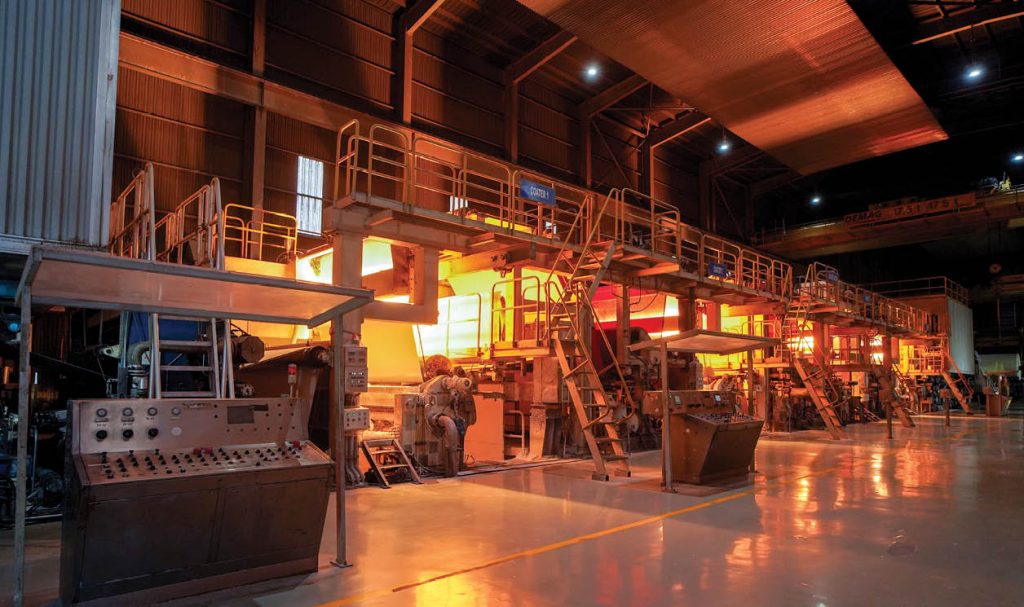
AG: One of the important examples at Emami Paper Mills is the recent rebuild of PM2, where a new headbox with profile-control capability through QCS and a heated calendar with calliper-control capability were introduced.
These automation-enabled improvements have contributed to significantly better GSM and calliper profiles, improved product quality consistency and better machine performance. The tighter control has also helped reduce finishing losses and supported higher productivity.
This experience reinforces our belief that automation should be closely integrated with machine and process improvements, rather than treated as a standalone IT or instrumentation project.
Looking ahead, Emami Paper Mills is progressively strengthening its automation roadmap. One important area is the proposed Power Management System (PMS) for the power plant, which will help optimise generation capacity and power utilisation while operating in synchronisation with the grid. This has the potential to improve energy utilisation, operational visibility and decision-making.
Plans are also underway for mill-wide DCS upgrades to enhance control capability and integration of process data.
More broadly, our priorities are to strengthen the automation foundation, improve instrumentation and data quality, and then progressively introduce APC, predictive analytics and AI where they can deliver measurable business value.
Overall, the long-term objective is to build a more stable, data-driven and intelligent paper mill capable of producing consistently high-quality paper with lower variability, lower energy and chemical consumption, reduced losses and higher sustainable productivity. The next generation of paper mills will combine reliable field instrumentation, DCS and QCS, advanced process control, integrated data platforms, analytics and AI, supported by experienced and capable operating teams.
The real measure of success will not be the sophistication of the automation system itself, but the extent to which it delivers lower process variability, consistent product quality, higher machine availability, improved energy and fibre efficiency, reduced waste and ultimately better value for the customer and the business.
Emami Paper Mills is progressively strengthening its automation roadmap. One important area is the proposed Power Management System (PMS) for the power plant, which will help optimise generation capacity and power utilisation while operating in synchronisation with the grid.