
Fiber management now affects the long-term competitiveness of Indian paper mills as much as raw material availability. This story examines the different approaches mills are adopting to strengthen resource security and build resilient fiber ecosystems.
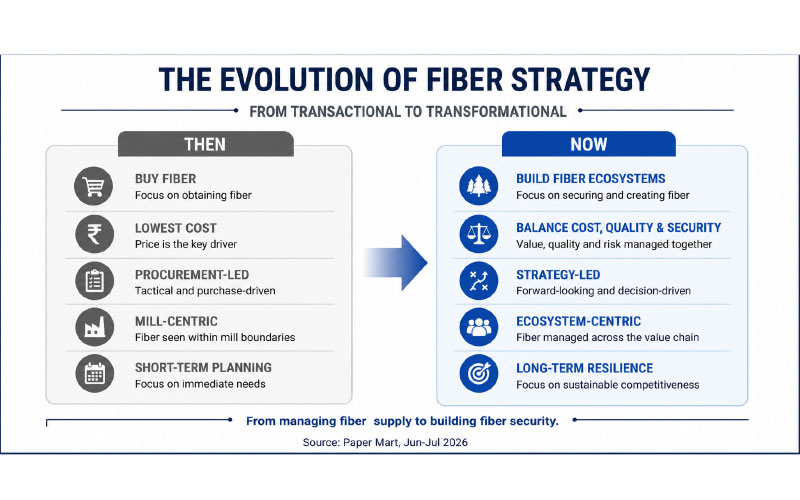
For decades, fiber discussions in the Indian paper industry largely revolved around availability. The central concern was securing enough wood, agro-residues and recovered paper to sustain production. While supply continues to remain a challenge, the nature of the problem has fundamentally changed. Fiber is no longer merely a raw material to be procured. It has become a business resource that affects competitiveness, resilience and long-term growth.

Watch: Top Paper Companies 2023
Why Fiber Has Become a Strategic Issue
The fiber challenge extends well beyond availability. Resource constraints, import dependence, and competing demand are making supply less predictable. At the same time, evolving regulations, changing customer expectations, and rising quality standards are forcing mills to rethink how they manage fiber. Consequently, procurement decisions now extend well beyond purchasing and pricing. They determine a mill’s ability to maintain product consistency, optimise costs, manage supply risks and respond to market volatility.
One of the most significant structural changes has been the rapid rise of recovered fiber, particularly in packaging grades driven by the growth of e-commerce. According to Kuantum Papers, recovered paper today accounts for nearly three-fourths of the industry’s overall fiber basket, exposing Indian mills more directly to global markets, freight fluctuations and geopolitical uncertainties. Domestic collection systems have improved. However, inconsistent segregation, contamination and seasonal shortages continue to affect supply reliability.
Simultaneously, wood availability faces increasing pressure from competing industries such as plywood and MDF, while agro-residue availability remains closely linked to climatic conditions and alternative end uses.
Global policy developments are further reshaping the sourcing landscape. Ruchira Papers points to regulatory changes such as the European Union’s Waste Shipment Regulation, which seeks to retain recyclable fiber within Europe, making imported waste paper progressively more difficult for countries like India to access. Earlier, China’s National Sword Policy had already demonstrated how policy interventions in one geography can significantly alter global fiber flows. These developments indicate that imported fiber can no longer be treated as a predictable source of supply.
For virgin fiber producers, the challenge is equally structural. Star Paper Mills observes that India has historically faced persistent fiber deficits, reflected in continued imports of wood pulp, wood chips and recovered paper. More importantly, it argues that the country’s competitiveness is constrained by the absence of captive plantation models that are common in several major paper-producing nations, limiting mills’ ability to exercise long-term control over both fiber availability and cost.
Against this backdrop, fiber management has evolved into a boardroom issue rather than remaining solely an operational concern. Mills are no longer asking how to procure sufficient fiber; they are redesigning sourcing strategies to reduce uncertainty, diversify risk and strengthen resilience. The industry’s future will be shaped less by the fiber it uses than by how effectively it manages, secures and optimises it.
Three Models of Fiber Resilience
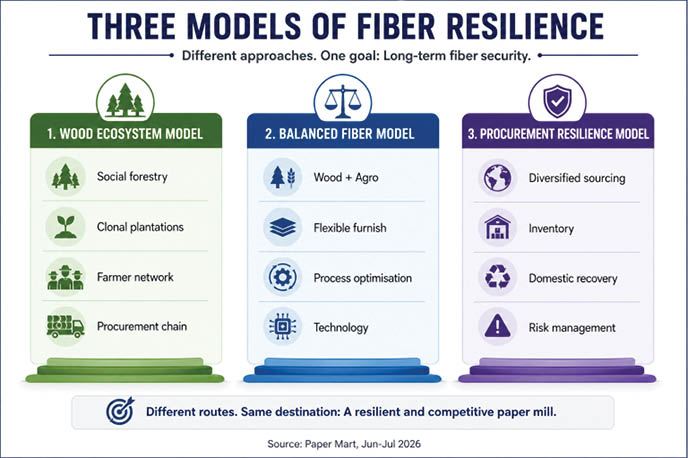
Rather than converging on a single solution, the Indian paper industry appears to be pursuing three distinct pathways towards fiber resilience, each reflecting different raw material realities, product portfolios, and long-term strategic priorities. These approaches are not mutually exclusive, nor are they defined by fiber type alone. Instead, they represent different philosophies for managing uncertainty, securing raw materials, and sustaining competitiveness.
Different routes, one destination: transforming fiber from a source of uncertainty into a source of competitive advantage.
For mills committed to virgin fiber, resilience is being built by strengthening the wood ecosystem itself rather than diversifying into alternative fiber sources. Investments in social forestry, high-yielding clonal development, farmer engagement, and structured procurement networks are aimed at improving fiber availability and supply security.
Highlighting this integrated approach, Madhukar Mishra, Managing Director, Star Paper Mills, says, “For wood, we have a complete chain right from clonal multiplication and providing high-yielding clones to farmers, to a network of suppliers, agents, and own depots.”
However, the model also reflects the realities of India’s wood economy. While social forestry has significantly reduced dependence on government forest allocations, it offers limited control over pricing and supply volumes. Competition from industries such as plywood and MDF, fragmented landholdings, volatile wood prices, and long tree rotation cycles continue to constrain fiber security. As a result, inventory management and continuous improvements in plantation productivity are becoming critical elements of long-term wood strategy.
A second approach is to reduce dependence on any single fiber source by maintaining a balanced furnish portfolio. By combining the strengths of wood and agro-based fiber, mills are improving their ability to respond to seasonal fluctuations, changing customer requirements, and evolving product specifications without compromising quality or operational stability.
Describing this philosophy, Jagdeep Hira, CEO–Operations, Kuantum Papers Limited, notes, “Our fiber strategy has always been dynamic, balancing seasonal availability, cost and fiber characteristics.”
This approach extends well beyond balancing the furnish mix. It includes strengthening farm forestry programmes, expanding high-yield clonal plantations and building closer relationships with farmers. Advanced process technologies then help mills manage fiber variability more effectively. Automation, AI-enabled process controls and improved fiber recovery systems help mills maintain pulp quality despite changing fiber characteristics. This allows sourcing flexibility to become a competitive advantage.
A third and increasingly important approach is the transformation of fiber sourcing from a procurement function into a strategic business capability. Rather than focusing solely on securing raw material at the lowest possible cost, mills are redesigning procurement systems around risk management, supply continuity, inventory planning, and resilience.
Reflecting this approach, Jagdeep Singh, President, Ruchira Papers Limited, observes, “fiber sourcing is no longer viewed as a purely procurement function, but as a capability centred on risk management, operational resilience, and competitiveness.”
Recent global disruptions have accelerated this transition. Events such as the COVID-19 pandemic, freight volatility, tighter international regulations governing waste paper movement, and supply chain disruptions have demonstrated the limitations of traditional procurement models. Consequently, greater emphasis is now being placed on diversified sourcing, higher inventories, increased domestic procurement, and closer coordination between procurement and production teams to ensure uninterrupted operations even during periods of market disruption.
Taken together, these approaches signal a broader transformation in the industry’s thinking. Whether through strengthening the wood ecosystem, balancing multiple fiber streams, or building procurement resilience, the objective remains the same: reducing uncertainty, increasing control over fiber resources, and positioning fiber management as a source of competitive advantage rather than merely a procurement challenge.
Strategic Tensions Shaping Fiber Decisions
Although fiber strategies vary widely across the industry, the underlying decisions revolve around a common set of strategic tensions. Regardless of raw material mix, mills are confronting the same questions. How much control can be built into the fiber supply chain? How much flexibility should be retained? How much investment is justified today to secure tomorrow’s raw materials? And to what extent can technology compensate for fiber constraints?
One of the most defining tensions is control versus market dependence. Indian paper mills have traditionally relied on open-market procurement. This has exposed them to seasonal shortages, price fluctuations and competition from other industries. Consequently, increasing efforts are being directed towards strengthening upstream control through social forestry, clonal development, farmer partnerships, collection centres, and dedicated procurement networks. The objective is not necessarily complete self-sufficiency, but reducing exposure to market uncertainty.
While Indian mills continue to rely largely on open-market procurement, Madhukar Mishra points out that “most other large paper-producing countries allow captive plantations, which enable planned harvesting and total control on costs.” Jagdeep Hira notes that the company’s long-term strategy is centred on developing a “wood-surplus ecosystem” through extensive social farm forestry, clonal plantations, and expanded collection networks.
The second tension is consistency versus flexibility. Product quality demands consistency, yet fiber availability demands adaptability. Mills therefore face the challenge of maintaining stable quality while responding to seasonal changes, shifting raw material economics, and evolving customer requirements. Rather than treating consistency and flexibility as opposing objectives, many are attempting to achieve both through balanced furnish strategies, tighter process controls, and improved operational discipline.
As Jagdeep Hira explains, “We have consistently maintained a 50:50 agro and wood-based furnish ratio, enabling us to leverage the strengths of both sources.” The objective is not simply to balance fiber types, but to retain the flexibility to respond to changing availability without compromising product quality. For mills built around a single fiber source, flexibility takes a different form. Rather than changing the furnish mix, they rely on stronger plantations, better procurement systems and process optimisation to maintain consistency under varying supply conditions.
Another important tension is short-term cost optimisation versus long-term investment. Historically, procurement decisions were largely driven by immediate cost considerations. However, mills are now investing in initiatives whose returns may only become visible several years later: social forestry programmes, proprietary clonal development, farmer engagement, domestic pulp production, and expanded procurement infrastructure. These investments may not immediately reduce procurement costs, but they strengthen resilience against future supply disruptions.
Ruchira Papers offers a good example of this approach. During the COVID-19 disruption, the company diversified procurement, expanded domestic sourcing and maintained higher inventory levels despite rising costs. “We had to simultaneously manage three competing priorities: availability, cost and quality,” recalls Jagdeep Singh.
Perhaps the most significant change, however, is the growing role of technology in redefining fiber economics. Improvements in automation, process controls and fiber recovery are helping mills extract greater value from the same raw material base. Advances in pulping equipment, AI-enabled monitoring and chemical optimisation are further improving fiber utilisation. Technology is no longer just improving efficiency; it is improving fiber utilisation.
Kuantum Papers, for instance, attributes improved yield and process stability to AI-driven controls, advanced cleaning systems, and an upcoming Displacement Digester System, while Ruchira Papers highlights significant improvements in waste paper yield through advances in pulping equipment and process chemicals over the past two decades. Such developments suggest that future competitiveness will depend not only on securing more fiber, but also on extracting more value from every tonne of fiber available.
Viewed collectively, these tensions reveal that fiber strategy has evolved into a multidimensional management challenge. Success is no longer determined solely by access to wood, agro residues, or recovered paper. It depends on how effectively mills balance competing priorities, invest in capabilities, and integrate technology with supply chain strategy to build enduring resilience.
Beyond the Mill Gate
If the Indian paper industry’s fiber strategy has undergone one fundamental transformation, it is this: fiber security is no longer being built inside the paper mill. It is being created outside it.
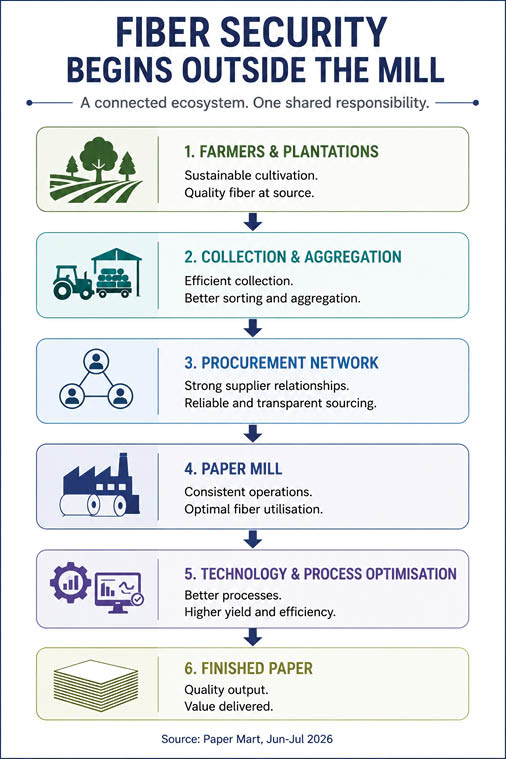
For decades, fiber management largely began at the procurement stage. Today, it begins much earlier, with planting material, farmer engagement, plantation development, collection infrastructure and resilient sourcing networks. In other words, mills are no longer merely buying fiber; they are actively participating in creating it.
This change is most visible in the growing emphasis on developing long-term fiber ecosystems. Investments in social forestry, high-yield clonal development, farmer outreach and structured procurement networks are steadily replacing transactional sourcing models. Kuantum Papers, for example, has invested extensively in social farm forestry, high-yield clonal development and collection centres to strengthen long-term fiber availability, while Star Paper Mills has built an integrated wood value chain spanning clonal multiplication, farmer engagement and procurement networks. Together, these initiatives reflect a broader industry realisation that sustainable fiber security begins at the source rather than at the mill gate.
The changing strategy is also redefining where capital is being deployed. Traditionally, mills invested primarily in machinery, process improvements, and production capacity. Increasingly, however, they are investing in assets that do not produce paper directly, i.e., nurseries, superior planting material, plantation programmes, farmer partnerships, collection centres, and procurement infrastructure. These investments may not immediately increase production, but they significantly improve the reliability and resilience of the fiber supply chain over the long term.
This ecosystem approach is also prompting a reassessment of India’s dependence on imported fiber. Imported pulp and recovered paper continue to play an important balancing role, but they are becoming progressively less predictable due to geopolitical developments, freight volatility, and changing international regulations.
Jagdeep Singh observes that the European Union’s Waste Shipment Regulation will make imported waste paper difficult to access, reinforcing the need to strengthen domestic pulp production. Likewise, Kuantum Papers notes that imported fiber remains exposed to “geopolitical disruptions, freight fluctuations and quality inconsistencies.” The industry’s response, therefore, is to strengthen domestic fiber resources rather than depend more heavily on imports.
Technology, too, is assuming a different role in this transformation. Earlier, technological investments were largely expected to improve operational efficiency. Today, they are expected to extend the value of every tonne of fiber available. Advanced pulping systems, fiber recovery technologies and digital process controls are helping mills improve yield and maintain quality. They are also allowing greater flexibility in handling variable raw materials.
As Jagdeep Singh aptly remarks, the objective is to produce pulp with “minimum damage to the fiber,” while Kuantum Papers expects its Displacement Digester System to deliver higher pulp yield through improved cooking efficiency. Technology, therefore, is not replacing fiber; it is multiplying its value.
Collectively, these developments point towards an important transition in the industry’s competitive landscape. The next advantage is unlikely to come from discovering a new fiber source or securing cheaper raw materials alone. It will come from building stronger fiber ecosystems, integrating farmers, plantations, collection networks, technology, and procurement into a single, resilient value chain. In the years ahead, the mills best positioned for growth may not necessarily be those with the largest capacities, but those that exercise the greatest control over the journey of fiber, from the field to the finished sheet.
Also Read: Kuantum Papers: Creating A Wood-Surplus Ecosystem for Consistent Fiber Availability and Cost Competitiveness
Fiber as a Strategic Asset
The Indian paper industry’s fiber challenge now is not defined simply by the availability of wood, agro residues, or recovered paper. It is defined by how effectively mills can anticipate uncertainty, build resilience, and convert fiber management into a strategic capability.
Wood-, agro- and recycled fiber-based mills will naturally follow different paths. Yet all are working towards the same objective: stronger fiber security and greater resilience. fiber strategy is moving beyond procurement towards ecosystem development; beyond short-term cost optimisation towards resource security; and beyond mill operations towards stronger integration with farmers, technology providers, collection networks, and policymakers.
The transition is also redefining competitiveness. Historically, production capacity, machine speed, product quality, and manufacturing efficiency were the principal differentiators. However, another capability is emerging alongside them: the ability to secure, optimise, and sustain fiber resources in an environment characterised by growing demand, finite domestic availability, regulatory change, and global market volatility.
Ultimately, the future of the Indian paper industry may depend less on which fiber mills choose than on how intelligently they build, manage, and replenish the ecosystems that supply it. fiber is no longer merely the industry’s most important raw material. It is fast becoming one of its most important competitive advantages.