
Among India’s most modern paper and paperboard producers, Emami Paper Mills Ltd. has built its Balasore complex around a philosophy of continuous upgradation, selective modernization and disciplined technological integration. In an exclusive interview with Paper Mart, Mr. Sushil Kumar Khetan, Wholetime Director & CEO, Emami Paper Mills, outlines the technology landscape across the mill, the systems that drive its competitiveness, and the company’s view of where the next level of efficiency for the Indian paper industry will come from.
Paper Mart: Could you walk us through the current technology landscape in your mill, particularly the key systems deployed across process areas such as stock preparation, paper machines, automation, energy, water, and chemical control, and indicate whether these are fully integrated or implemented in a more selective manner?
Sushil Kumar Khetan: At Emami Paper Mills, technology is at the heart of how we serve our customers. Our approach combines continuous upgradation, selective modernization, and disciplined integration across operations to deliver consistent quality, operational reliability, and products that meet evolving market requirements.
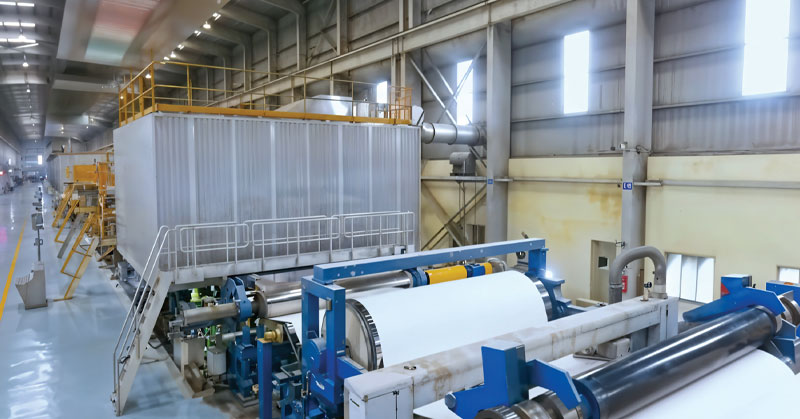
Our PM-3 is India’s best newsprint machine and among the best globally in terms of newsprint quality. It is equipped with a hydraulic headbox, twin-wire technology, and a back-to-back soft nip calendar, enabling the production of import-substitute newsprint with a high MD-CD ratio and superior bulk. This high MD-CD ratio ensures excellent runnability on high-speed newspaper printing machines. Operating at 1,100 mpm, PM-3 is the fastest newsprint machine in the country. It is supported by a state-of-the-art 300 TPD Voith double-loop deinking plant that converts diverse wastepaper grades into clean, high-quality pulp for the production of premium newsprint from 100% imported wastepaper. The machine is fully automated with modern DCS and QCS systems and features fully automatic reel wrapping and packing for superior protection, product appearance, and delivery condition.
We have recently upgraded our PM-2 with a hydraulic headbox equipped with CD profiler, facilitating even pulp flow distribution for superior profile control. A new calendar with thermo-roll has been installed for improved calliper and surface finish. In addition to better profile control, finish, and overall product quality, this upgrade has increased the operating speed of PM-2 from 500 mpm to 550 mpm. Today, PM-2 produces premium pharma inserts for leading pharmaceutical brands in India, along with high-quality writing-printing paper. We are also set to launch our copier brand, “Emami Grand Print,” through a fully automated copier sheeting and packing line, further strengthening our presence in the premium office paper segment. We have also significantly upgraded PM-1, which is used for manufacturing specialty paper like oil & grease proof paper, interleaving paper and writing-printing grades.
Our paperboard unit, with a capacity of 2,00,000 TPA, produces premium virgin and recycled paperboard for a wide range of premium and eco-friendly packaging applications. Commissioned in 2016 and subsequently upgraded, it is among the finest paperboard machines in the country. Its four-layer design enables superior fiber blending and precise control over bulk, smoothness, and stiffness. The unit is equipped with a dilution profiler for cross-directional basis weight control, a shoe press for improved dryness without compromising bulk, and advanced calendaring for consistent finish and calliper. The coating section is equipped with combi blade coaters (three for top side and one for the bottom) and electric IR heaters that deliver superior finish and smoothness in coated board. Scan showers are installed in the wire sections of all four forming layers, which help maintain a uniform moisture profile, defect-free sheet formation, and lower water consumption.
Across our production facility, our focus remains on delivering superior quality, product consistency, and customer-specific solutions across both commodity and value-added grades.
Our captive power plant is a key enabler of operational reliability and cost efficiency, supporting the mill with dependable and economical power and steam. The facility is equipped with SST 300 turbo generators with a total TG capacity of 33.5 MW, along with high-efficiency boilers aggregating 185 tph capacity with modern combustion and process control systems that optimize fuel use, improve energy performance, and support environmental compliance. The integrated power and steam generation setup ensures uninterrupted mill operations, high plant availability, and the flexibility needed to meet varying production requirements while keeping manufacturing costs under control.
Our integrated DCS and QCS systems ensure stable production, consistent quality, and quick process response. On the sustainability side, mill-wide power and steam optimization, improved condensate recovery, VFDs, optimized pumps and blowers, compressor optimization, and reduced auxiliary load have helped us surpass the targets set under all three PAT cycles. Our water recycling and reuse systems have enabled us to achieve benchmark-level water consumption of 10.9 m3/tonne, well below the CPCB-prescribed limit of 15 m³/tonne and the Indian industry average. Chemical control is applied for all major chemicals in a process-specific manner to maintain product quality, optimize resource use, and ensure cost efficiency.
Emami Paper Mills has built a strong finishing and dispatch infrastructure. Our mill is equipped with advanced rewinding and sheeting facilities supplied by Milltex and Pasaban, complemented by automatic ream, bundle, and reel packing systems that provide excellent protection against moisture, dust, and handling damage while also improving the appearance of the finished product. In addition, our warehousing, racking, and dispatch systems support organized storage, traceability, faster loading, and efficient vehicle turnaround, strengthening our ability to deliver products reliably and on time.
Overall, our technology landscape is fully integrated where it adds value, enabling us to deliver reliable supply, consistent quality, product flexibility, and sustainable manufacturing with a strong customer focus.

Watch: Top Paper Companies 2023
PM: How would you assess the extent to which your installed technologies are being optimally utilized in day-to-day operations, and what factors, in your experience, prevent full utilization of these systems?
SKK: At Emami Paper Mills, we assess technology utilization as a continuous and evolving process rather than a static benchmark. Across our mill, the core systems and equipment are operated at high levels of functional utilization in day-to-day production. The DCS ensures real-time coordination across machine sections, while the QCS provides continuous feedback on quality parameters, helping us to respond flexibly to market demand and input variation across different grades. The full benefit of advanced systems, however, depends on how effectively they are operated and maintained. That is why we place strong emphasis on skilled people, regular training, disciplined preventive maintenance, and close performance monitoring using plant data. Overall, our approach to keep raising the operating performance of our assets through disciplined execution and continuous improvement rests on three pillars: team capability, robust preventive maintenance, and data-driven performance monitoring.
PM: In your view, which technologies or systems within your mill are currently underutilized or not delivering their full potential, and what are the underlying reasons: whether operational, economic, skill-related, or linked to process variability?
SKK: At present, there are no major technologies or equipment that are underutilized. The existing systems are effectively integrated into routine operations and are delivering the intended benefits in terms of production efficiency, quality control, and resource optimization.
That being said, certain facilities have been created with deliberate fungibility and are therefore used selectively depending on the product being manufactured. For example, the film size press in the paper machines is deployed when we produce writing and printing paper as well as specialty paper, while our state-of-the-art de-inking plants are utilized during the manufacture of newsprint and recycled grades. This is by design and reflects our strategic approach to build operational flexibility, enabling us to respond more effectively to changing market conditions and product mix requirements.

The key learning has been the importance of selecting technologies that are compatible with our process conditions, product mix, and long-term operating objectives, while also ensuring proper integration, training, and maintenance support.
PM: Despite increasing levels of automation, are there specific areas where manual intervention continues to play a significant role in your operations, and what drives the need for such overrides?
SKK: Our machines operate with a high degree of automation, and there are currently no areas requiring significant manual intervention beyond standard operational supervision. Any operator involvement is largely limited to routine monitoring, parameter verification, and normal process oversight to ensure stable and uninterrupted running.
Experienced operator judgement remains valuable at points of transition — for instance during grade changeovers or when raw material characteristics vary — where it complements, rather than replaces, the automated control systems.
PM: Which sections of your mill continue to face the greatest operational challenges or variability despite the presence of modern equipment and systems, and what are the key issues you encounter in these areas?
SKK: No major operational challenges or process variability issues are currently being experienced that cannot be effectively managed through our existing equipment and systems. The areas that naturally demand the closest attention are those most exposed to incoming raw material variability, particularly the recovered-paper and de-inking streams, where consistency of furnish quality directly influences downstream stability. These are managed proactively through screening, cleaning and stock-quality control. At the same time, given the competitive nature of the industry, continuous technological upgradation, disciplined maintenance, and close process monitoring remain essential to sustain performance and improve further.
PM: How effectively are different systems within your mill (such as process equipment, automation platforms, chemical dosing, and utilities) integrated with one another, and where do gaps in coordination most impact overall performance?
SKK: The major systems in our mill are largely well integrated and operate in a coordinated manner. Process equipment, automation platforms, chemical dosing, and utilities are linked through centralized control and monitoring systems, which helps maintain stable operation, product consistency, and resource efficiency.
Where coordination matters most is at the interfaces between process sections, especially when raw material quality, grade changeovers, or operating conditions vary. In such cases, even a well-integrated system requires timely adjustment of parameters, chemical dosing, and utility balance to maintain optimal performance. Strengthening the flow and use of data across these interfaces is precisely where we see the greatest scope to push integration to the next level.
PM: Over the past three to five years, what measurable improvements have you achieved through technology deployment in terms of energy efficiency, water consumption, chemical usage, productivity, or product quality, and could you share specific examples or figures where possible?
SKK: Over the past five years, Emami Paper Mills has achieved measurable improvements through a continuous process of technological absorption and process optimization across operations, which has helped reduce both water and energy consumption while improving productivity and product quality.
In the paper segment, installation of film size press in PM-3 has improved grade flexibility, while PM-2’s upgraded headbox with CD profiler, and new calendar have enhanced profile control, finish, and overall quality. In the board mill, scan showers in all four forming layers and the recent refining-system alignment have improved formation, consistency, and water efficiency. Supported by automation and testing systems, these initiatives have helped us achieve a freshwater consumption benchmark of 10.9 m³/tonne and improve runnability, reduce defects, and strengthen product consistency. Alongside these major upgrades, we have also pursued a series of incremental technological improvements across the mill, which have helped us steadily refine operations, improve stability, and extract greater value from existing assets.
On the energy side, the 7 MW captive solar project has increased the renewable share in our energy mix, while mill-wide power and steam optimization has helped us surpass PAT cycle targets. A notable milestone, though older than five years, has been the upgrade of our 15 MW TG to 18 MW, adding 3 MW of generation capacity and improving overall power efficiency.
We approach technology upgrades with a clear balance between cost, performance, and long-term operating benefit. Our preference is for investments that deliver productivity enhancement or measurable improvements in quality, energy efficiency, or resource conservation.
PM: Have there been instances where technology investments did not deliver the expected outcomes, and what lessons have emerged from those experiences in terms of selection, implementation, or integration?
SKK: There have been no such instances where technology investments failed to deliver the expected outcomes; rather, the outcome often surpasses our expectation. This is because the investments have been preceded by careful evaluation, phased implementation, and alignment with operational requirements, which has helped ensure successful execution and realization of the intended benefits. The key learning has been the importance of selecting technologies that are compatible with our process conditions, product mix, and long-term operating objectives, while also ensuring proper integration, training, and maintenance support.
PM: When planning technology upgrades or investments, how do you approach the balance between cost and performance, and do you typically favor incremental improvements or more integrated, system-wide modernization?
SKK: We approach technology upgrades with a clear balance between cost, performance, and long-term operating benefit. Our preference is for investments that deliver productivity enhancement or measurable improvements in quality, energy efficiency, or resource conservation. We have followed this practice from the very inception, and it has become a key driver of our sustainable growth.
We target incremental improvements when they can deliver quick gains. At the same time, where a stronger business case exists, we are open to more integrated expansion and system-wide modernization that can create a step change in efficiency, flexibility, and competitiveness over the longer term.
Also Read: Sripathi Paper & Boards: Looks Beyond Price in Technology Investments; Prioritizes ‘Total Cost of Ownership’ Approach
PM: Looking ahead, what do you believe will drive the next level of efficiency and competitiveness in Indian paper mills: greater adoption of new technologies, better utilization of existing systems, or stronger integration across processes? What specific changes would make the most meaningful impact in your own operations?
SKK: We believe that the next level of efficiency and competitiveness in Indian paper mills will be driven by larger capacities and by making the machines and their components act together through digital integration, disciplined use of data, and selective adoption of enabling technologies that shift the entire system to a higher, more stable performance level. Producers who successfully transition from traditional automation to data-driven smart mills — deploying AI-assisted controls, IoT-enabled sensing, and advanced analytics to improve efficiency, reduce process variability, and support sustainability targets — are best positioned to emerge as the industry leaders of the next decade.