


An industry outlook by ResourceWise, based on insights from FisherSolve’s global mill intelligence, highlights the capacity, investment and strategic shifts shaping the pulp and paper industry through 2030.
The global pulp and paper industry is entering a new investment cycle-but unlike previous expansion periods, growth is becoming increasingly selective.
Rather than broad-based investment across every region and grade, producers are concentrating capital in markets where fiber availability, production costs, export opportunities, and long-term demand create a competitive advantage. At the same time, mature markets continue to optimize their manufacturing footprint by rationalizing older assets through closures, converting grades, and modernization projects where it makes sense.
For producers, suppliers, and investors, the opportunity isn’t simply in tracking new mill announcements; it’s in understanding the broader investment patterns shaping the industry’s competitive landscape.
Using FisherSolve’s® global mill database, we analyzed announced capacity additions, site changes, and investment activity through 2030 to identify where the industry is heading—and what those trends may signal for future market dynamics.
[bsa_pro_ad_space id=16]
Watch: Top Paper Companies 2023
Global Growth Is Becoming Increasingly Concentrated
The industry’s investment story isn’t one of broad global expansion. Instead, capital is flowing toward a relatively small number of regions that offer the strongest combination of demand growth, cost competitiveness, and long-term strategic value.
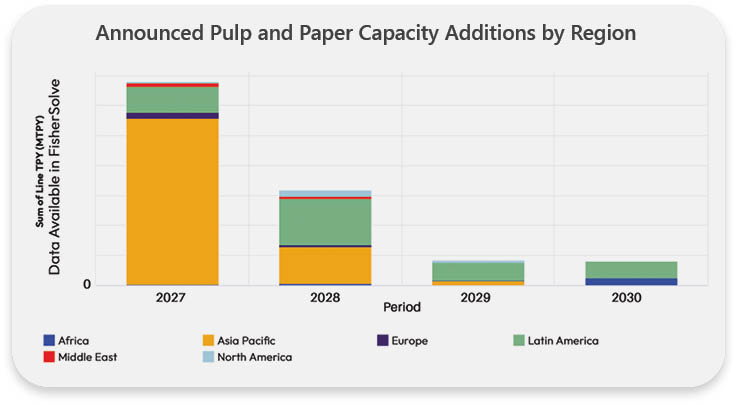
Announced Pulp and Paper Capacity Additions by Region
The regional investment pipeline shows a pronounced concentration of new capacity in Asia-Pacific, particularly in projects scheduled to come online over the next several years. While North America, Latin America, Europe, Middle East continue to see investment activity, their pipelines are considerably smaller by comparison.
This isn’t simply a reflection of population growth. Producers are making deliberate decisions about where they can manufacture most competitively in the long term.
Several factors continue to influence these decisions:
- Access to cost-competitive fiber
- Availability and cost of energy
- Modern infrastructure
- Export potential
- Long-term regional demand
- Regulatory certainty
The implication is clear: competitive advantage is becoming increasingly regional. Companies operating in lower-cost regions with access to expanding demand are likely to strengthen their position, while producers in higher-cost markets will face pressure to differentiate through efficiency, specialization, or modernization.
For suppliers, these regional investment trends provide an early indicator of where future demand for equipment, chemicals, automation systems, and engineering services is likely to emerge.
Where Producers Are Placing Their Long-Term Bets
Investment by product grade offers another important signal.
Rather than spreading capital evenly across all product categories, producers continue to focus on grades supported by long-term demand fundamentals.
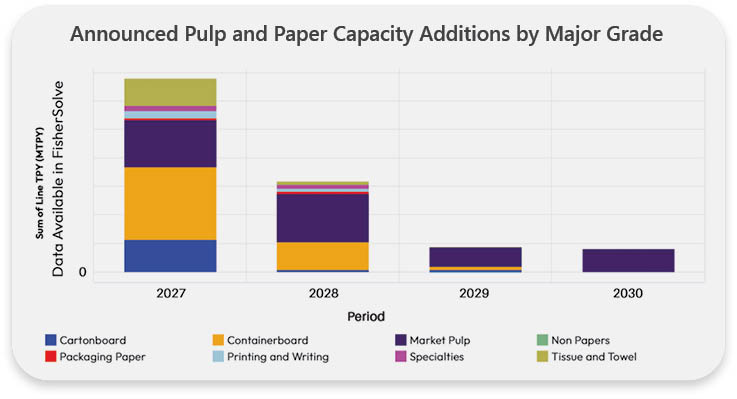
Announced Pulp and Paper Capacity Additions by Major Grade
Packaging grades account for a significant share of announced investments, reflecting continued confidence in global corrugated and consumer packaging demand. Market pulp also remains an area of sustained investment as producers position themselves to serve growing global fiber requirements. Meanwhile, printing and writing grades continue to represent a much smaller portion of announced projects, reinforcing the structural transition that has been underway for years.
More important than the absolute volume of new capacity is what these investments communicate about executive confidence.
Capital projects typically require years of planning and significant financial commitment. They represent long-term expectations—not short-term reactions.
Where companies choose to invest today provides one of the clearest signals of where they expect demand to exist tomorrow.
Industry Transformation Is Happening Through Both Expansion and Rationalization
Focusing exclusively on announced capacity additions tells only part of the story.
Every new machine startup exists alongside facility closures, machine conversions, and permanent shutdowns that continue reshaping the industry’s production footprint.
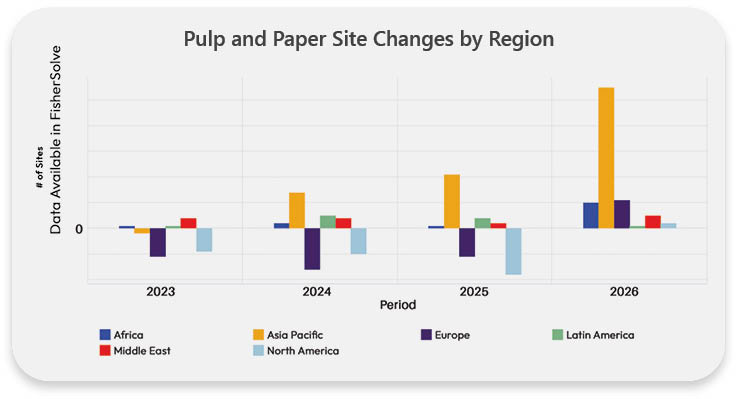
Pulp and Paper Site Changes by Region
FisherSolve data shows this dynamic playing out across multiple regions. While Asia-Pacific continues adding sites, Europe experiences continued rationalization, with additional closures reflecting efforts to reduce excess capacity and improve overall competitiveness. North America presents a more balanced picture, where investment increasingly focuses on optimizing existing assets rather than broad expansion.
Across much of the industry, producers are replacing smaller, older, higher-cost assets with larger, more efficient operations capable of delivering stronger long-term returns.
For investors, these closures often reveal where assets have become structurally uncompetitive.
Producers highlight how competitors are reshaping their manufacturing footprint to remain cost-competitive.
Suppliers identify where maintenance spending may decline—and where modernization activity is likely to increase.
Modernization Is Becoming a Preferred Investment Strategy
Perhaps the clearest signal of today’s investment environment is how companies are choosing to deploy capital.
Rather than pursuing large-scale greenfield developments, many producers are extending the life of existing assets through machine conversions and modernization projects.
Conversions offer several advantages, including lower capital requirements, faster implementation timelines, reduced project risk, and greater flexibility to respond to changing market conditions. This approach reflects a more disciplined investment strategy compared with previous expansion cycles.
Instead of adding capacity simply because demand exists, producers are increasingly asking whether existing assets can be upgraded to meet future market needs more efficiently.
That shift is likely to continue as companies balance growth opportunities with higher capital costs, sustainability objectives, and shareholder expectations.
Three Strategic Takeaways
Looking across the global investment pipeline, three themes stand out.
- Investment Is Becoming More Selective
Capital is increasingly flowing toward regions that combine favorable economics with long-term demand potential. Future competitiveness will depend as much on location as production capability. - The Industry Is Prioritizing Efficiency Over Expansion
Growth is no longer measured solely by new mills. Modernization, conversion, and asset optimization are becoming equally important strategies for maintaining competitiveness. - Investment Decisions Offer a Window into Future Markets
Capacity projects are among the strongest leading indicators of where producers expect future demand, margin opportunities, and competitive advantage to exist. Monitoring these investments helps companies anticipate market shifts well before they appear in production or trade data.
Also Read: Paper Mart Emagazine Aug-Sep, 2026
Looking Ahead
The next five years are unlikely to resemble previous investment cycles.
Rather than widespread expansion, the industry is entering a period of targeted capital deployment focused on efficiency, resilience, and long-term competitiveness. Companies are investing where they believe they can secure lasting advantages, not simply where demand is strongest today.
For producers, suppliers, and investors, understanding these trends before new capacity comes online creates a meaningful strategic advantage. Knowing where capital is flowing, which grades are attracting investment, and how competitors are reshaping their asset base can inform everything from commercial strategy to procurement planning and investment decisions.
FisherSolve’s global mill intelligence enables you to move beyond individual announcements and see the larger story: one in which capital allocation, regional competitiveness, and operational efficiency are redefining the future of the pulp and paper industry.